AQA · GCSE · Chemistry
Course version: 8462 · Version from Sept 2018
Elements in the same group in the periodic table have the same number of…
Full specification wording
The periodic table: Elements in the same group in the periodic table have the same number of electrons in their outer shell (outer electrons) and this gives them similar chemical properties.
Chemical behaviour is controlled mainly by the outer-shell electrons, because these are the electrons involved in bonding and reactions.
Checked against the AQA 8462 specification (opens in a new tab) on .
- Point 3 of 4
- 4 key terms
Study notes
From the checked teaching notes for this specification point.
The idea
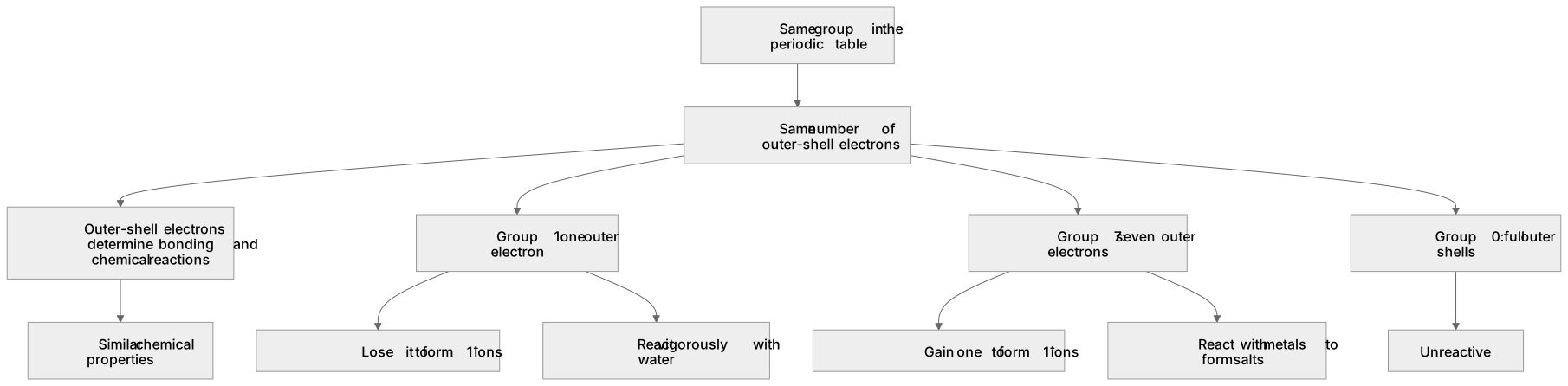
Chemical behaviour is controlled mainly by the outer-shell electrons, because these are the electrons involved in bonding and reactions. Elements in the same group have equal numbers of outer electrons, so they form similar ions and show similar reactivity trends. Group 1 elements each have one outer electron, lose it to form 1⁺ ions and react vigorously with water. Group 7 elements each have seven outer electrons, gain one to form 1⁻ ions and react with metals to form salts. Group 0 elements have full outer shells, so they are unreactive. The total number of electrons differs within a group, but the outer count stays the same.
What earns the marks
- State that elements in the same group have the same number of outer-shell electrons.
- Explain that outer-shell electrons determine bonding and chemical reactions.
- Link a group's outer-electron count to the charge on the ion it forms, such as one outer electron giving a 1⁺ ion.
- Use a named group to show similar properties, for example Group 1 metals reacting with water.
- Recognise that total electron number changes down a group while outer-electron number does not.
Common mistakes and how to put them right
Saying group members have the same total number of electrons.
Put it right by specifying the same number of outer-shell electrons only.
Believing reactivity is identical within a group.
Put it right by noting similar properties but trends in reactivity, such as Group 1 becoming more reactive down the group.
Ignoring the full outer shell of Group 0.
Put it right by explaining that a full outer shell makes noble gases unreactive.
Exam tips
- Always write outer-shell electrons, not just electrons, when explaining group similarity.
- Name the group and its outer-electron count before describing the shared reaction.
- Use ion charges with correct superscript signs, for example Na⁺ and Cl⁻, to show the link between outer electrons and bonding.
Try the lesson
The start of the The periodic table: Elements in the same group in the periodic table have the same number of electrons in their outer shell (outer electrons) and this gives them similar chemical properties. lesson, made from checked teaching notes for this specification point.
Have a go first
What do elements in the same group of the periodic table have in common?
Listen
Chemical behaviour is controlled mainly by the outer-shell electrons, because these are the electrons involved in bonding and reactions. Elements in the same group have equal numbers of outer electrons, so they form similar ions and show similar reactivity trends. Group 1 elements each have one outer electron, lose it to form 1⁺ ions and react vigorously with water. Group 7 elements each have seven outer electrons, gain one to form 1⁻ ions and react with metals to form salts. Group 0 elements have full outer shells, so they are unreactive. The total number of electrons differs within a group, but the outer count stays the same. A strong answer earns marks for these points. State that elements in the same group have the same number of outer-shell electrons. Explain that outer-shell electrons determine bonding and chemical reactions. Link a group's outer-electron count to the charge on the ion it forms, such as one outer electron giving a 1⁺ ion. Use a named group to show similar properties, for example Group 1 metals reacting with water. A common slip: Saying group members have the same total number of electrons. Instead, specifying the same number of outer-shell electrons only. Exam tip: Always write outer-shell electrons, not just electrons, when explaining group similarity.
See it
Key words
Say what each word means before you turn the card.
Outer electrons
Try answering aloud or in your head before turning the card.
Group properties
Try answering aloud or in your head before turning the card.
Ion formation
Try answering aloud or in your head before turning the card.
Reactivity trends
Try answering aloud or in your head before turning the card.
See every definition
- Outer electrons
- The electrons in the outer shell of an element, which are the electrons involved in bonding and reactions.
- Group properties
- Elements in the same group have the same number of outer electrons, which gives them similar chemical properties.
- Ion formation
- Outer electrons are lost or gained to form ions, such as one outer electron giving a 1⁺ ion.
- Reactivity trends
- Elements in a group show similar properties but trends in reactivity, such as Group 1 becoming more reactive down the group.
Label the diagram
Some boxes have lost their names. Pick the right name for each number.
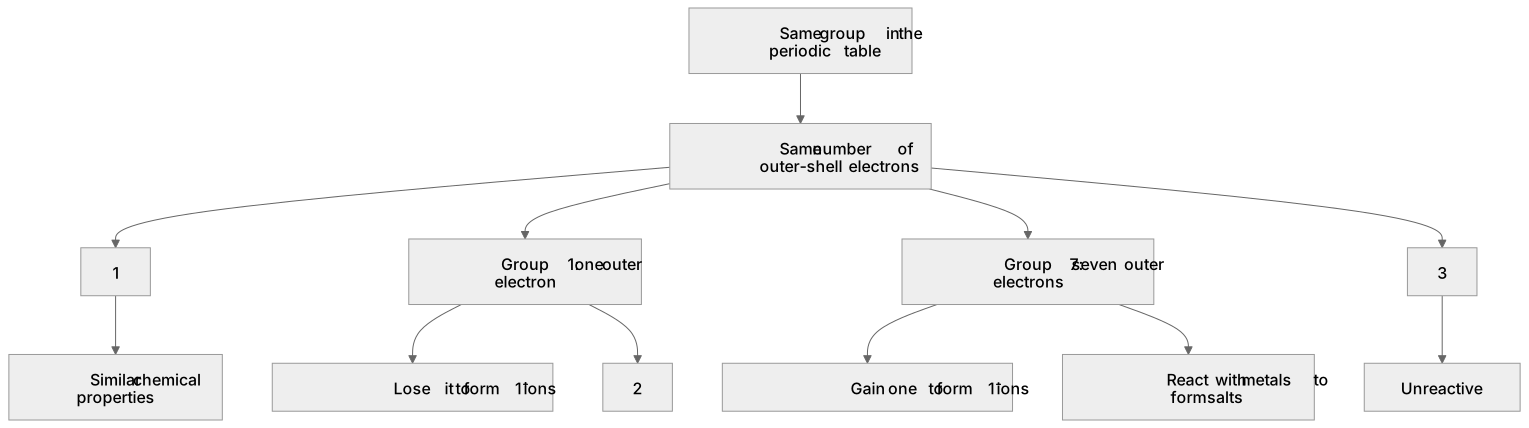
1Box 1
2Box 2
3Box 3
There is more to this lesson
The full lesson goes on to check your understanding and help you earn the marks. Create a free account to carry on, with your progress saved.
A week of Premium from your first lesson · Then the free plan continues · No card, no charge
Test your understanding of The periodic table: Elements in the same group in the periodic table have the same number of electrons in their outer shell (outer electrons) and this gives them similar chemical properties.
Active recall beats re-reading. Take an instant quiz now to test what you’ve learned and lock it into long-term memory.
A week of Premium from your first lesson · Then the free plan continues · No card, no charge