AQA · GCSE · Chemistry
Course version: 8462 · Version from Sept 2018
The table is called a periodic table because similar properties occur at…
Full specification wording
The periodic table: The table is called a periodic table because similar properties occur at regular intervals.
The word periodic means happening at regular intervals.
Checked against the AQA 8462 specification (opens in a new tab) on .
- Point 2 of 4
- 4 key terms
Study notes
From the checked teaching notes for this specification point.
The idea
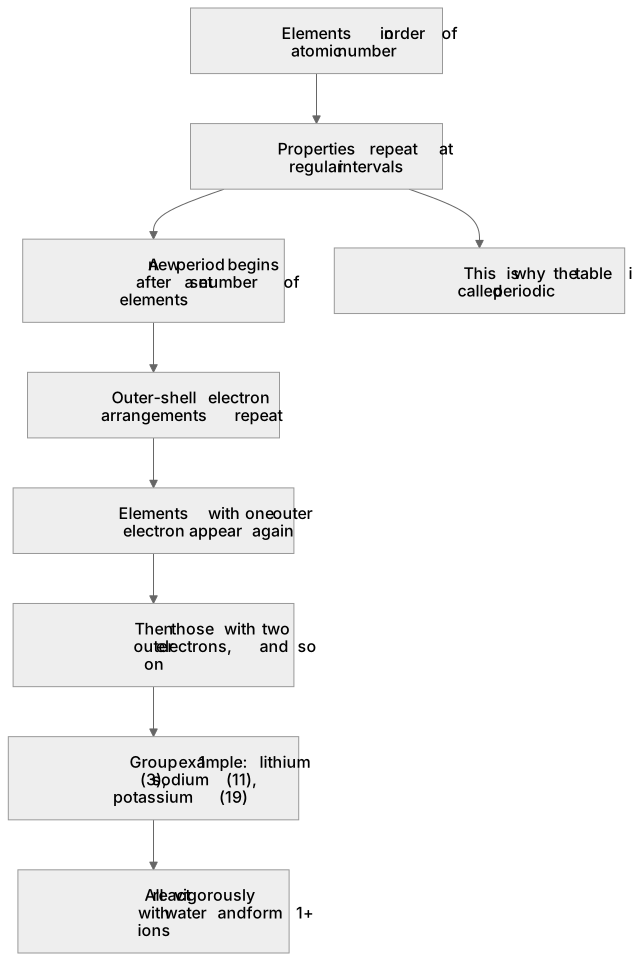
The word periodic means happening at regular intervals. In the periodic table, chemical and physical properties repeat as you move through the elements in order of atomic number. After a set number of elements, a new period begins and the pattern of outer-shell electron arrangements repeats, so elements with one outer electron appear again, then those with two, and so on. For example, lithium (3), sodium (11) and potassium (19) all react vigorously with water and form 1⁺ ions, and they are separated by eight elements in the first two cases. This repeating pattern is why Mendeleev's arrangement could predict unknown elements and why the modern table is described as periodic rather than merely sequential.
What earns the marks
- Define periodic as recurring at regular intervals.
- Explain that similar properties reappear after a fixed number of elements in atomic number order.
- Link the repetition to repeating patterns of outer-shell electron arrangement.
- Use a group example, such as Group 1 metals, to show properties recurring.
- Contrast the periodic pattern with a simple list that shows no repetition.
Common mistakes and how to put them right
Thinking periodic means the table is arranged in rows.
Put it right by explaining that periodic refers to repeating property patterns.
Assuming every element has unique properties with no repetition.
Put it right by citing a group where similar reactions recur.
Confusing the interval with a fixed mass difference.
Put it right by linking the repeat to atomic number and outer-electron patterns.
Exam tips
- Define the key term periodic in the first sentence of your answer.
- Give one concrete group example to show the repeat, naming the elements and their shared behaviour.
- If asked why the table is called periodic, mention both regular intervals and repeating properties.
Try the lesson
The start of the The periodic table: The table is called a periodic table because similar properties occur at regular intervals. lesson, made from checked teaching notes for this specification point.
Have a go first
Why is the arrangement of elements called a periodic table?
Listen
The word periodic means happening at regular intervals. In the periodic table, chemical and physical properties repeat as you move through the elements in order of atomic number. After a set number of elements, a new period begins and the pattern of outer-shell electron arrangements repeats, so elements with one outer electron appear again, then those with two, and so on. For example, lithium (3), sodium (11) and potassium (19) all react vigorously with water and form 1⁺ ions, and they are separated by eight elements in the first two cases. This repeating pattern is why Mendeleev's arrangement could predict unknown elements and why the modern table is described as periodic rather than merely sequential. A strong answer earns marks for these points. Define periodic as recurring at regular intervals. Explain that similar properties reappear after a fixed number of elements in atomic number order. Link the repetition to repeating patterns of outer-shell electron arrangement. Use a group example, such as Group 1 metals, to show properties recurring. A common slip: Thinking periodic means the table is arranged in rows. Instead, explaining that periodic refers to repeating property patterns. Exam tip: Define the key term periodic in the first sentence of your answer.
See it
Key words
Say what each word means before you turn the card.
Periodicity
Try answering aloud or in your head before turning the card.
Patterns in properties
Try answering aloud or in your head before turning the card.
Atomic number ordering
Try answering aloud or in your head before turning the card.
Prediction from patterns
Try answering aloud or in your head before turning the card.
See every definition
- Periodicity
- Similar properties occur at regular intervals, which is why the table is called a periodic table.
- Patterns in properties
- Chemical and physical properties repeat as you move through the elements in order of atomic number.
- Atomic number ordering
- Elements are arranged in order of atomic number, and after a set number of elements a new period begins.
- Prediction from patterns
- The repeating pattern is why Mendeleev's arrangement could predict unknown elements.
Label the diagram
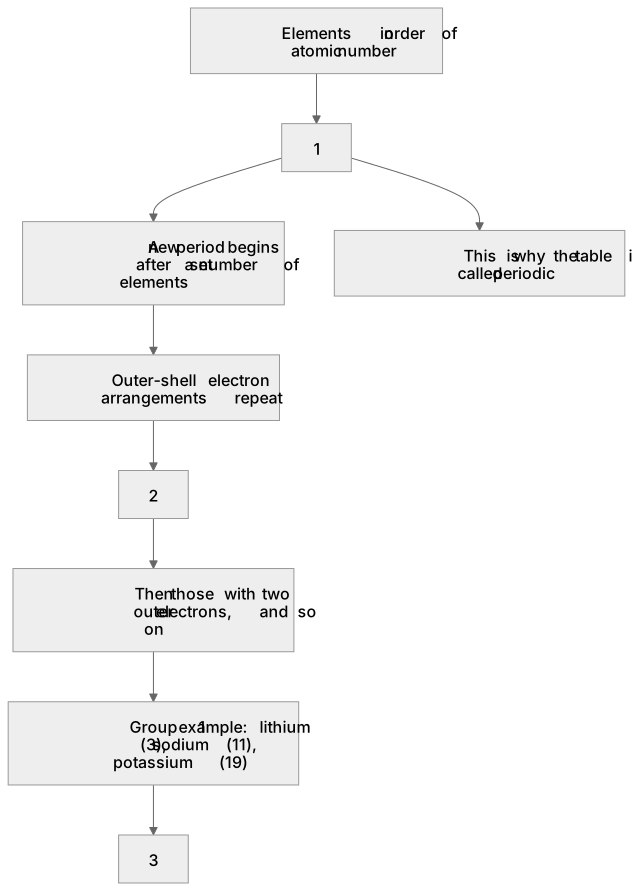
Some boxes have lost their names. Pick the right name for each number.
1Box 1
2Box 2
3Box 3
There is more to this lesson
The full lesson goes on to check your understanding and help you earn the marks. Create a free account to carry on, with your progress saved.
A week of Premium from your first lesson · Then the free plan continues · No card, no charge
Test your understanding of The periodic table: The table is called a periodic table because similar properties occur at regular intervals.
Active recall beats re-reading. Take an instant quiz now to test what you’ve learned and lock it into long-term memory.
A week of Premium from your first lesson · Then the free plan continues · No card, no charge