AQA · GCSE · Chemistry
Course version: 8462 · Version from Sept 2018
– Aqueous solutions of alkalis contain hydroxide ions (OH ).
Full specification wording
The pH scale and neutralisation: – Aqueous solutions of alkalis contain hydroxide ions (OH ).
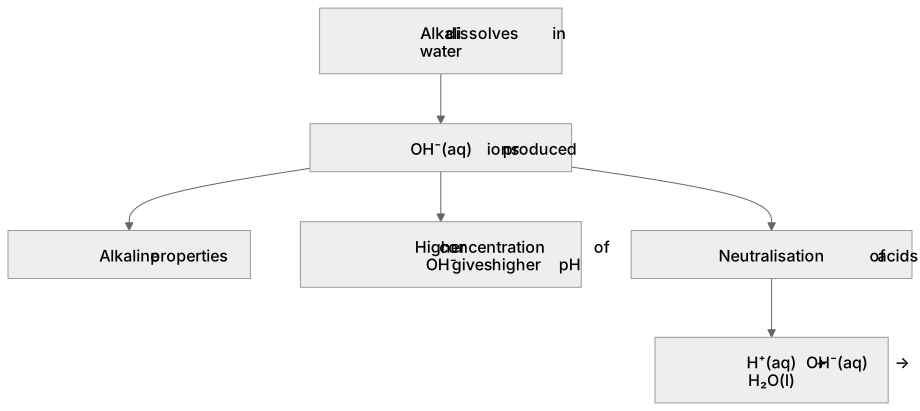
Alkalis are bases that dissolve in water to produce hydroxide ions, OH⁻(aq).
Checked against the AQA 8462 specification (opens in a new tab) on .
- Point 2 of 6
- 4 key terms
Study notes
From the checked teaching notes for this specification point.
The idea
Alkalis are bases that dissolve in water to produce hydroxide ions, OH⁻(aq). These ions are responsible for alkaline properties such as turning universal indicator blue or purple, feeling soapy, and neutralising acids to form a salt and water. For example, sodium hydroxide dissolves in water to form Na⁺(aq) and OH⁻(aq); the OH⁻ ions make the solution alkaline. The concentration of OH⁻ ions determines the pH: a higher concentration of OH⁻ gives a higher pH value. In neutralisation, H⁺(aq) from the acid reacts with OH⁻(aq) from the alkali to form water, H₂O(l). This ionic equation, H⁺(aq) + OH⁻(aq) → H₂O(l), is the essential neutralisation reaction and applies to any acid reacting with any alkali.
What earns the marks
- State that aqueous solutions of alkalis contain hydroxide ions, OH⁻.
- Use the term aqueous or the symbol (aq) to show that the ions are in solution.
- Link the presence of OH⁻ ions to alkaline properties such as high pH and neutralisation of acids.
- Explain that the concentration of OH⁻ ions determines the pH value, with more OH⁻ giving a higher pH.
- Write the ionic equation for neutralisation: H⁺(aq) + OH⁻(aq) → H₂O(l).
Common mistakes and how to put them right
Writing the hydroxide ion without a charge or with the charge in the wrong place.
Put it right: Show the negative charge as a superscript, OH⁻.
Confusing alkalis with bases.
Put it right: An alkali is a base that is soluble in water and produces OH⁻(aq); not all bases dissolve.
Forgetting that the hydroxide ions must be in aqueous solution.
Put it right: Include (aq) because the alkali must be dissolved in water to release OH⁻ ions.
Exam tips
- When describing an alkali, name the ions present and state that they are aqueous, for example OH⁻(aq).
- For neutralisation questions, use the ionic equation H⁺(aq) + OH⁻(aq) → H₂O(l) and balance charges.
- If comparing acidity and alkalinity, refer to the relative concentrations of H⁺ and OH⁻ ions rather than just colour changes.
Try the lesson
The start of the The pH scale and neutralisation: – Aqueous solutions of alkalis contain hydroxide ions (OH ). lesson, made from checked teaching notes for this specification point.
Have a go first
Which ion is present in all aqueous solutions of alkalis?
Listen
Alkalis are bases that dissolve in water to produce hydroxide ions, OH⁻(aq). These ions are responsible for alkaline properties such as turning universal indicator blue or purple, feeling soapy, and neutralising acids to form a salt and water. For example, sodium hydroxide dissolves in water to form Na⁺(aq) and OH⁻(aq); the OH⁻ ions make the solution alkaline. The concentration of OH⁻ ions determines the pH: a higher concentration of OH⁻ gives a higher pH value. In neutralisation, H⁺(aq) from the acid reacts with OH⁻(aq) from the alkali to form water, H₂O(l). This ionic equation, H⁺(aq) + OH⁻(aq) → H₂O(l), is the essential neutralisation reaction and applies to any acid reacting with any alkali. A strong answer earns marks for these points. State that aqueous solutions of alkalis contain hydroxide ions, OH⁻. Use the term aqueous or the symbol (aq) to show that the ions are in solution. Link the presence of OH⁻ ions to alkaline properties such as high pH and neutralisation of acids. Explain that the concentration of OH⁻ ions determines the pH value, with more OH⁻ giving a higher pH. A common slip: Writing the hydroxide ion without a charge or with the charge in the wrong place: students may write OH or OH- instead of OH⁻. Instead, show the negative charge as a superscript, OH⁻. Exam tip: When describing an alkali, name the ions present and state that they are aqueous, for example OH⁻(aq).
See it
Key words
Say what each word means before you turn the card.
Ions in aqueous solution
Try answering aloud or in your head before turning the card.
Alkaline properties and pH
Try answering aloud or in your head before turning the card.
Neutralisation and ionic equations
Try answering aloud or in your head before turning the card.
Solubility of bases and alkalis
Try answering aloud or in your head before turning the card.
See every definition
- Ions in aqueous solution
- Aqueous solutions of alkalis contain hydroxide ions, OH⁻, and the term aqueous or the symbol (aq) shows that the ions are in solution.
- Alkaline properties and pH
- The presence of OH⁻ ions is linked to alkaline properties such as high pH, and the concentration of OH⁻ ions determines the pH value, with more OH⁻ giving a higher pH.
- Neutralisation and ionic equations
- In neutralisation, H⁺(aq) from the acid reacts with OH⁻(aq) from the alkali to form water, H₂O(l), and this ionic equation applies to any acid reacting with any alkali.
- Solubility of bases and alkalis
- An alkali is a base that is soluble in water and produces OH⁻(aq), and not all bases dissolve.
Label the diagram
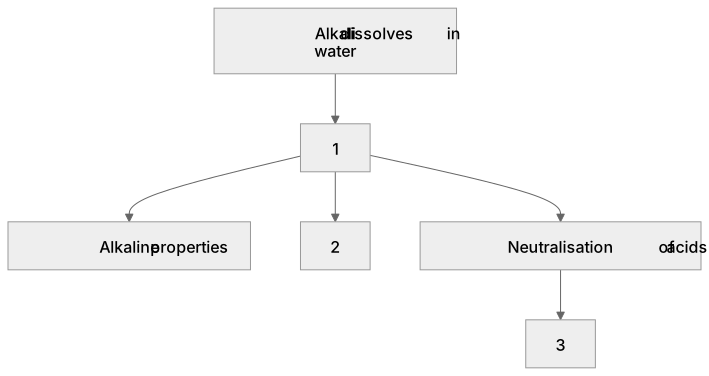
Some boxes have lost their names. Pick the right name for each number.
1Box 1
2Box 2
3Box 3
There is more to this lesson
The full lesson goes on to check your understanding and help you earn the marks. Create a free account to carry on, with your progress saved.
A week of Premium from your first lesson · Then the free plan continues · No card, no charge
Test your understanding of The pH scale and neutralisation: – Aqueous solutions of alkalis contain hydroxide ions (OH ).
Active recall beats re-reading. Take an instant quiz now to test what you’ve learned and lock it into long-term memory.
A week of Premium from your first lesson · Then the free plan continues · No card, no charge