AQA · GCSE · Chemistry
Course version: 8462 · Version from Sept 2018
In neutralisation reactions between an acid and an alkali, hydrogen ions…
Full specification wording
The pH scale and neutralisation: In neutralisation reactions between an acid and an alkali, hydrogen ions react with hydroxide ions to produce water.
When an acid reacts with an alkali, the reaction is called neutralisation.
Checked against the AQA 8462 specification (opens in a new tab) on .
- Point 5 of 6
- 4 key terms
Study notes
From the checked teaching notes for this specification point.
The idea
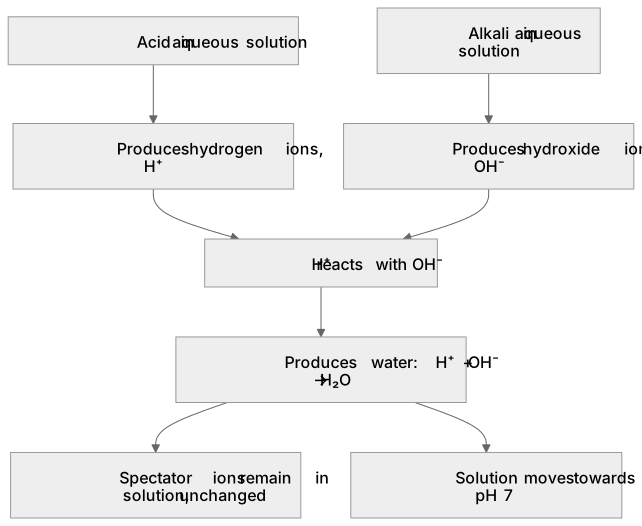
When an acid reacts with an alkali, the reaction is called neutralisation. In aqueous solution, acids produce hydrogen ions, H⁺, and alkalis produce hydroxide ions, OH⁻. The essential change is that a hydrogen ion reacts with a hydroxide ion to form water: H⁺ + OH⁻ → H₂O. This ionic equation shows the reacting particles rather than the whole compounds. For example, when hydrochloric acid reacts with sodium hydroxide solution, the sodium ions and chloride ions remain in solution as spectator ions, while H⁺ and OH⁻ combine to make water. The resulting solution is closer to neutral because the hydrogen and hydroxide ions have been removed. The same ionic change happens whenever any acid neutralises any alkali, which is why it is called the ionic equation for neutralisation.
What earns the marks
- Identifies that acids in aqueous solution provide hydrogen ions, H⁺.
- Identifies that alkalis in aqueous solution provide hydroxide ions, OH⁻.
- States that hydrogen ions react with hydroxide ions to produce water.
- Writes or recognises the ionic equation H⁺ + OH⁻ → H₂O.
- Explains that spectator ions do not change during the reaction and remain in solution.
- Links the removal of H⁺ and OH⁻ to the solution becoming less acidic and less alkaline, moving towards pH 7.
Common mistakes and how to put them right
Writing the ionic equation with incorrect charges or missing charges.
Put it right by showing H⁺ and OH⁻ with their charges and the product as H₂O.
Including spectator ions in the ionic equation.
Put it right by removing ions that are unchanged on both sides, such as Na⁺ and Cl⁻ in hydrochloric acid reacting with sodium hydroxide.
Confusing neutralisation with dilution.
Put it right by explaining that neutralisation is a chemical reaction between H⁺ and OH⁻, not simply adding water.
Exam tips
- When asked for the ionic equation for neutralisation, write H⁺ + OH⁻ → H₂O and check that both sides are balanced for atoms and charge.
- If a question gives a word equation, identify the acid and alkali first, then focus on the H⁺ and OH⁻ ions they produce in aqueous solution.
- Use the term spectator ions only when you can name the ions that remain unchanged in the reaction.
Try the lesson
The start of the The pH scale and neutralisation: In neutralisation reactions between an acid and an alkali, hydrogen ions react with hydroxide ions to produce water. lesson, made from checked teaching notes for this specification point.
Have a go first
In a neutralisation reaction between hydrochloric acid and sodium hydroxide, which two ions react together to produce water?
Listen
When an acid reacts with an alkali, the reaction is called neutralisation. In aqueous solution, acids produce hydrogen ions, H⁺, and alkalis produce hydroxide ions, OH⁻. The essential change is that a hydrogen ion reacts with a hydroxide ion to form water: H⁺ + OH⁻ → H₂O. This ionic equation shows the reacting particles rather than the whole compounds. For example, when hydrochloric acid reacts with sodium hydroxide solution, the sodium ions and chloride ions remain in solution as spectator ions, while H⁺ and OH⁻ combine to make water. The resulting solution is closer to neutral because the hydrogen and hydroxide ions have been removed. The same ionic change happens whenever any acid neutralises any alkali, which is why it is called the ionic equation for neutralisation. A strong answer earns marks for these points. Identifies that acids in aqueous solution provide hydrogen ions, H⁺. Identifies that alkalis in aqueous solution provide hydroxide ions, OH⁻. States that hydrogen ions react with hydroxide ions to produce water. Writes or recognises the ionic equation H⁺ + OH⁻ → H₂O. A common slip: Writing the ionic equation with incorrect charges or missing charges. Instead, showing H⁺ and OH⁻ with their charges and the product as H₂O. Exam tip: When asked for the ionic equation for neutralisation, write H⁺ + OH⁻ → H₂O and check that both sides are balanced for atoms and charge.
See it
Key words
Say what each word means before you turn the card.
Neutralisation
Try answering aloud or in your head before turning the card.
Acids
Try answering aloud or in your head before turning the card.
Alkalis
Try answering aloud or in your head before turning the card.
Spectator ions
Try answering aloud or in your head before turning the card.
See every definition
- Neutralisation
- The reaction between an acid and an alkali in which hydrogen ions react with hydroxide ions to produce water.
- Acids
- In aqueous solution, these produce hydrogen ions, H⁺.
- Alkalis
- In aqueous solution, these produce hydroxide ions, OH⁻.
- Spectator ions
- Ions that remain in solution and do not change during the reaction, while H⁺ and OH⁻ combine to make water.
Label the diagram
Some boxes have lost their names. Pick the right name for each number.
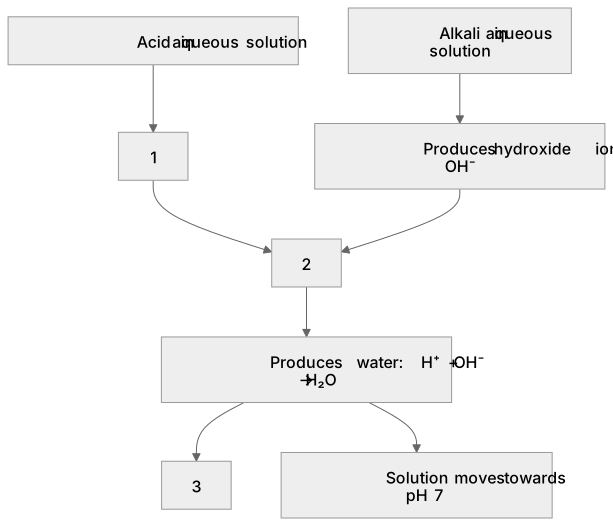
1Box 1
2Box 2
3Box 3
There is more to this lesson
The full lesson goes on to check your understanding and help you earn the marks. Create a free account to carry on, with your progress saved.
A week of Premium from your first lesson · Then the free plan continues · No card, no charge
Test your understanding of The pH scale and neutralisation: In neutralisation reactions between an acid and an alkali, hydrogen ions react with hydroxide ions to produce water.
Active recall beats re-reading. Take an instant quiz now to test what you’ve learned and lock it into long-term memory.
A week of Premium from your first lesson · Then the free plan continues · No card, no charge