AQA · GCSE · Chemistry
Course version: 8462 · Version from Sept 2018
Students should be able to: predict the states of substances at different…
Full specification wording
The three states of matter: Students should be able to: predict the states of substances at different temperatures given appropriate data explain the different temperatures at which changes of state occur in terms of energy transfers and types of bonding recognise that atoms themselves do not have the bulk properties of materials (HT only) explain the limitations of the particle theory in relation to changes of state when particles are represented by solid inelastic spheres which have no forces between them.
This outcome combines four skills.
Checked against the AQA 8462 specification (opens in a new tab) on .
- Point 9 of 9
- 4 key terms
Study notes
From the checked teaching notes for this specification point.
The idea
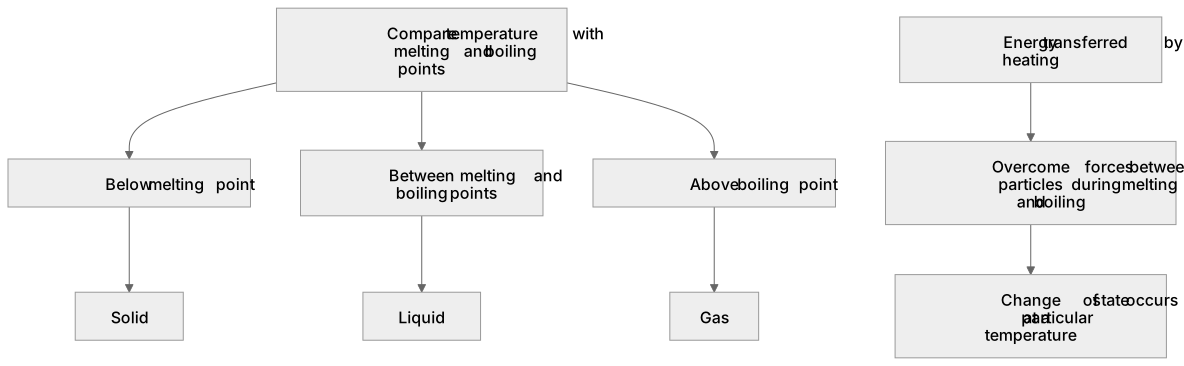
This outcome combines four skills. First, use melting and boiling point data to predict whether a substance is solid, liquid or gas at a stated temperature: below the melting point it is solid, between melting and boiling points it is liquid, and above the boiling point it is gas. Second, explain why changes of state occur at particular temperatures by linking energy transferred by heating to the strength and type of bonding or forces between particles. Third, recognise that a single atom does not have the bulk properties of the material it makes up, such as melting point or electrical conductivity. Fourth, at Higher tier, explain that a model of solid inelastic spheres with no forces between them cannot account for energy transfers during melting and boiling.
What earns the marks
- Use melting and boiling point data to classify a substance as solid, liquid or gas at a given temperature.
- Explain that energy transferred by heating is used to overcome forces between particles during melting and boiling.
- Link the temperature of a change of state to the type and strength of bonding or forces between particles.
- State that individual atoms do not show bulk properties such as melting point, boiling point or conductivity.
- Explain that solid inelastic spheres with no forces between them cannot explain energy changes during melting and boiling.
Common mistakes and how to put them right
Reading a temperature between the melting and boiling points as a gas.
Put it right by identifying it as a liquid.
Saying energy is destroyed or lost during a change of state.
Put it right by stating that energy is transferred to overcome forces between particles.
Attributing bulk properties such as melting point to a single atom.
Put it right by stating that bulk properties arise from the collection of particles and their interactions.
Exam tips
- Compare the given temperature with the melting and boiling points before naming the state.
- Use the phrase forces between particles and link the energy transferred to overcoming those forces.
- For the Higher tier limitation, name the feature of the model and explain what it cannot account for.
Try the lesson
The start of the The three states of matter: Students should be able to: predict the states of substances at different temperatures given appropriate data explain the different temperatures at which changes of state occur in terms of energy transfers and types of bonding recognise that atoms themselves do not have the bulk properties of materials (HT only) explain the limitations of the particle theory in relation to changes of state when particles are represented by solid inelastic spheres which have no forces between them. lesson, made from checked teaching notes for this specification point.
Have a go first
Substance W melts at 10 °C and boils at 90 °C. What state is W at 50 °C?
Listen
This outcome combines four skills. First, use melting and boiling point data to predict whether a substance is solid, liquid or gas at a stated temperature: below the melting point it is solid, between melting and boiling points it is liquid, and above the boiling point it is gas. Second, explain why changes of state occur at particular temperatures by linking energy transferred by heating to the strength and type of bonding or forces between particles. Third, recognise that a single atom does not have the bulk properties of the material it makes up, such as melting point or electrical conductivity. Fourth, at Higher tier, explain that a model of solid inelastic spheres with no forces between them cannot account for energy transfers during melting and boiling. A strong answer earns marks for these points. Use melting and boiling point data to classify a substance as solid, liquid or gas at a given temperature. Explain that energy transferred by heating is used to overcome forces between particles during melting and boiling. Link the temperature of a change of state to the type and strength of bonding or forces between particles. State that individual atoms do not show bulk properties such as melting point, boiling point or conductivity. A common slip: Reading a temperature between the melting and boiling points as a gas. Instead, identifying it as a liquid. Exam tip: Compare the given temperature with the melting and boiling points before naming the state.
See it
Key words
Say what each word means before you turn the card.
States of matter and changes of state
Try answering aloud or in your head before turning the card.
Energy transfers
Try answering aloud or in your head before turning the card.
Bonding and forces between particles
Try answering aloud or in your head before turning the card.
Limitations of models
Try answering aloud or in your head before turning the card.
See every definition
- States of matter and changes of state
- A substance is solid below its melting point, liquid between its melting and boiling points, and gas above its boiling point.
- Energy transfers
- Energy transferred by heating is used to overcome forces between particles during melting and boiling.
- Bonding and forces between particles
- The temperature of a change of state is linked to the type and strength of bonding or forces between particles.
- Limitations of models
- Solid inelastic spheres with no forces between them cannot explain energy changes during melting and boiling.
Label the diagram
Some boxes have lost their names. Pick the right name for each number.
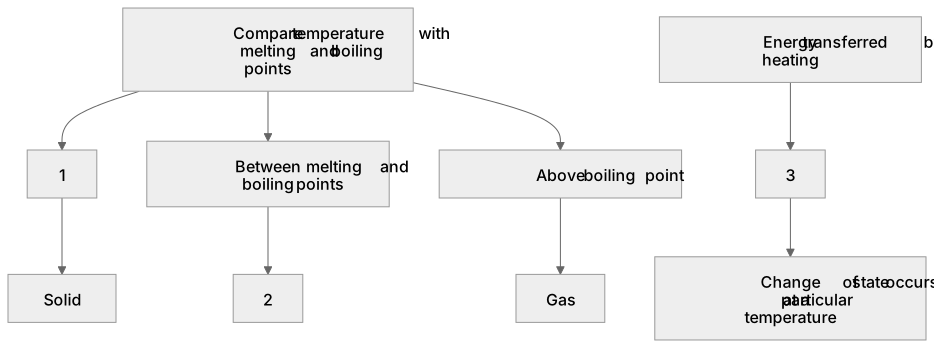
1Box 1
2Box 2
3Box 3
There is more to this lesson
The full lesson goes on to check your understanding and help you earn the marks. Create a free account to carry on, with your progress saved.
A week of Premium from your first lesson · Then the free plan continues · No card, no charge
Test your understanding of The three states of matter: Students should be able to: predict the states of substances at different temperatures given appropriate data explain the different temperatures at which changes of state occur in terms of energy transfers and types of bonding recognise that atoms themselves do not have the bulk properties of materials (HT only) explain the limitations of the particle theory in relation to changes of state when particles are represented by solid inelastic spheres which have no forces between them.
Active recall beats re-reading. Take an instant quiz now to test what you’ve learned and lock it into long-term memory.
A week of Premium from your first lesson · Then the free plan continues · No card, no charge