AQA · GCSE · Chemistry
Course version: 8462 · Version from Sept 2018
(HT only) Limitations of the simple model above include that in the model…
Full specification wording
The three states of matter: (HT only) Limitations of the simple model above include that in the model there are no forces, that all particles are represented as spheres and that the spheres are solid.
The simple particle model draws particles as small solid spheres with empty space between them.
Checked against the AQA 8462 specification (opens in a new tab) on .
- Point 8 of 9
Study notes
From the checked teaching notes for this specification point.
The idea
The simple particle model draws particles as small solid spheres with empty space between them. This is useful for explaining diffusion, gas pressure and changes of state, but it is a simplification. Real particles exert forces on one another, and those forces explain why substances melt and boil at particular temperatures. Real particles are not solid spheres: atoms and molecules have internal structure, and their shapes affect how they pack and how they interact. The model also omits the range and direction of forces and any vibration or movement within particles. A strong answer identifies a specific limitation and explains how it affects a prediction, for example that a model with no forces cannot explain why energy is needed to melt a solid.
What earns the marks
- The simple model shows no forces between particles, so it cannot by itself explain melting and boiling points.
- Particles are represented as spheres, but real particles have shapes and internal structures that affect behaviour.
- The spheres are shown as solid, whereas real particles are not solid inelastic objects and can have internal motion.
- A limitation should be linked to a feature the model cannot explain, such as energy transfers during changes of state.
- A valid improvement is to include forces between particles or to represent particles with more realistic shapes.
Common mistakes and how to put them right
Stating that the model is wrong rather than limited.
Put it right by saying the model is a simplification that explains some observations but not others.
Claiming the model shows particles as solid spheres with no internal structure and leaving it there.
Put it right by explaining what this prevents the model from explaining.
Confusing limitations of the particle model with limitations of the kinetic theory of gases.
Put it right by keeping the discussion focused on the simple particle model described.
Exam tips
- State one limitation, then explain the consequence for what the model can explain.
- Use the wording of the model, such as no forces or solid spheres, and contrast it with real behaviour.
- If asked to improve the model, suggest adding forces between particles or using non-spherical particles.
Try the lesson
The start of the The three states of matter: (HT only) Limitations of the simple model above include that in the model there are no forces, that all particles are represented as spheres and that the spheres are solid. lesson, made from checked teaching notes for this specification point.
Have a go first
Which statement describes a limitation of the simple particle model for the states of matter?
Listen
The simple particle model draws particles as small solid spheres with empty space between them. This is useful for explaining diffusion, gas pressure and changes of state, but it is a simplification. Real particles exert forces on one another, and those forces explain why substances melt and boil at particular temperatures. Real particles are not solid spheres: atoms and molecules have internal structure, and their shapes affect how they pack and how they interact. The model also omits the range and direction of forces and any vibration or movement within particles. A strong answer identifies a specific limitation and explains how it affects a prediction, for example that a model with no forces cannot explain why energy is needed to melt a solid. A strong answer earns marks for these points. The simple model shows no forces between particles, so it cannot by itself explain melting and boiling points. Particles are represented as spheres, but real particles have shapes and internal structures that affect behaviour. The spheres are shown as solid, whereas real particles are not solid inelastic objects and can have internal motion. A limitation should be linked to a feature the model cannot explain, such as energy transfers during changes of state. A common slip: Stating that the model is wrong rather than limited. Instead, saying the model is a simplification that explains some observations but not others. Exam tip: State one limitation, then explain the consequence for what the model can explain.
See it
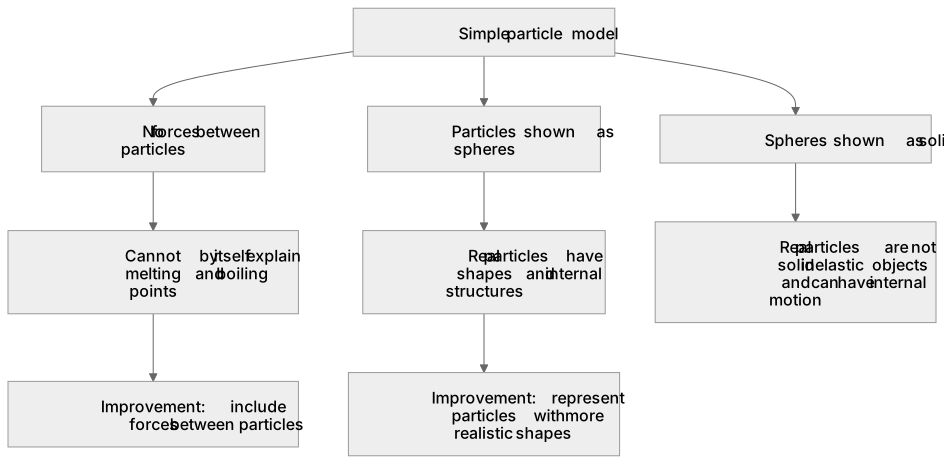
Label the diagram
Some boxes have lost their names. Pick the right name for each number.
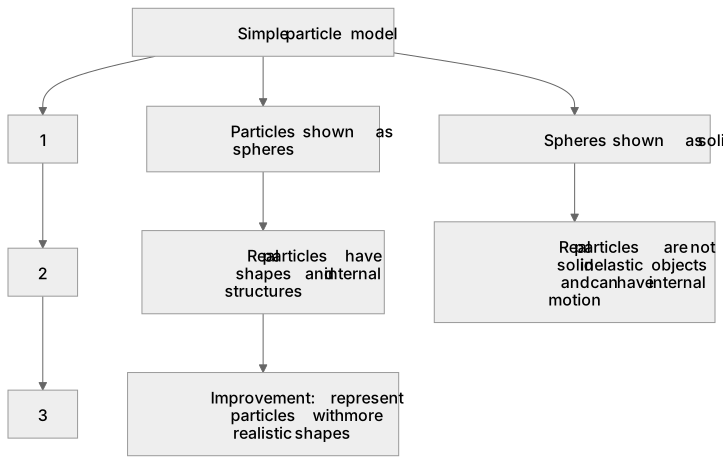
1Box 1
2Box 2
3Box 3
There is more to this lesson
The full lesson goes on to check your understanding and help you earn the marks. Create a free account to carry on, with your progress saved.
A week of Premium from your first lesson · Then the free plan continues · No card, no charge
Test your understanding of The three states of matter: (HT only) Limitations of the simple model above include that in the model there are no forces, that all particles are represented as spheres and that the spheres are solid.
Active recall beats re-reading. Take an instant quiz now to test what you’ve learned and lock it into long-term memory.
A week of Premium from your first lesson · Then the free plan continues · No card, no charge