AQA · GCSE · Chemistry
Course version: 8462 · Version from Sept 2018
The stronger the forces between the particles the higher the melting point…
Full specification wording
The three states of matter: The stronger the forces between the particles the higher the melting point and boiling point of the substance.
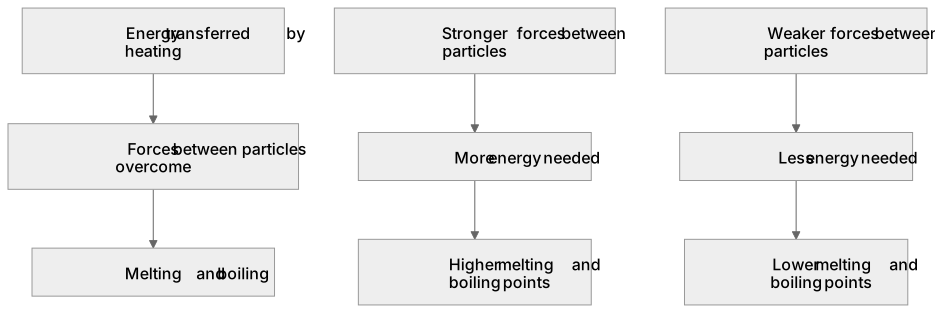
Melting and boiling happen when energy transferred by heating overcomes the forces holding particles together.
Checked against the AQA 8462 specification (opens in a new tab) on .
- Point 7 of 9
- 4 key terms
Study notes
From the checked teaching notes for this specification point.
The idea
Melting and boiling happen when energy transferred by heating overcomes the forces holding particles together. Stronger forces need more energy to weaken or break, so the substance melts and boils at higher temperatures. For example, magnesium oxide has strong electrostatic forces between Mg²⁺ and O²⁻ ions, giving a melting point around 2852 °C, whereas iodine has weak intermolecular forces between I₂ molecules and melts near 114 °C. The forces overcome are between particles, not inside molecules: covalent bonds within molecules stay intact during melting and boiling. Comparing substances therefore means comparing the type and strength of forces between their particles, and linking this to the energy needed for the change of state.
What earns the marks
- Melting and boiling involve overcoming forces between particles, not breaking covalent bonds within molecules.
- Stronger forces between particles require more energy to overcome, so melting and boiling points are higher.
- Weaker forces between particles require less energy, so melting and boiling points are lower.
- The type of particle and the type of force present must be identified before comparing strengths, for example ions in a giant ionic lattice or molecules with intermolecular forces.
- A correct comparison links the relative strength of forces to the relative melting or boiling point, using data if provided.
Common mistakes and how to put them right
Saying covalent bonds inside molecules break when a simple molecular substance boils.
Put it right by stating that intermolecular forces between molecules are overcome, while covalent bonds remain.
Treating all forces as equally strong.
Put it right by comparing the type and strength of forces between particles in each substance.
Assuming a larger molecule always has a higher boiling point without considering the forces present.
Put it right by explaining the comparison in terms of the forces between particles.
Exam tips
- Name the particles and the force between them before comparing melting or boiling points.
- Use comparative language such as stronger or weaker and link it directly to more or less energy needed.
- When data are given, quote the values and state which substance has the stronger forces between particles.
Try the lesson
The start of the The three states of matter: The stronger the forces between the particles the higher the melting point and boiling point of the substance. lesson, made from checked teaching notes for this specification point.
Have a go first
Substance P has weak forces between its particles. Substance Q has strong forces between its particles. Which statement about their melting points is correct?
Listen
Melting and boiling happen when energy transferred by heating overcomes the forces holding particles together. Stronger forces need more energy to weaken or break, so the substance melts and boils at higher temperatures. For example, magnesium oxide has strong electrostatic forces between Mg²⁺ and O²⁻ ions, giving a melting point around 2852 °C, whereas iodine has weak intermolecular forces between I₂ molecules and melts near 114 °C. The forces overcome are between particles, not inside molecules: covalent bonds within molecules stay intact during melting and boiling. Comparing substances therefore means comparing the type and strength of forces between their particles, and linking this to the energy needed for the change of state. A strong answer earns marks for these points. Melting and boiling involve overcoming forces between particles, not breaking covalent bonds within molecules. Stronger forces between particles require more energy to overcome, so melting and boiling points are higher. Weaker forces between particles require less energy, so melting and boiling points are lower. The type of particle and the type of force present must be identified before comparing strengths, for example ions in a giant ionic lattice or molecules with intermolecular forces. A common slip: Saying covalent bonds inside molecules break when a simple molecular substance boils. Instead, stating that intermolecular forces between molecules are overcome, while covalent bonds remain. Exam tip: Name the particles and the force between them before comparing melting or boiling points.
See it
Key words
Say what each word means before you turn the card.
Forces between particles
Try answering aloud or in your head before turning the card.
Melting and boiling points
Try answering aloud or in your head before turning the card.
Comparing melting and boiling points
Try answering aloud or in your head before turning the card.
Energy transfers during changes of state
Try answering aloud or in your head before turning the card.
See every definition
- Forces between particles
- The forces holding particles together, which are overcome when energy transferred by heating causes melting and boiling.
- Melting and boiling points
- The temperatures at which a substance melts and boils, which are higher when the forces between the particles are stronger.
- Comparing melting and boiling points
- Comparing the type and strength of forces between the particles of substances and linking this to the energy needed for the change of state.
- Energy transfers during changes of state
- Energy transferred by heating overcomes the forces holding particles together, and stronger forces need more energy to weaken or break.
Label the diagram
Some boxes have lost their names. Pick the right name for each number.
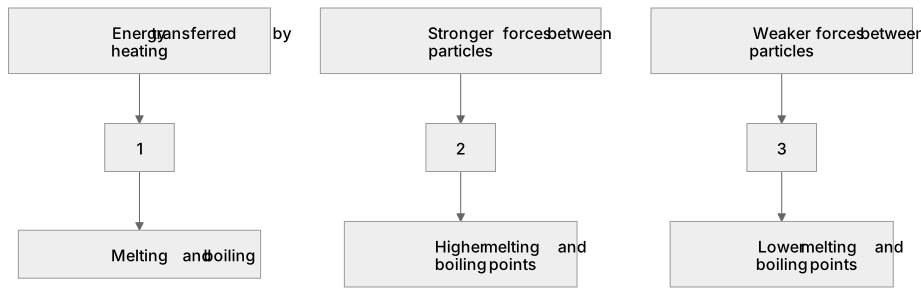
1Box 1
2Box 2
3Box 3
There is more to this lesson
The full lesson goes on to check your understanding and help you earn the marks. Create a free account to carry on, with your progress saved.
A week of Premium from your first lesson · Then the free plan continues · No card, no charge
Test your understanding of The three states of matter: The stronger the forces between the particles the higher the melting point and boiling point of the substance.
Active recall beats re-reading. Take an instant quiz now to test what you’ve learned and lock it into long-term memory.
A week of Premium from your first lesson · Then the free plan continues · No card, no charge