AQA · GCSE · Chemistry
Course version: 8462 · Version from Sept 2018
Required practical 2: (chemistry only) determination of the reacting…
Full specification wording
Titrations (chemistry only): Required practical 2: (chemistry only) determination of the reacting volumes of solutions of a strong acid and a strong alkali by titration.
In this required practical you find the volume of one solution that exactly reacts with a known volume of another.
Checked against the AQA 8462 specification (opens in a new tab) on .
- Point 2 of 2
- 3 key terms
Study notes
From the checked teaching notes for this specification point.
The idea
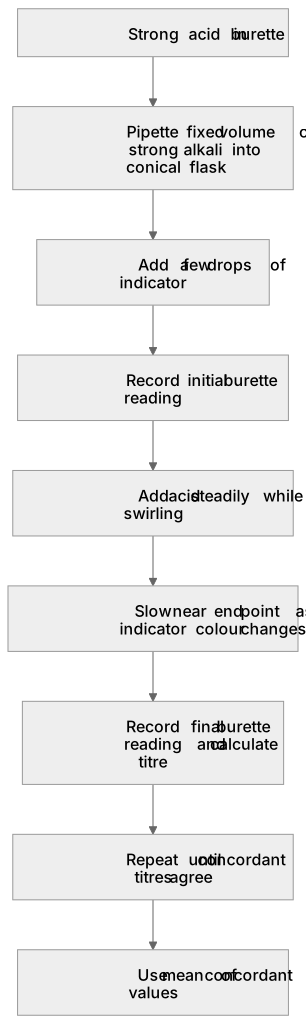
In this required practical you find the volume of one solution that exactly reacts with a known volume of another. A strong acid, such as hydrochloric acid, is placed in a burette and a measured volume of strong alkali, such as sodium hydroxide solution, is pipetted into a conical flask with a few drops of indicator. You record the initial burette reading, then add acid steadily while swirling, slowing near the end point as the indicator colour changes. Repeating until concordant titres agree improves reliability. You must use accurate procedural techniques, such as rinsing the burette with the acid and reading the bottom of the meniscus at eye level, to ensure precise volume measurements.
What earns the marks
- Records initial and final burette readings to two decimal places and calculates each titre by subtraction.
- Uses a pipette and filler to deliver an accurate fixed volume of alkali into a clean conical flask.
- Adds indicator in small amounts and swirls the flask during the titration to mix the solutions.
- Repeats the titration until concordant titres are obtained and uses a mean of concordant values.
- Applies accurate procedural techniques, such as reading the meniscus at eye level, to ensure precise measurements.
Common mistakes and how to put them right
Reading the top of the meniscus instead of the bottom.
Put it right by aligning eye level with the bottom of the curved surface.
Forgetting to record the initial burette reading.
Put it right by noting it before adding any acid.
Using the first rough titre in the mean.
Put it right by repeating and averaging only concordant accurate titres.
Exam tips
- State the colour change at the end point for the indicator used, for example phenolphthalein changing from pink to colourless when acid is added to alkali.
- Ensure you subtract the initial volume from the final volume to find the titre.
- Give burette readings to two decimal places and quote the mean titre with the same precision.
Try the lesson
The start of the Titrations (chemistry only): Required practical 2: (chemistry only) determination of the reacting volumes of solutions of a strong acid and a strong alkali by titration. lesson, made from checked teaching notes for this specification point.
Have a go first
In the titration practical, which piece of apparatus is used to add the alkali to the acid a little at a time near the end point?
Listen
In this required practical you find the volume of one solution that exactly reacts with a known volume of another. A strong acid, such as hydrochloric acid, is placed in a burette and a measured volume of strong alkali, such as sodium hydroxide solution, is pipetted into a conical flask with a few drops of indicator. You record the initial burette reading, then add acid steadily while swirling, slowing near the end point as the indicator colour changes. Repeating until concordant titres agree improves reliability. You must use accurate procedural techniques, such as rinsing the burette with the acid and reading the bottom of the meniscus at eye level, to ensure precise volume measurements. A strong answer earns marks for these points. Records initial and final burette readings to two decimal places and calculates each titre by subtraction. Uses a pipette and filler to deliver an accurate fixed volume of alkali into a clean conical flask. Adds indicator in small amounts and swirls the flask during the titration to mix the solutions. Repeats the titration until concordant titres are obtained and uses a mean of concordant values. A common slip: Reading the top of the meniscus instead of the bottom. Instead, aligning eye level with the bottom of the curved surface. Exam tip: State the colour change at the end point for the indicator used, for example phenolphthalein changing from pink to colourless when acid is added to alkali.
See it
Key words
Say what each word means before you turn the card.
Accurate measurement of volume
Try answering aloud or in your head before turning the card.
Concordant results and reliability
Try answering aloud or in your head before turning the card.
Procedural techniques for precision
Try answering aloud or in your head before turning the card.
See every definition
- Accurate measurement of volume
- Using accurate procedural techniques, such as rinsing the burette with the acid and reading the bottom of the meniscus at eye level, to ensure precise volume measurements.
- Concordant results and reliability
- Repeating the titration until concordant titres agree, which improves reliability, and using a mean of concordant values.
- Procedural techniques for precision
- Accurate procedural techniques, such as rinsing the burette with the acid and reading the bottom of the meniscus at eye level, to ensure precise measurements.
Label the diagram
Some boxes have lost their names. Pick the right name for each number.
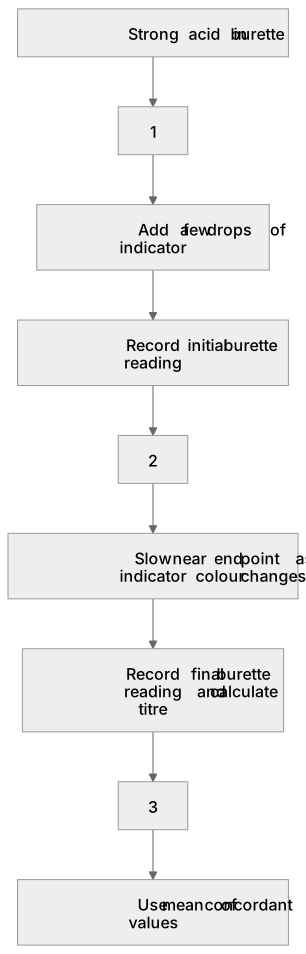
1Box 1
2Box 2
3Box 3
There is more to this lesson
The full lesson goes on to check your understanding and help you earn the marks. Create a free account to carry on, with your progress saved.
A week of Premium from your first lesson · Then the free plan continues · No card, no charge
Test your understanding of Titrations (chemistry only): Required practical 2: (chemistry only) determination of the reacting volumes of solutions of a strong acid and a strong alkali by titration.
Active recall beats re-reading. Take an instant quiz now to test what you’ve learned and lock it into long-term memory.
A week of Premium from your first lesson · Then the free plan continues · No card, no charge