AQA · GCSE · Chemistry
Course version: 8462 · Version from Sept 2018
The volumes of acid and alkali solutions that react with each other can be…
Full specification wording
Titrations (chemistry only): The volumes of acid and alkali solutions that react with each other can be measured by titration using a suitable indicator.
A titration is a practical method used to measure the volume of one solution that reacts exactly with a known volume of another solution.
Checked against the AQA 8462 specification (opens in a new tab) on .
- Point 1 of 2
- 3 key terms
Study notes
From the checked teaching notes for this specification point.
The idea
A titration is a practical method used to measure the volume of one solution that reacts exactly with a known volume of another solution. In an acid-alkali titration, a suitable indicator is added to the alkali in a conical flask. A burette is filled with the acid, and the acid is added gradually while the flask is swirled. The indicator changes colour at the end point, showing that the acid and alkali have reacted completely. The volume of acid added is read from the burette before and after the titration, and the difference gives the volume used. Repeating the titration and taking a concordant result improves reliability. A suitable indicator changes colour sharply at the end point, so the volume can be measured accurately.
What earns the marks
- States that titration measures the volume of acid that reacts exactly with a known volume of alkali, or vice versa.
- Describes using a burette to add one solution gradually to a measured volume of the other in a conical flask.
- Explains that a suitable indicator is used to show the end point by a sharp colour change.
- Records the initial and final burette readings and calculates the volume used by subtraction.
- Repeats the titration to obtain concordant results and improve reliability.
Common mistakes and how to put them right
Reading the burette scale from the bottom up instead of from the top down.
Put it right by remembering the zero mark is at the top, so you must read downwards to the bottom of the meniscus at eye level.
Forgetting to record the initial burette reading before starting.
Put it right by recording both initial and final readings so the volume used can be calculated.
Choosing an indicator that changes colour gradually over a wide pH range.
Put it right by selecting a suitable indicator that gives a sharp colour change at the end point.
Exam tips
- When describing a titration, include the key apparatus: burette, pipette, conical flask and a suitable indicator.
- Calculate the volume used by subtracting the initial burette reading from the final burette reading, and show your working clearly.
- Explain that repeating the titration and using concordant results reduces the effect of random errors.
Try the lesson
The start of the Titrations (chemistry only): The volumes of acid and alkali solutions that react with each other can be measured by titration using a suitable indicator. lesson, made from checked teaching notes for this specification point.
Have a go first
What is the name of the technique used to measure the volume of acid that reacts with a known volume of alkali?
Listen
A titration is a practical method used to measure the volume of one solution that reacts exactly with a known volume of another solution. In an acid-alkali titration, a suitable indicator is added to the alkali in a conical flask. A burette is filled with the acid, and the acid is added gradually while the flask is swirled. The indicator changes colour at the end point, showing that the acid and alkali have reacted completely. The volume of acid added is read from the burette before and after the titration, and the difference gives the volume used. Repeating the titration and taking a concordant result improves reliability. A suitable indicator changes colour sharply at the end point, so the volume can be measured accurately. A strong answer earns marks for these points. States that titration measures the volume of acid that reacts exactly with a known volume of alkali, or vice versa. Describes using a burette to add one solution gradually to a measured volume of the other in a conical flask. Explains that a suitable indicator is used to show the end point by a sharp colour change. Records the initial and final burette readings and calculates the volume used by subtraction. A common slip: Reading the burette scale from the bottom up instead of from the top down. Instead, remembering the zero mark is at the top, so you must read downwards to the bottom of the meniscus at eye level. Exam tip: When describing a titration, include the key apparatus: burette, pipette, conical flask and a suitable indicator.
See it
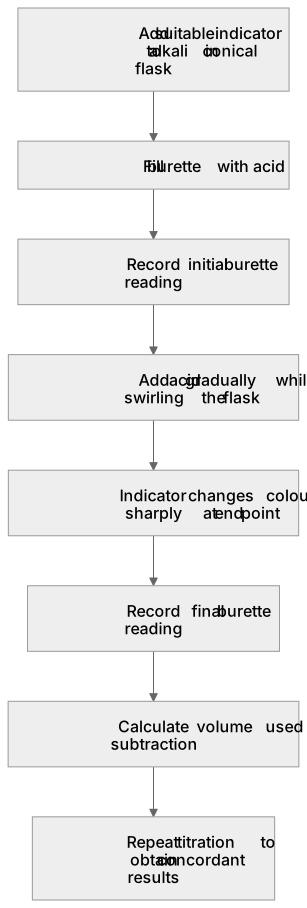
Put it in order
Put these steps in the order they happen.
- 1. Indicator changes colour sharply at end point
- 2. Repeat titration to obtain concordant results
- 3. Record final burette reading
- 4. Add suitable indicator to alkali in conical flask
- 5. Fill burette with acid
- 6. Calculate volume used by subtraction
- 7. Record initial burette reading
- 8. Add acid gradually while swirling the flask
Key words
Say what each word means before you turn the card.
Titration
Try answering aloud or in your head before turning the card.
End point
Try answering aloud or in your head before turning the card.
Burette
Try answering aloud or in your head before turning the card.
See every definition
- Titration
- A practical method used to measure the volume of one solution that reacts exactly with a known volume of another solution.
- End point
- The point at which a suitable indicator changes colour, showing that the acid and alkali have reacted completely.
- Burette
- A piece of apparatus filled with the acid, from which the acid is added gradually while the flask is swirled.
Label the diagram
Some boxes have lost their names. Pick the right name for each number.
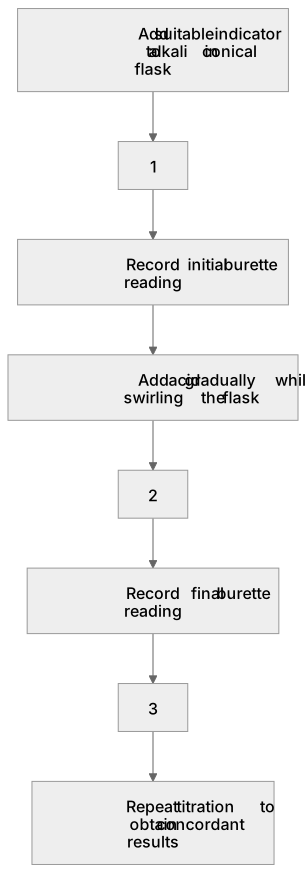
1Box 1
2Box 2
3Box 3
There is more to this lesson
The full lesson goes on to check your understanding and help you earn the marks. Create a free account to carry on, with your progress saved.
A week of Premium from your first lesson · Then the free plan continues · No card, no charge
Test your understanding of Titrations (chemistry only): The volumes of acid and alkali solutions that react with each other can be measured by titration using a suitable indicator.
Active recall beats re-reading. Take an instant quiz now to test what you’ve learned and lock it into long-term memory.
A week of Premium from your first lesson · Then the free plan continues · No card, no charge