AQA · GCSE · Chemistry
Course version: 8462 · Version from Sept 2018
Nanoparticles have many applications in medicine, in electronics, in…
Full specification wording
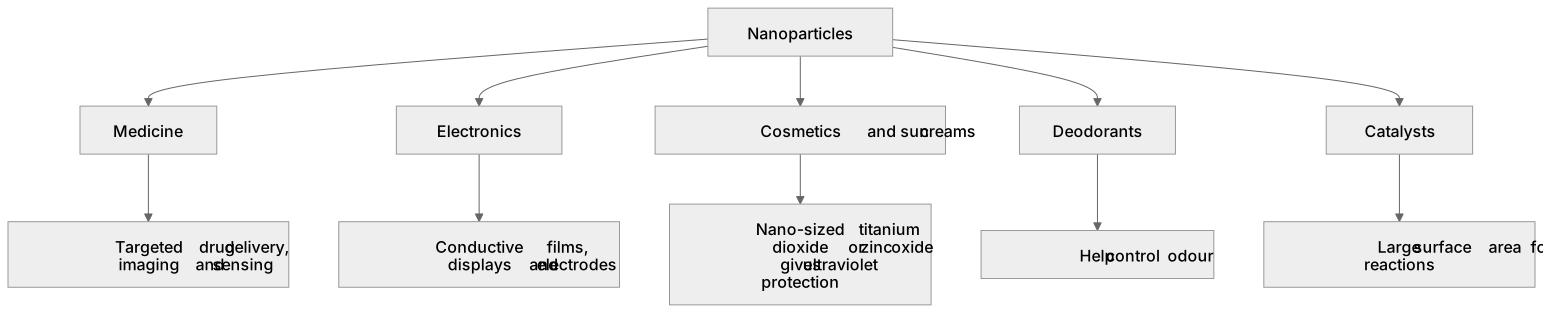
Uses of nanoparticles: Nanoparticles have many applications in medicine, in electronics, in cosmetics and sun creams, as deodorants, and as catalysts.
Nanoparticles are used in many fields because their high surface area to volume ratio and small size give useful properties.
Checked against the AQA 8462 specification (opens in a new tab) on .
- Point 1 of 4
- 4 key terms
Study notes
From the checked teaching notes for this specification point.
The idea
Nanoparticles are used in many fields because their high surface area to volume ratio and small size give useful properties. In medicine, nanoparticles can carry drugs to specific cells or be used in imaging and sensors. In electronics, they are used in components such as conductive films, displays and high-surface-area electrodes. In cosmetics and sun creams, nano-sized titanium dioxide or zinc oxide gives transparent protection by absorbing or scattering ultraviolet radiation. As deodorants, nanoparticles can help control odour, and as catalysts they provide a large surface area for reactions, often allowing lower temperatures or smaller quantities. The applications link to properties such as surface area, reactivity and the ability to pass through barriers.
What earns the marks
- Medicine: nanoparticles can be used for targeted drug delivery, imaging and sensing because of their small size and high surface area.
- Electronics: nanoparticles are used in components such as conductive films, displays and electrodes where a high surface area or small size is useful.
- Cosmetics and sun creams: nano-sized titanium dioxide or zinc oxide provides ultraviolet protection and can appear transparent on the skin.
- Deodorants: nanoparticles can be included to help control odour.
- Catalysts: nanoparticles provide a large surface area for reactions, so a smaller quantity may be effective.
Common mistakes and how to put them right
Listing applications without linking them to a property.
Put it right: State the property, such as high surface area to volume ratio, and then the use.
Claiming nanoparticles are always safe or always harmful.
Put it right: Risks and benefits depend on the material, dose and application, and both should be considered.
Confusing the role of nanoparticles in sun cream with blocking all light.
Put it right: They absorb or scatter ultraviolet radiation while often appearing transparent.
Exam tips
- For each application, name the property that makes nanoparticles suitable, such as large surface area for catalysts.
- Use specific examples, such as nano-sized titanium dioxide in sun cream or nanoparticles in targeted drug delivery.
- When asked to evaluate, give both a benefit and a possible risk for the same application.
Try the lesson
The start of the Uses of nanoparticles: Nanoparticles have many applications in medicine, in electronics, in cosmetics and sun creams, as deodorants, and as catalysts. lesson, made from checked teaching notes for this specification point.
Have a go first
Which of the following is an application of nanoparticles in medicine?
Listen
Nanoparticles are used in many fields because their high surface area to volume ratio and small size give useful properties. In medicine, nanoparticles can carry drugs to specific cells or be used in imaging and sensors. In electronics, they are used in components such as conductive films, displays and high-surface-area electrodes. In cosmetics and sun creams, nano-sized titanium dioxide or zinc oxide gives transparent protection by absorbing or scattering ultraviolet radiation. As deodorants, nanoparticles can help control odour, and as catalysts they provide a large surface area for reactions, often allowing lower temperatures or smaller quantities. The applications link to properties such as surface area, reactivity and the ability to pass through barriers. A strong answer earns marks for these points. Medicine: nanoparticles can be used for targeted drug delivery, imaging and sensing because of their small size and high surface area. Electronics: nanoparticles are used in components such as conductive films, displays and electrodes where a high surface area or small size is useful. Cosmetics and sun creams: nano-sized titanium dioxide or zinc oxide provides ultraviolet protection and can appear transparent on the skin. Deodorants: nanoparticles can be included to help control odour. A common slip: Listing applications without linking them to a property. Instead, state the property, such as high surface area to volume ratio, and then the use. Exam tip: For each application, name the property that makes nanoparticles suitable, such as large surface area for catalysts.
See it
Key words
Say what each word means before you turn the card.
Medicine
Try answering aloud or in your head before turning the card.
Electronics
Try answering aloud or in your head before turning the card.
Cosmetics and sun creams
Try answering aloud or in your head before turning the card.
Catalysts
Try answering aloud or in your head before turning the card.
See every definition
- Medicine
- Nanoparticles can carry drugs to specific cells or be used in imaging and sensors because of their small size and high surface area.
- Electronics
- Nanoparticles are used in components such as conductive films, displays and high-surface-area electrodes where a high surface area or small size is useful.
- Cosmetics and sun creams
- Nano-sized titanium dioxide or zinc oxide gives transparent protection by absorbing or scattering ultraviolet radiation.
- Catalysts
- Nanoparticles provide a large surface area for reactions, so a smaller quantity may be effective.
Label the diagram
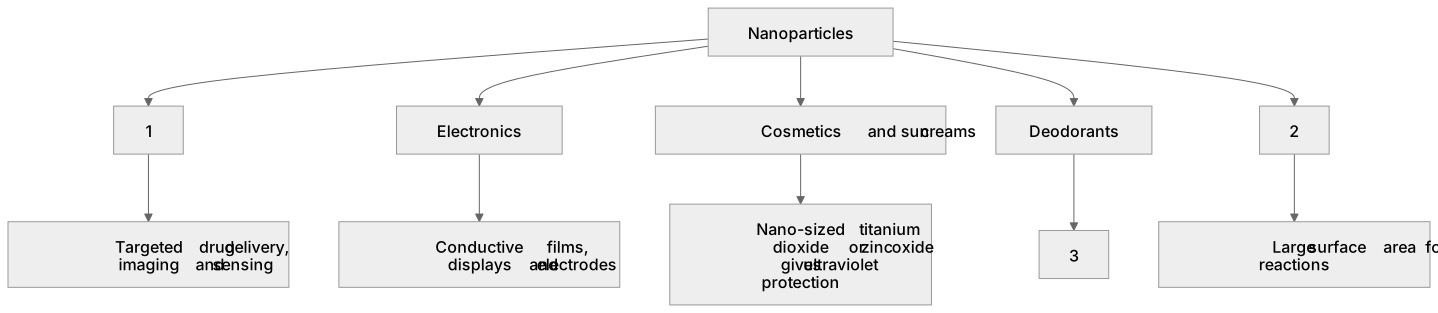
Some boxes have lost their names. Pick the right name for each number.
1Box 1
2Box 2
3Box 3
There is more to this lesson
The full lesson goes on to check your understanding and help you earn the marks. Create a free account to carry on, with your progress saved.
A week of Premium from your first lesson · Then the free plan continues · No card, no charge
Test your understanding of Uses of nanoparticles: Nanoparticles have many applications in medicine, in electronics, in cosmetics and sun creams, as deodorants, and as catalysts.
Active recall beats re-reading. Take an instant quiz now to test what you’ve learned and lock it into long-term memory.
A week of Premium from your first lesson · Then the free plan continues · No card, no charge