AQA · GCSE · Chemistry
Course version: 8462 · Version from Sept 2018
Students should consider advantages and disadvantages of the applications…
Full specification wording
Uses of nanoparticles: Students should consider advantages and disadvantages of the applications of these nanoparticulate materials, but do not need to know specific examples or properties other than those specified.
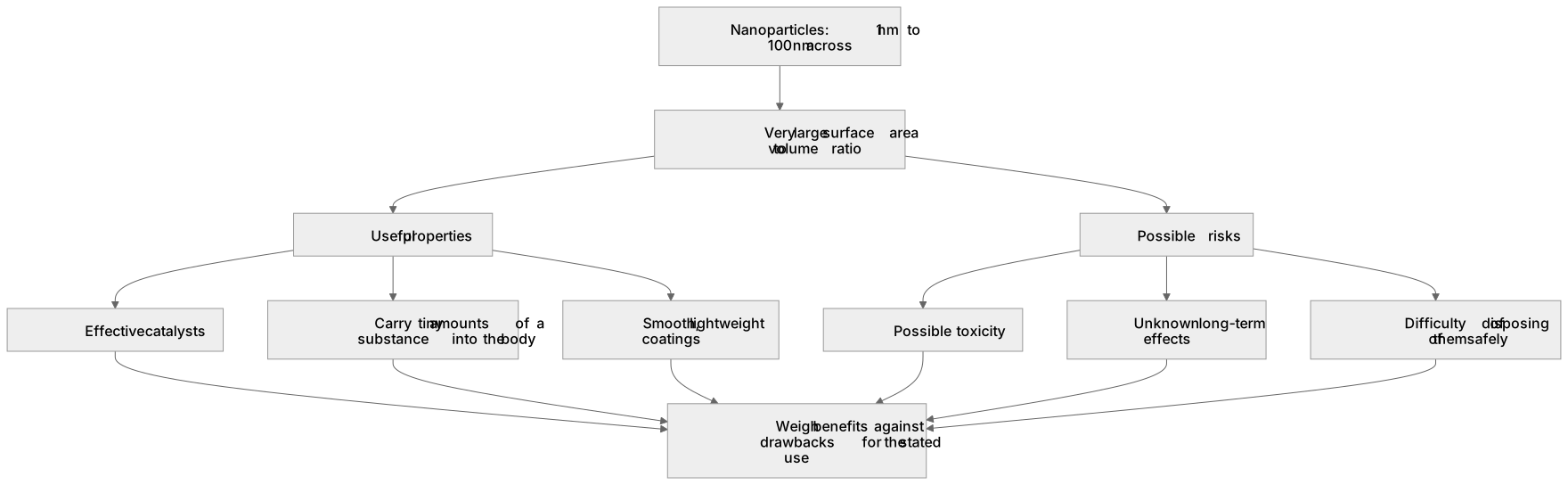
Nanoparticles are particles between about 1 nm and 100 nm across, so they have a very large surface area to volume ratio.
Checked against the AQA 8462 specification (opens in a new tab) on .
- Point 3 of 4
- 3 key terms
Study notes
From the checked teaching notes for this specification point.
The idea
Nanoparticles are particles between about 1 nm and 100 nm across, so they have a very large surface area to volume ratio. This gives nanoparticulate materials useful properties: they can be effective catalysts, they can carry tiny amounts of a substance into the body, and they can give smooth, lightweight coatings. For example, a sunscreen containing titanium dioxide nanoparticles spreads easily and gives good protection, but the particles may enter cells and their long-term effect is uncertain. You are not required to recall extra examples or properties beyond those taught; instead, use the information given in a question to judge whether a use is worthwhile.
What earns the marks
- State that nanoparticles have a very large surface area to volume ratio, which makes them effective catalysts and allows small quantities to have a large effect.
- Describe a benefit of a named application, such as improved coverage, lower mass or more efficient delivery of a substance.
- Describe a disadvantage, such as possible toxicity, unknown long-term health effects or environmental harm.
- Use information supplied in the question to reach a justified judgement about whether a particular use is suitable for the stated purpose.
- Recognise that the same property, such as small size, can be both an advantage and a disadvantage depending on the application.
Common mistakes and how to put them right
Treating all nanoparticles as automatically harmful.
Put it right: The correct approach is to weigh evidence for the specific use rather than assume a general danger.
Confusing nanoparticles with atoms or molecules.
Put it right: Nanoparticles are much larger than individual atoms and contain many atoms, so descriptions should refer to particles in the 1 nm to 100 nm range.
Giving only advantages or only disadvantages when the question asks for a balanced consideration.
Put it right: Include at least one point on each side before judging.
Exam tips
- Read the purpose stated in the question and link each advantage or disadvantage directly to that purpose rather than listing general facts.
- Use comparative language such as more effective, less mass or greater risk to make the weighing of evidence clear.
- Finish with a short judgement that follows from the points you made, for example that the benefit outweighs the risk for this use.
Try the lesson
The start of the Uses of nanoparticles: Students should consider advantages and disadvantages of the applications of these nanoparticulate materials, but do not need to know specific examples or properties other than those specified. lesson, made from checked teaching notes for this specification point.
Have a go first
Which statement describes a disadvantage of using nanoparticulate materials in a product?
Listen
Nanoparticles are particles between about 1 nm and 100 nm across, so they have a very large surface area to volume ratio. This gives nanoparticulate materials useful properties: they can be effective catalysts, they can carry tiny amounts of a substance into the body, and they can give smooth, lightweight coatings. For example, a sunscreen containing titanium dioxide nanoparticles spreads easily and gives good protection, but the particles may enter cells and their long-term effect is uncertain. You are not required to recall extra examples or properties beyond those taught; instead, use the information given in a question to judge whether a use is worthwhile. A strong answer earns marks for these points. State that nanoparticles have a very large surface area to volume ratio, which makes them effective catalysts and allows small quantities to have a large effect. Describe a benefit of a named application, such as improved coverage, lower mass or more efficient delivery of a substance. Describe a disadvantage, such as possible toxicity, unknown long-term health effects or environmental harm. Use information supplied in the question to reach a justified judgement about whether a particular use is suitable for the stated purpose. A common slip: Giving only advantages or only disadvantages when the question asks for a balanced consideration. Instead, include at least one point on each side before judging. Exam tip: Read the purpose stated in the question and link each advantage or disadvantage directly to that purpose rather than listing general facts.
See it
Key words
Say what each word means before you turn the card.
Benefits and risks of nanotechnology
Try answering aloud or in your head before turning the card.
Evaluating applications against a specified purpose
Try answering aloud or in your head before turning the card.
Evidence-based decision making
Try answering aloud or in your head before turning the card.
See every definition
- Benefits and risks of nanotechnology
- The useful properties of nanoparticulate materials must be weighed against drawbacks such as possible toxicity, unknown long-term effects and the difficulty of disposing of them safely.
- Evaluating applications against a specified purpose
- Use the information given in a question to judge whether a use is worthwhile, reaching a justified judgement about whether a particular use is suitable for the stated purpose.
- Evidence-based decision making
- The correct approach is to weigh evidence for the specific use rather than assume a general danger, using information supplied in the question to reach a justified judgement.
Label the diagram
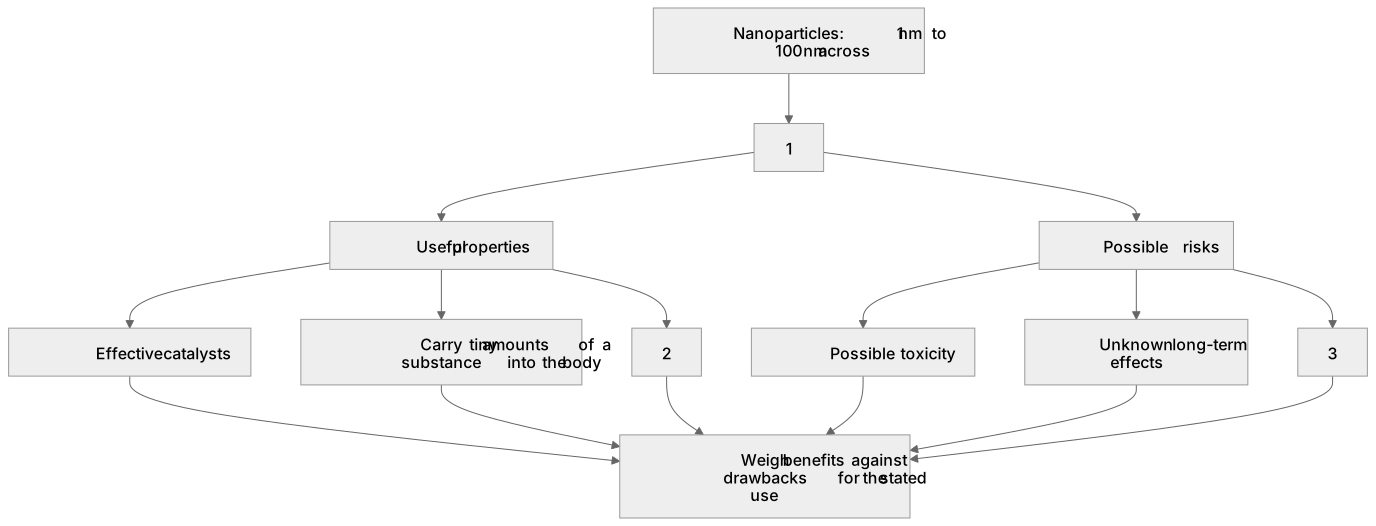
Some boxes have lost their names. Pick the right name for each number.
1Box 1
2Box 2
3Box 3
There is more to this lesson
The full lesson goes on to check your understanding and help you earn the marks. Create a free account to carry on, with your progress saved.
A week of Premium from your first lesson · Then the free plan continues · No card, no charge
Test your understanding of Uses of nanoparticles: Students should consider advantages and disadvantages of the applications of these nanoparticulate materials, but do not need to know specific examples or properties other than those specified.
Active recall beats re-reading. Take an instant quiz now to test what you’ve learned and lock it into long-term memory.
A week of Premium from your first lesson · Then the free plan continues · No card, no charge