AQA · GCSE · Chemistry
Course version: 8462 · Version from Sept 2018
Humans use the Earth’s resources to provide warmth, shelter, food and…
Full specification wording
Using the Earth's resources and sustainable development: Humans use the Earth’s resources to provide warmth, shelter, food and transport.
This statement asks you to connect everyday human needs to specific Earth resources.
Checked against the AQA 8462 specification (opens in a new tab) on .
- Point 1 of 6
- 3 key terms
Study notes
From the checked teaching notes for this specification point.
The idea
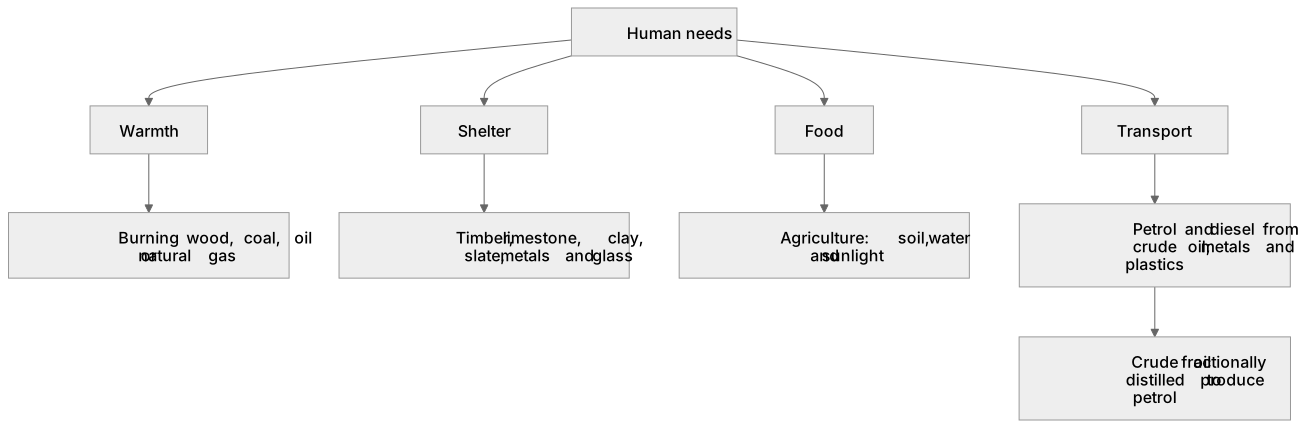
This statement asks you to connect everyday human needs to specific Earth resources. Warmth comes from burning wood, coal, oil or natural gas, or from electricity generated from these fuels. Shelter uses timber, limestone, clay, slate, metals and glass, all obtained from the Earth. Food depends on soil, water and sunlight, supported by agriculture. Transport relies on crude oil fractions such as petrol and diesel, plus metals and plastics for vehicles. For each need, name a resource, state whether it is finite or renewable, and explain how it is processed or used. A concrete example is crude oil, a finite resource, fractionally distilled to produce petrol for transport. This links resource use to sustainability and the need to conserve finite reserves.
What earns the marks
- Warmth is provided by burning fuels such as wood, coal, oil or natural gas, or by using electricity generated from them.
- Shelter uses materials such as timber, limestone, clay, slate, metals and glass obtained from the Earth.
- Food is provided by agriculture, which depends on soil, water and suitable climate conditions.
- Transport uses fuels such as petrol and diesel from crude oil, plus metals and plastics for vehicle manufacture.
- Resources can be classified as finite or renewable, and this affects how long they will last.
Common mistakes and how to put them right
Treating all Earth resources as renewable.
Put it right: Fossil fuels and metal ores are finite and will run out.
Ignoring the processing step.
Put it right: Crude oil must be fractionally distilled before petrol can be used.
Assuming food is independent of Earth resources.
Put it right: Agriculture depends on soil, water and nutrients from the Earth.
Exam tips
- Link each human need to a named resource and state whether it is finite or renewable.
- Use one clear example, such as crude oil to petrol for transport, to show the processing chain.
- Avoid listing needs without resources, because the question asks how resources are used.
Try the lesson
The start of the Using the Earth's resources and sustainable development: Humans use the Earth’s resources to provide warmth, shelter, food and transport. lesson, made from checked teaching notes for this specification point.
Have a go first
Humans use the Earth's resources to provide warmth, shelter, food and transport. Which of these is a renewable resource used to provide warmth?
Listen
This statement asks you to connect everyday human needs to specific Earth resources. Warmth comes from burning wood, coal, oil or natural gas, or from electricity generated from these fuels. Shelter uses timber, limestone, clay, slate, metals and glass, all obtained from the Earth. Food depends on soil, water and sunlight, supported by agriculture. Transport relies on crude oil fractions such as petrol and diesel, plus metals and plastics for vehicles. For each need, name a resource, state whether it is finite or renewable, and explain how it is processed or used. A concrete example is crude oil, a finite resource, fractionally distilled to produce petrol for transport. This links resource use to sustainability and the need to conserve finite reserves. A strong answer earns marks for these points. Warmth is provided by burning fuels such as wood, coal, oil or natural gas, or by using electricity generated from them. Shelter uses materials such as timber, limestone, clay, slate, metals and glass obtained from the Earth. Food is provided by agriculture, which depends on soil, water and suitable climate conditions. Transport uses fuels such as petrol and diesel from crude oil, plus metals and plastics for vehicle manufacture. A common slip: Treating all Earth resources as renewable. Instead, fossil fuels and metal ores are finite and will run out. Exam tip: Link each human need to a named resource and state whether it is finite or renewable.
See it
Key words
Say what each word means before you turn the card.
Human needs
Try answering aloud or in your head before turning the card.
Finite and renewable resources
Try answering aloud or in your head before turning the card.
Processing resources
Try answering aloud or in your head before turning the card.
See every definition
- Human needs
- Warmth, shelter, food and transport are provided by using the Earth's resources.
- Finite and renewable resources
- Resources can be classified in this way, and this affects how long they will last.
- Processing resources
- Crude oil must be fractionally distilled before petrol can be used for transport.
Label the diagram
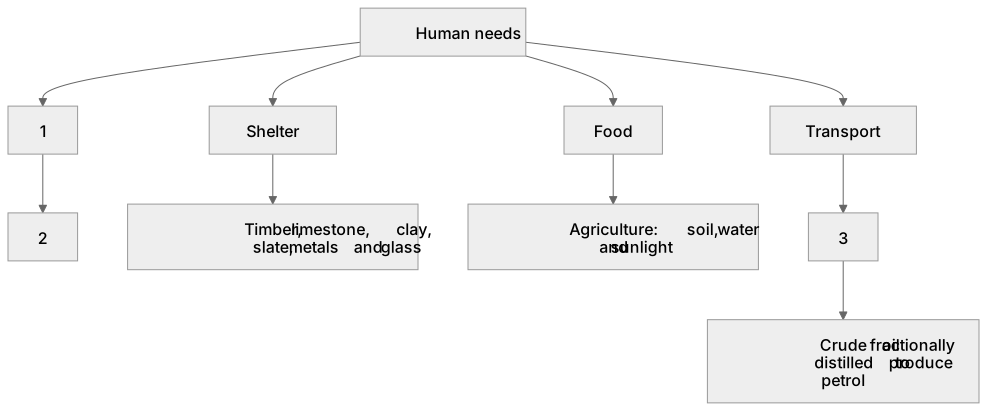
Some boxes have lost their names. Pick the right name for each number.
1Box 1
2Box 2
3Box 3
There is more to this lesson
The full lesson goes on to check your understanding and help you earn the marks. Create a free account to carry on, with your progress saved.
A week of Premium from your first lesson · Then the free plan continues · No card, no charge
Test your understanding of Using the Earth's resources and sustainable development: Humans use the Earth’s resources to provide warmth, shelter, food and transport.
Active recall beats re-reading. Take an instant quiz now to test what you’ve learned and lock it into long-term memory.
A week of Premium from your first lesson · Then the free plan continues · No card, no charge