AQA · GCSE · Chemistry
Course version: 8462 · Version from Sept 2018
Students should be able to: state examples of natural products that are…
Full specification wording
Using the Earth's resources and sustainable development: Students should be able to: state examples of natural products that are supplemented or replaced by agricultural and synthetic products distinguish between finite and renewable resources given appropriate information.
Natural products are those obtained from plants, animals or the Earth without chemical synthesis.
Checked against the AQA 8462 specification (opens in a new tab) on .
- Point 5 of 6
- 4 key terms
Study notes
From the checked teaching notes for this specification point.
The idea
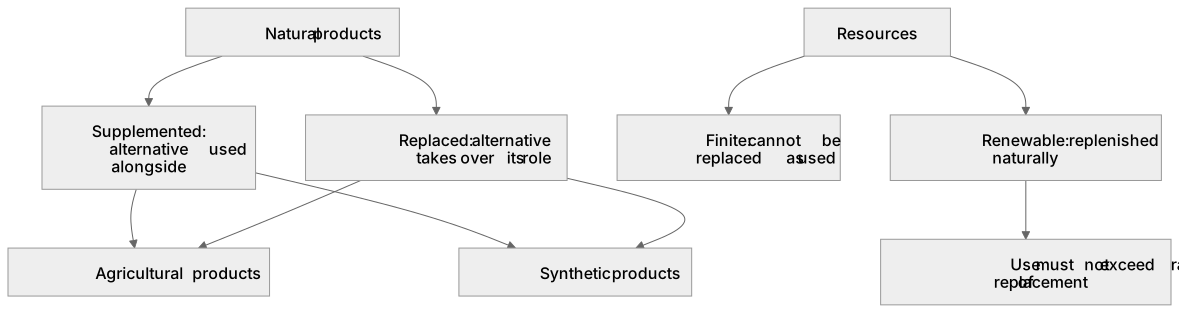
Natural products are those obtained from plants, animals or the Earth without chemical synthesis. Examples include rubber from trees, cotton, wool, timber, and plant oils. Agricultural products are grown or farmed, such as crops and livestock, while synthetic products are made by chemical processes, such as synthetic rubber, nylon, polyester and fertilisers. A natural product is supplemented when it is still used but additional synthetic or agricultural material is produced alongside it; it is replaced when the synthetic product takes over its role. Finite resources, such as crude oil, coal, natural gas and metal ores, cannot be replaced as they are used. Renewable resources, such as timber, solar energy, wind and water, are replenished naturally at a rate that can match use. To distinguish them, ask whether the resource is being used faster than it is replaced.
What earns the marks
- Natural products include rubber, cotton, wool, timber and plant oils obtained from living organisms or the Earth.
- Agricultural products are grown or farmed, for example crops, livestock and biofuels.
- Synthetic products are made by chemical processes, for example synthetic rubber, nylon, polyester and fertilisers.
- A natural product is supplemented when synthetic or agricultural alternatives are used alongside it, and replaced when the alternative takes over its role.
- Finite resources such as crude oil, coal, natural gas and metal ores cannot be replaced as they are used.
- Renewable resources such as timber, solar energy, wind and water are replenished naturally and can be used repeatedly if managed carefully.
Common mistakes and how to put them right
Calling all man-made materials synthetic while ignoring that agricultural products are also produced by humans.
Put it right: Agricultural products come from farming, whereas synthetic products come from chemical synthesis.
Classifying nuclear fuel as renewable.
Put it right: Uranium is a finite metal ore.
Assuming any resource that can regrow is automatically renewable regardless of use rate.
Put it right: Use must not exceed the rate of replacement.
Exam tips
- When asked to distinguish finite from renewable, give the definition of each and then apply it to the named resource.
- For supplement or replace questions, name the natural product and the alternative, then state clearly which term applies and why.
- Use data from the question, such as years of supply remaining or annual production, to support your classification.
Try the lesson
The start of the Using the Earth's resources and sustainable development: Students should be able to: state examples of natural products that are supplemented or replaced by agricultural and synthetic products distinguish between finite and renewable resources given appropriate information. lesson, made from checked teaching notes for this specification point.
Have a go first
Which of these is an example of a natural product that can be supplemented or replaced by a synthetic product?
Listen
Natural products are those obtained from plants, animals or the Earth without chemical synthesis. Examples include rubber from trees, cotton, wool, timber, and plant oils. Agricultural products are grown or farmed, such as crops and livestock, while synthetic products are made by chemical processes, such as synthetic rubber, nylon, polyester and fertilisers. A natural product is supplemented when it is still used but additional synthetic or agricultural material is produced alongside it; it is replaced when the synthetic product takes over its role. Finite resources, such as crude oil, coal, natural gas and metal ores, cannot be replaced as they are used. Renewable resources, such as timber, solar energy, wind and water, are replenished naturally at a rate that can match use. To distinguish them, ask whether the resource is being used faster than it is replaced. A strong answer earns marks for these points. Natural products include rubber, cotton, wool, timber and plant oils obtained from living organisms or the Earth. Agricultural products are grown or farmed, for example crops, livestock and biofuels. Synthetic products are made by chemical processes, for example synthetic rubber, nylon, polyester and fertilisers. A natural product is supplemented when synthetic or agricultural alternatives are used alongside it, and replaced when the alternative takes over its role. A common slip: Calling all man-made materials synthetic while ignoring that agricultural products are also produced by humans. Instead, agricultural products come from farming, whereas synthetic products come from chemical synthesis. Exam tip: When asked to distinguish finite from renewable, give the definition of each and then apply it to the named resource.
See it
Key words
Say what each word means before you turn the card.
Natural versus synthetic materials
Try answering aloud or in your head before turning the card.
Agricultural production
Try answering aloud or in your head before turning the card.
Finite and renewable resources
Try answering aloud or in your head before turning the card.
Resource management
Try answering aloud or in your head before turning the card.
See every definition
- Natural versus synthetic materials
- Natural products are obtained from plants, animals or the Earth without chemical synthesis, while synthetic products are made by chemical processes.
- Agricultural production
- Products that are grown or farmed, such as crops and livestock.
- Finite and renewable resources
- Finite resources cannot be replaced as they are used, whereas renewable resources are replenished naturally at a rate that can match use.
- Resource management
- Renewable resources can be used repeatedly if managed carefully, with use not exceeding the rate of replacement.
Label the diagram
Some boxes have lost their names. Pick the right name for each number.
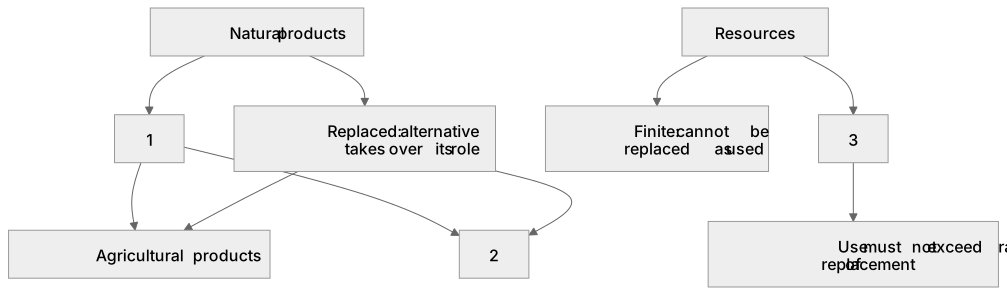
1Box 1
2Box 2
3Box 3
There is more to this lesson
The full lesson goes on to check your understanding and help you earn the marks. Create a free account to carry on, with your progress saved.
A week of Premium from your first lesson · Then the free plan continues · No card, no charge
Test your understanding of Using the Earth's resources and sustainable development: Students should be able to: state examples of natural products that are supplemented or replaced by agricultural and synthetic products distinguish between finite and renewable resources given appropriate information.
Active recall beats re-reading. Take an instant quiz now to test what you’ve learned and lock it into long-term memory.
A week of Premium from your first lesson · Then the free plan continues · No card, no charge