AQA · GCSE · Combined Science
Course version: 8464 · Version from Sept 2018
Acceleration: An object that slows down is decelerating.
Acceleration is the rate of change of velocity, so it is a vector quantity with both magnitude and direction.
Checked against the AQA 8464 specification (opens in a new tab) on .
- Point 7 of 21
- 2 key terms
Study notes
From the checked teaching notes for this specification point.
The idea
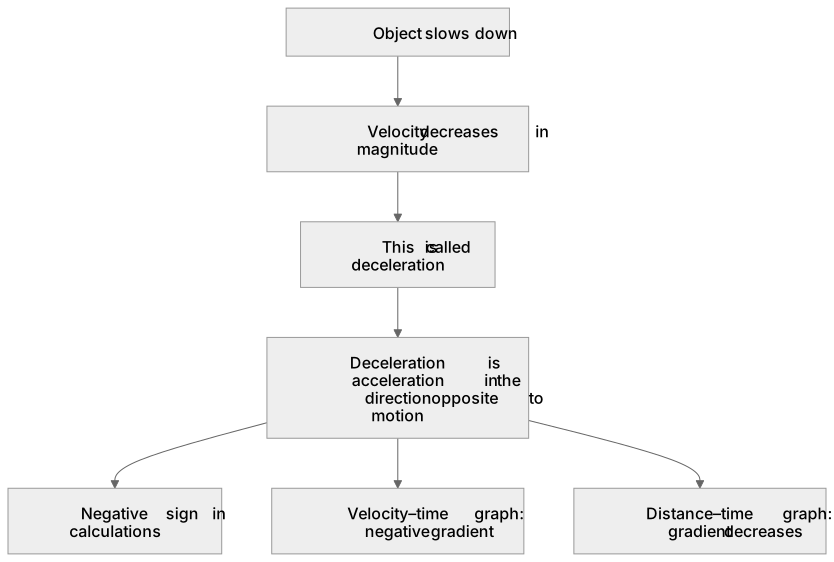
Acceleration is the rate of change of velocity, so it is a vector quantity with both magnitude and direction. When an object slows down, its velocity decreases in magnitude, and this is called deceleration. Deceleration is simply acceleration in the direction opposite to the object's motion. For example, a car travelling forwards at 20 m/s that reduces its velocity to 5 m/s over 3 s has an acceleration of (5 − 20) ÷ 3 = −5 m/s²; the negative sign shows deceleration. In everyday language, deceleration means slowing down, but in physics it is still an acceleration. The skill is assessed by asking students to identify deceleration in descriptions, graphs or calculations, and to interpret the sign of acceleration correctly.
What earns the marks
- Acceleration is the rate of change of velocity, so it is a vector quantity with magnitude and direction.
- Deceleration occurs when the velocity of an object decreases in magnitude, meaning the object is slowing down.
- Deceleration is acceleration in the opposite direction to the object's motion, often indicated by a negative sign in calculations.
- On a velocity–time graph, deceleration is shown by a negative gradient; on a distance–time graph, the gradient decreases.
- Calculating acceleration using a = Δv ÷ t gives a negative value for deceleration when the final velocity is less than the initial velocity.
Common mistakes and how to put them right
Thinking that deceleration is not acceleration.
Put it right: Deceleration is a type of acceleration where the object slows down; acceleration is any change in velocity.
Ignoring the direction of motion when interpreting negative acceleration.
Put it right: A negative acceleration means the acceleration is opposite to the direction of motion, which causes slowing down if the object is moving in the positive direction.
Confusing deceleration with negative velocity.
Put it right: Velocity can be negative while the object speeds up (if acceleration is also negative), so deceleration depends on the relative directions of velocity and acceleration.
Exam tips
- When describing motion, state clearly whether the object is speeding up or slowing down and refer to the direction of the acceleration relative to motion.
- In calculations, always include the sign of the acceleration and explain what it means in the context of the motion.
- On graphs, identify deceleration by looking for a decreasing velocity (negative gradient on a velocity–time graph) or a flattening curve on a distance–time graph.
Try the lesson
The start of the Acceleration: An object that slows down is decelerating. lesson, made from checked teaching notes for this specification point.
Have a go first
A cyclist applies their brakes and their speed decreases as they approach a junction. Which term is used to describe this change in motion?
Listen
Acceleration is the rate of change of velocity, so it is a vector quantity with both magnitude and direction. When an object slows down, its velocity decreases in magnitude, and this is called deceleration. Deceleration is simply acceleration in the direction opposite to the object's motion. For example, a car travelling forwards at 20 m/s that reduces its velocity to 5 m/s over 3 s has an acceleration of (5 − 20) ÷ 3 = −5 m/s²; the negative sign shows deceleration. In everyday language, deceleration means slowing down, but in physics it is still an acceleration. The skill is assessed by asking students to identify deceleration in descriptions, graphs or calculations, and to interpret the sign of acceleration correctly. A strong answer earns marks for these points. Acceleration is the rate of change of velocity, so it is a vector quantity with magnitude and direction. Deceleration occurs when the velocity of an object decreases in magnitude, meaning the object is slowing down. Deceleration is acceleration in the opposite direction to the object's motion, often indicated by a negative sign in calculations. On a velocity–time graph, deceleration is shown by a negative gradient; on a distance–time graph, the gradient decreases. A common slip: thinking that deceleration is not acceleration. Instead, deceleration is a type of acceleration where the object slows down; acceleration is any change in velocity. Exam tip: When describing motion, state clearly whether the object is speeding up or slowing down and refer to the direction of the acceleration relative to motion.
See it
Key words
Say what each word means before you turn the card.
Deceleration
Try answering aloud or in your head before turning the card.
Acceleration
Try answering aloud or in your head before turning the card.
See every definition
- Deceleration
- Occurs when the velocity of an object decreases in magnitude, meaning the object is slowing down.
- Acceleration
- The rate of change of velocity, so it is a vector quantity with magnitude and direction.
Label the diagram
Some boxes have lost their names. Pick the right name for each number.
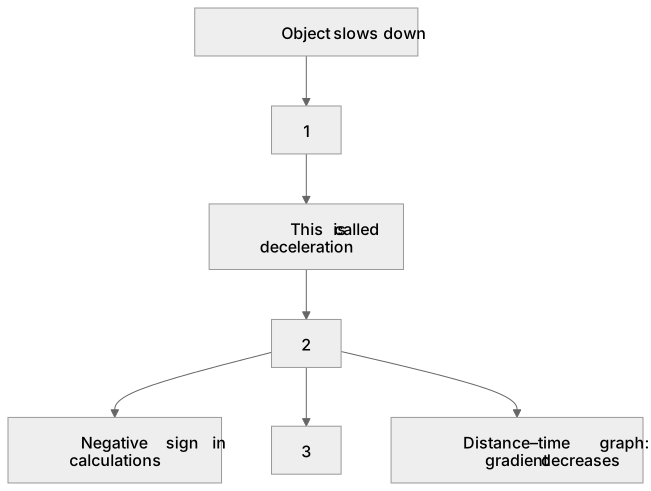
1Box 1
2Box 2
3Box 3
There is more to this lesson
The full lesson goes on to check your understanding and help you earn the marks. Create a free account to carry on, with your progress saved.
A week of Premium from your first lesson · Then the free plan continues · No card, no charge
Test your understanding of Acceleration: An object that slows down is decelerating.
Active recall beats re-reading. Take an instant quiz now to test what you’ve learned and lock it into long-term memory.
A week of Premium from your first lesson · Then the free plan continues · No card, no charge