AQA · GCSE · Combined Science
Course version: 8464 · Version from Sept 2018
Students should be able to estimate the magnitude of everyday accelerations.
Full specification wording
Acceleration: Students should be able to estimate the magnitude of everyday accelerations.
Estimating everyday accelerations means using familiar reference values to judge the size of acceleration in common situations.
Checked against the AQA 8464 specification (opens in a new tab) on .
- Point 8 of 21
Study notes
From the checked teaching notes for this specification point.
The idea
Estimating everyday accelerations means using familiar reference values to judge the size of acceleration in common situations. For example, a car accelerating from rest to 30 m/s in 10 s has an average acceleration of 3 m/s²; a bus might accelerate at about 1 m/s²; a falling object near Earth's surface accelerates at about 10 m/s² due to gravity. The skill involves using the equation a = Δv ÷ t with approximate values, or comparing to known benchmarks. Assessment may ask students to choose sensible estimates, calculate approximate accelerations from given data, or explain why an estimated value is reasonable. This helps develop a sense of scale in physics.
What earns the marks
- Everyday accelerations can be estimated by using typical changes in velocity over typical time intervals.
- The equation a = Δv ÷ t can be used with approximate values to estimate acceleration magnitude.
- Reference values include: free fall ≈ 10 m/s², car acceleration ≈ 2–4 m/s², bus ≈ 1 m/s², walking ≈ 0.5 m/s².
- Estimates should be given with appropriate units (m/s²) and a sensible number of significant figures.
Common mistakes and how to put them right
Using final velocity instead of change in velocity when estimating acceleration.
Put it right: Calculate Δv = final velocity − initial velocity.
Forgetting to convert units, e.g. using km/h directly in a = Δv ÷ t.
Put it right: Convert all velocities to m/s before calculating acceleration.
Giving unrealistic estimates, such as a car accelerating at 100 m/s².
Put it right: Compare with known benchmarks like free-fall acceleration (≈10 m/s²) to check reasonableness.
Exam tips
- Memorise a few benchmark accelerations, such as free fall ≈ 10 m/s², to help judge whether an estimate is sensible.
- When estimating, show your assumed values for velocity change and time, then calculate to demonstrate your reasoning.
- Check that your answer has the correct unit (m/s²) and is stated with an appropriate number of significant figures.
Try the lesson
The start of the Acceleration: Students should be able to estimate the magnitude of everyday accelerations. lesson, made from checked teaching notes for this specification point.
Have a go first
Which of the following is the most reasonable estimate for the acceleration of a typical family car setting off from traffic lights?
Listen
Estimating everyday accelerations means using familiar reference values to judge the size of acceleration in common situations. For example, a car accelerating from rest to 30 m/s in 10 s has an average acceleration of 3 m/s²; a bus might accelerate at about 1 m/s²; a falling object near Earth's surface accelerates at about 10 m/s² due to gravity. The skill involves using the equation a = Δv ÷ t with approximate values, or comparing to known benchmarks. Assessment may ask students to choose sensible estimates, calculate approximate accelerations from given data, or explain why an estimated value is reasonable. This helps develop a sense of scale in physics. A strong answer earns marks for these points. Everyday accelerations can be estimated by using typical changes in velocity over typical time intervals. The equation a = Δv ÷ t can be used with approximate values to estimate acceleration magnitude. Reference values include: free fall ≈ 10 m/s², car acceleration ≈ 2–4 m/s², bus ≈ 1 m/s², walking ≈ 0.5 m/s². Estimates should be given with appropriate units (m/s²) and a sensible number of significant figures. A common slip: using final velocity instead of change in velocity when estimating acceleration. Instead, calculate Δv = final velocity − initial velocity. Exam tip: Memorise a few benchmark accelerations, such as free fall ≈ 10 m/s², to help judge whether an estimate is sensible.
See it

Label the diagram
Some boxes have lost their names. Pick the right name for each number.
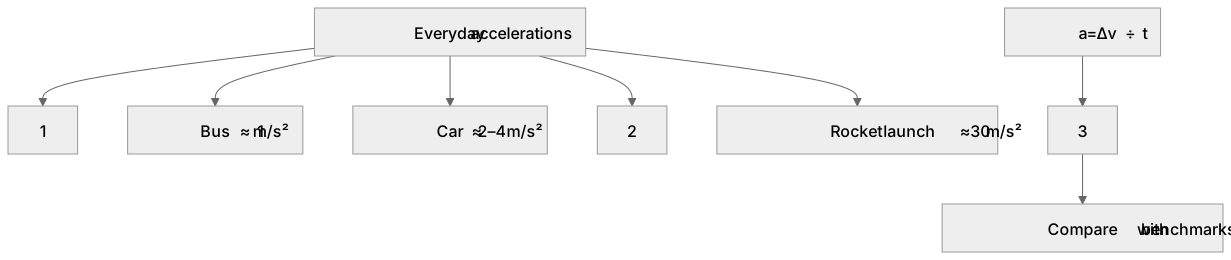
1Box 1
2Box 2
3Box 3
There is more to this lesson
The full lesson goes on to check your understanding and help you earn the marks. Create a free account to carry on, with your progress saved.
A week of Premium from your first lesson · Then the free plan continues · No card, no charge
Test your understanding of Acceleration: Students should be able to estimate the magnitude of everyday accelerations.
Active recall beats re-reading. Take an instant quiz now to test what you’ve learned and lock it into long-term memory.
A week of Premium from your first lesson · Then the free plan continues · No card, no charge