AQA · GCSE · Combined Science
Course version: 8464 · Version from Sept 2018
Near the Earth’s surface any object falling freely under gravity has an…
Full specification wording
Acceleration: Near the Earth’s surface any object falling freely under gravity has an acceleration of about 9.8 m/s².
Free fall means the only force acting is gravity, so air resistance is negligible.
Checked against the AQA 8464 specification (opens in a new tab) on .
- Point 20 of 21
- 3 key terms
Study notes
From the checked teaching notes for this specification point.
The idea
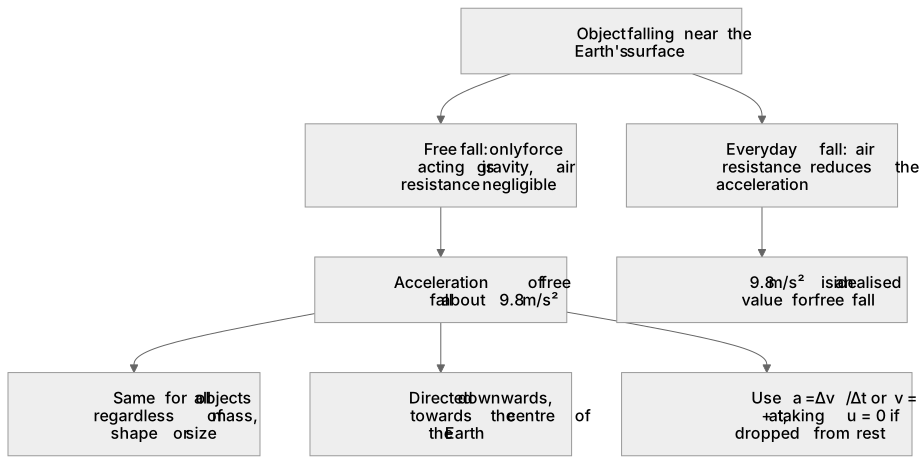
Free fall means the only force acting is gravity, so air resistance is negligible. Near the Earth’s surface, all objects have the same downward acceleration of about 9.8 m/s², often rounded to 10 m/s². This acceleration is independent of mass, shape or size when drag is absent. For example, in a vacuum a coin and a feather dropped together hit the ground at the same time. You can use a = Δv / Δt to find acceleration from velocity changes, or v = u + at to predict speed after a time t. The value 9.8 m/s² is a magnitude; the direction is towards the Earth’s centre. In everyday falls, air resistance reduces the acceleration, so 9.8 m/s² is an idealised value for free fall.
What earns the marks
- State that free fall means the only force acting on the object is gravity, so air resistance is negligible.
- Recall that near the Earth’s surface the acceleration of free fall is about 9.8 m/s², and that this value is the same for all objects regardless of mass.
- Explain that the acceleration is directed downwards, towards the centre of the Earth, and is a vector quantity.
- Use a = Δv / Δt or v = u + at to calculate speed or time for an object falling freely, taking u = 0 if dropped from rest.
- Recognise that in a vacuum all objects fall with the same acceleration, whereas in air drag reduces the acceleration.
Common mistakes and how to put them right
Thinking heavier objects fall faster.
Put it right by explaining that in free fall all objects have the same acceleration of about 9.8 m/s², and any difference in air is due to air resistance, not weight.
Using 9.8 m/s² as a speed rather than an acceleration.
Put it right by emphasising the unit m/s² and that it describes how velocity changes each second.
Forgetting that 9.8 m/s² is only valid near the Earth’s surface and ignoring air resistance.
Put it right by stating that the value is an approximation for free fall and that drag reduces acceleration in a fluid.
Exam tips
- When calculating, write the equation, substitute values with units, and give the answer with the correct unit and an appropriate number of significant figures.
- If a question says ‘free fall’ or ‘in a vacuum’, use a = 9.8 m/s² unless told otherwise; if air resistance is mentioned, explain that acceleration is less than 9.8 m/s².
- Use the value 9.8 m/s² rather than 10 m/s² unless the question explicitly asks you to use 10 m/s² for simplicity.
Try the lesson
The start of the Acceleration: Near the Earth’s surface any object falling freely under gravity has an acceleration of about 9.8 m/s². lesson, made from checked teaching notes for this specification point.
Have a go first
A stone is dropped from a cliff and falls freely towards the ground. Ignoring air resistance, what is the approximate acceleration of the stone as it falls near the Earth's surface?
Listen
Free fall means the only force acting is gravity, so air resistance is negligible. Near the Earth’s surface, all objects have the same downward acceleration of about 9.8 m/s², often rounded to 10 m/s². This acceleration is independent of mass, shape or size when drag is absent. For example, in a vacuum a coin and a feather dropped together hit the ground at the same time. You can use a = Δv / Δt to find acceleration from velocity changes, or v = u + at to predict speed after a time t. The value 9.8 m/s² is a magnitude; the direction is towards the Earth’s centre. In everyday falls, air resistance reduces the acceleration, so 9.8 m/s² is an idealised value for free fall. A strong answer earns marks for these points. State that free fall means the only force acting on the object is gravity, so air resistance is negligible. Recall that near the Earth’s surface the acceleration of free fall is about 9.8 m/s², and that this value is the same for all objects regardless of mass. Explain that the acceleration is directed downwards, towards the centre of the Earth, and is a vector quantity. Use a = Δv / Δt or v = u + at to calculate speed or time for an object falling freely, taking u = 0 if dropped from rest. A common slip: Thinking heavier objects fall faster. Instead, explaining that in free fall all objects have the same acceleration of about 9.8 m/s², and any difference in air is due to air resistance, not weight. Exam tip: When calculating, write the equation, substitute values with units, and give the answer with the correct unit and an appropriate number of significant figures.
See it
Key words
Say what each word means before you turn the card.
Free fall
Try answering aloud or in your head before turning the card.
Acceleration of free fall
Try answering aloud or in your head before turning the card.
a = Δv / Δt
Try answering aloud or in your head before turning the card.
See every definition
- Free fall
- A situation where the only force acting on an object is gravity, so air resistance is negligible.
- Acceleration of free fall
- Near the Earth's surface, about 9.8 m/s², the same for all objects regardless of mass, shape or size when drag is absent.
- a = Δv / Δt
- An equation used to find acceleration from velocity changes.
Label the diagram
Some boxes have lost their names. Pick the right name for each number.
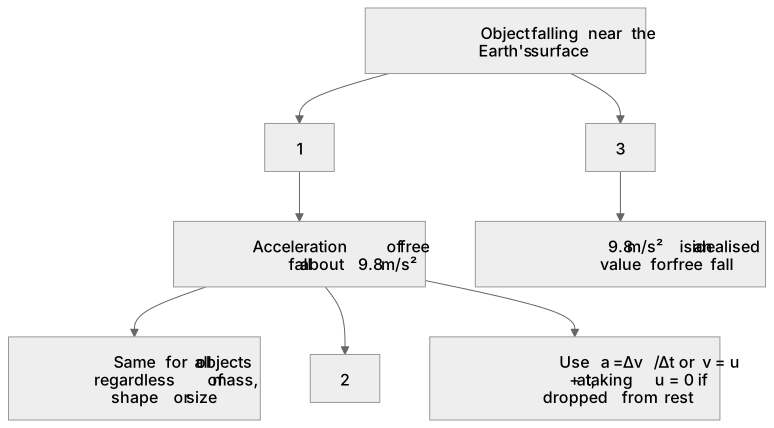
1Box 1
2Box 2
3Box 3
There is more to this lesson
The full lesson goes on to check your understanding and help you earn the marks. Create a free account to carry on, with your progress saved.
A week of Premium from your first lesson · Then the free plan continues · No card, no charge
Test your understanding of Acceleration: Near the Earth’s surface any object falling freely under gravity has an acceleration of about 9.8 m/s².
Active recall beats re-reading. Take an instant quiz now to test what you’ve learned and lock it into long-term memory.
A week of Premium from your first lesson · Then the free plan continues · No card, no charge