AQA · GCSE · Combined Science
Course version: 8464 · Version from Sept 2018
Acceleration: v² − u² = 2as
This equation links the four quantities of motion when time is not known.
Checked against the AQA 8464 specification (opens in a new tab) on .
- Point 16 of 21
Study notes
From the checked teaching notes for this specification point.
The idea
This equation links the four quantities of motion when time is not known. The symbol v is final velocity in m/s, u is initial velocity in m/s, a is acceleration in m/s² and s is displacement in m. It is derived from combining a = (v − u)/t with s = ((u + v)/2)t, eliminating t. To use it, list the known values, identify the unknown, substitute into v² − u² = 2as and solve. For example, a car accelerating at 2 m/s² from rest over 25 m gives v² = 0² + 2 × 2 × 25 = 100, so v = 10 m/s. If the object decelerates, a is negative, and if it reverses direction, v may be negative. Always check units are m/s, m/s² and m before substituting.
What earns the marks
- State the equation as v² − u² = 2as and identify each symbol with its unit: v and u in m/s, a in m/s², s in m.
- Substitute known values correctly, keeping signs for direction so deceleration uses a negative value.
- Rearrange to isolate the squared unknown, for example v² = u² + 2as, before taking the square root.
- Evaluate the arithmetic accurately, including squares and products, and give the final velocity with the correct unit and a sensible number of significant figures.
- Interpret the physical result, such as recognising that a negative square root indicates motion in the opposite direction to the chosen positive direction.
Common mistakes and how to put them right
Forgetting to take the square root after finding v², leaving an answer such as 100 m/s instead of 10 m/s.
Put it right: Finish by square-rooting the isolated squared term.
Using a positive value for deceleration.
Put it right: If the object slows down, substitute a negative acceleration so the equation reflects the change in velocity.
Mixing units, for example using distance in km with acceleration in m/s².
Put it right: Convert all quantities to m, m/s and m/s² before substituting.
Exam tips
- Write the equation, then a substitution line, then the rearranged line, then the answer with unit; this makes method marks clear even if arithmetic slips.
- Check whether the question gives time; if it does not, this equation is usually the intended route.
- Keep the sign of a and v consistent with your chosen positive direction, and state that direction if the answer is negative.
Try the lesson
The start of the Acceleration: v² − u² = 2as lesson, made from checked teaching notes for this specification point.
Have a go first
A train travelling at 10 m/s accelerates steadily to 30 m/s over a distance of 400 m. Using v² − u² = 2as, what is the acceleration a of the train?
Listen
This equation links the four quantities of motion when time is not known. The symbol v is final velocity in m/s, u is initial velocity in m/s, a is acceleration in m/s² and s is displacement in m. It is derived from combining a = (v − u)/t with s = ((u + v)/2)t, eliminating t. To use it, list the known values, identify the unknown, substitute into v² − u² = 2as and solve. For example, a car accelerating at 2 m/s² from rest over 25 m gives v² = 0² + 2 × 2 × 25 = 100, so v = 10 m/s. If the object decelerates, a is negative, and if it reverses direction, v may be negative. Always check units are m/s, m/s² and m before substituting. A strong answer earns marks for these points. State the equation as v² − u² = 2as and identify each symbol with its unit: v and u in m/s, a in m/s², s in m. Substitute known values correctly, keeping signs for direction so deceleration uses a negative value. Rearrange to isolate the squared unknown, for example v² = u² + 2as, before taking the square root. Evaluate the arithmetic accurately, including squares and products, and give the final velocity with the correct unit and a sensible number of significant figures. A common slip: Forgetting to take the square root after finding v², leaving an answer such as 100 m/s instead of 10 m/s. Instead, finish by square-rooting the isolated squared term. Exam tip: Write the equation, then a substitution line, then the rearranged line, then the answer with unit; this makes method marks clear even if arithmetic slips.
See it
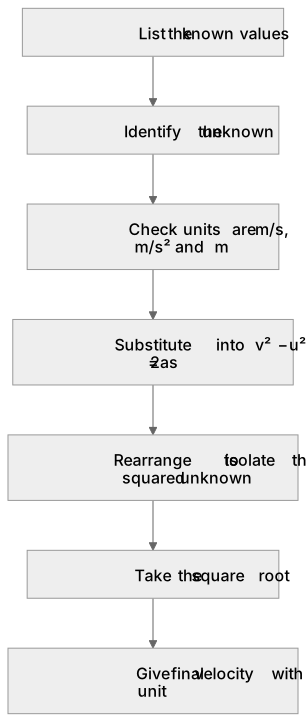
Put it in order
Put these steps in the order they happen.
- 1. Give final velocity with unit
- 2. Take the square root
- 3. Check units are m/s, m/s² and m
- 4. Rearrange to isolate the squared unknown
- 5. List the known values
- 6. Identify the unknown
- 7. Substitute into v² − u² = 2as
Label the diagram
Some boxes have lost their names. Pick the right name for each number.
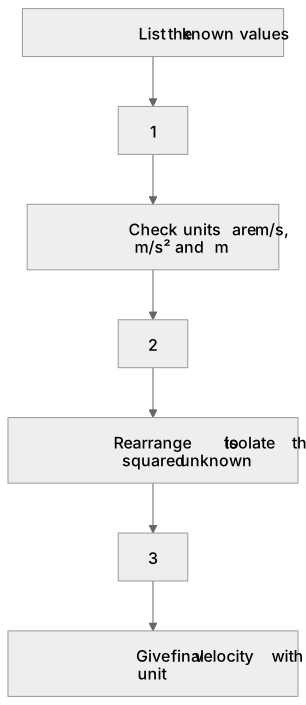
1Box 1
2Box 2
3Box 3
There is more to this lesson
The full lesson goes on to check your understanding and help you earn the marks. Create a free account to carry on, with your progress saved.
A week of Premium from your first lesson · Then the free plan continues · No card, no charge
Test your understanding of Acceleration: v² − u² = 2as
Active recall beats re-reading. Take an instant quiz now to test what you’ve learned and lock it into long-term memory.
A week of Premium from your first lesson · Then the free plan continues · No card, no charge