AQA · GCSE · Combined Science
Course version: 8464 · Version from Sept 2018
Acceleration: The following equation applies to uniform acceleration:
This statement introduces the condition for using the kinematic equation v² − u² = 2 × a × s: acceleration must be uniform, meaning it stays constant in magnitude and direction throughout the motion.
Checked against the AQA 8464 specification (opens in a new tab) on .
- Point 15 of 21
Study notes
From the checked teaching notes for this specification point.
The idea
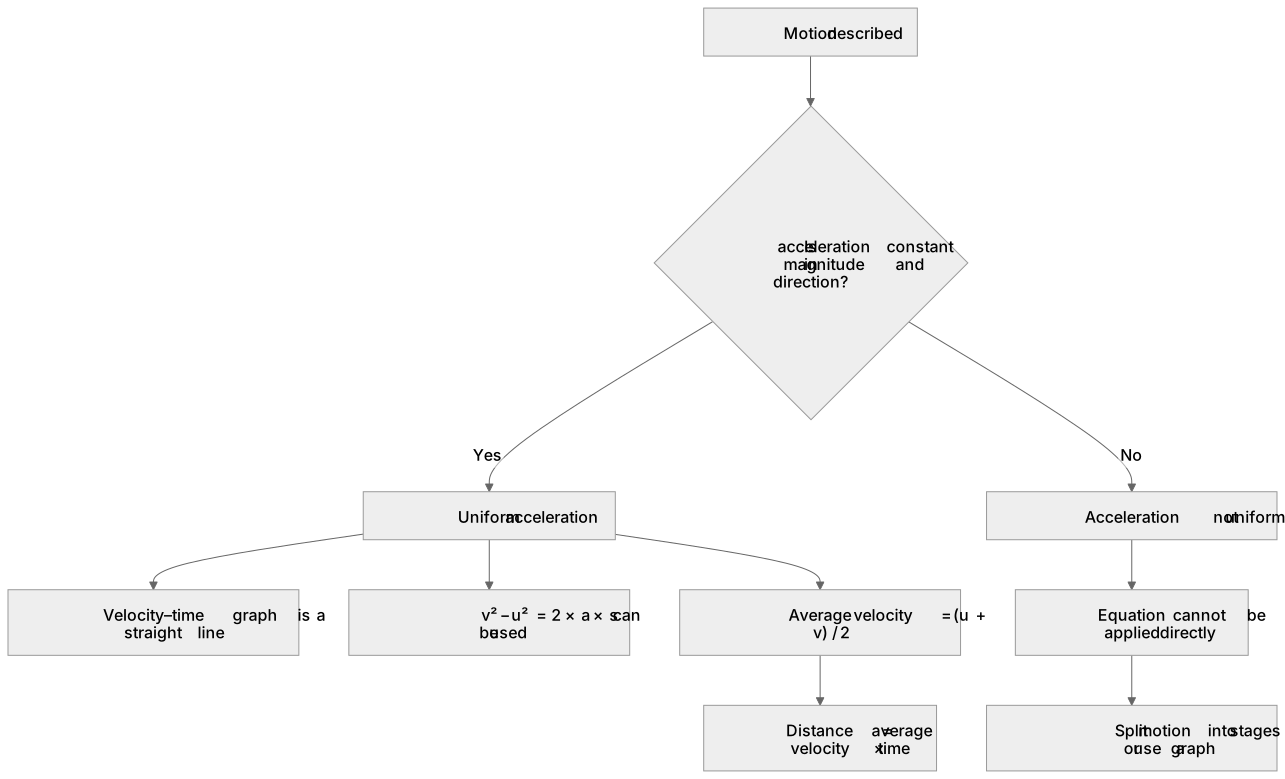
This statement introduces the condition for using the kinematic equation v² − u² = 2 × a × s: acceleration must be uniform, meaning it stays constant in magnitude and direction throughout the motion. Uniform acceleration produces a straight-line velocity–time graph, so the gradient is constant. For example, a ball rolling down a smooth slope may be modelled as uniform acceleration, but a car in stop-start traffic is not. When acceleration is uniform, average velocity is (u + v) / 2 and distance is that average multiplied by time. If acceleration changes, the equation cannot be applied directly; the motion must be split into stages or a graph used. Recognising this condition is part of choosing the correct equation.
What earns the marks
- Define uniform acceleration as constant acceleration in magnitude and direction, giving a straight-line velocity–time graph.
- Explain that v² − u² = 2 × a × s is valid only when acceleration is uniform, and state what happens if it is not.
- Use the gradient of a velocity–time graph to check whether acceleration is constant before selecting the equation.
- Apply the equation to a described uniform-acceleration stage, such as a vehicle braking steadily or a trolley accelerating down a ramp.
- Recognise that average velocity (u + v) / 2 can be used only for uniform acceleration, linking this to distance = average velocity × time.
Common mistakes and how to put them right
Assuming any motion with changing speed has uniform acceleration.
Put it right: Uniform acceleration requires a constant rate of change of velocity, shown by a straight velocity–time line.
Using v² − u² = 2 × a × s for a whole journey that includes different acceleration stages.
Put it right: Split the journey into stages where acceleration is uniform.
Confusing uniform acceleration with constant speed.
Put it right: Constant speed means a = 0, while uniform acceleration means a is constant and non-zero.
Exam tips
- Look for words such as steadily, uniformly or constant acceleration in the question before using the equation.
- Sketch a velocity–time graph to confirm the gradient is constant; this justifies your choice of equation.
- If acceleration changes, state that the equation applies only to each uniform stage and calculate stage by stage.
Try the lesson
The start of the Acceleration: The following equation applies to uniform acceleration: lesson, made from checked teaching notes for this specification point.
Have a go first
A cyclist accelerates uniformly from rest at a rate of 2 m/s². What is the final velocity of the cyclist after travelling a distance of 9 m?
Listen
This statement introduces the condition for using the kinematic equation v² − u² = 2 × a × s: acceleration must be uniform, meaning it stays constant in magnitude and direction throughout the motion. Uniform acceleration produces a straight-line velocity–time graph, so the gradient is constant. For example, a ball rolling down a smooth slope may be modelled as uniform acceleration, but a car in stop-start traffic is not. When acceleration is uniform, average velocity is (u + v) / 2 and distance is that average multiplied by time. If acceleration changes, the equation cannot be applied directly; the motion must be split into stages or a graph used. Recognising this condition is part of choosing the correct equation. A strong answer earns marks for these points. Define uniform acceleration as constant acceleration in magnitude and direction, giving a straight-line velocity–time graph. Explain that v² − u² = 2 × a × s is valid only when acceleration is uniform, and state what happens if it is not. Use the gradient of a velocity–time graph to check whether acceleration is constant before selecting the equation. Apply the equation to a described uniform-acceleration stage, such as a vehicle braking steadily or a trolley accelerating down a ramp. A common slip: Assuming any motion with changing speed has uniform acceleration. Instead, uniform acceleration requires a constant rate of change of velocity, shown by a straight velocity–time line. Exam tip: Look for words such as steadily, uniformly or constant acceleration in the question before using the equation.
See it
There is more to this lesson
The full lesson goes on to check your understanding and help you earn the marks. Create a free account to carry on, with your progress saved.
A week of Premium from your first lesson · Then the free plan continues · No card, no charge
Test your understanding of Acceleration: The following equation applies to uniform acceleration:
Active recall beats re-reading. Take an instant quiz now to test what you’ve learned and lock it into long-term memory.
A week of Premium from your first lesson · Then the free plan continues · No card, no charge