AQA · GCSE · Combined Science
Course version: 8464 · Version from Sept 2018
In double blind trials, some patients are given a placebo.
Full specification wording
Discovery and development of drugs: In double blind trials, some patients are given a placebo.
A double blind trial is a way of testing a new medicine fairly.
Checked against the AQA 8464 specification (opens in a new tab) on .
- Point 13 of 13
- 2 key terms
Study notes
From the checked teaching notes for this specification point.
The idea
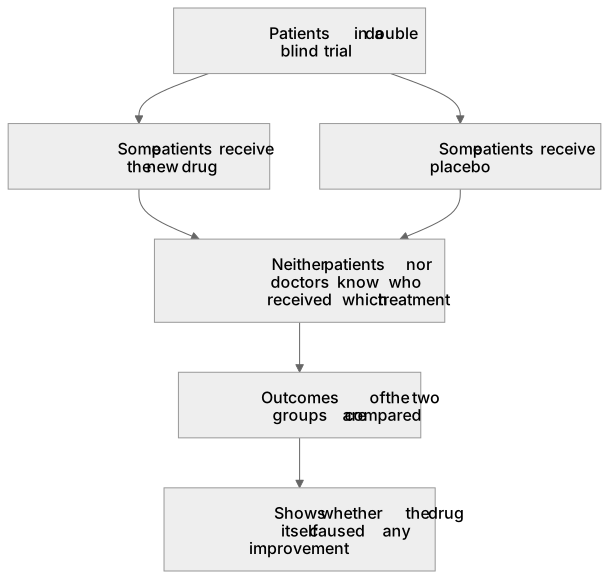
A double blind trial is a way of testing a new medicine fairly. Patients are split into groups: one group receives the new drug, while some patients receive a placebo — a treatment that looks identical but contains no active drug. Neither the patients nor the doctors assessing them know who received which treatment until the trial ends. This removes bias: patients cannot report feeling better simply because they expect the drug to work, and doctors cannot unconsciously favour one group when judging symptoms. For example, in a trial of a new painkiller, some patients swallow tablets containing the drug and others swallow identical dummy tablets. Comparing the two groups shows whether the drug itself, rather than expectation, caused any improvement.
What earns the marks
- A placebo is a dummy treatment with no active drug, made to look, taste and be given in the same way as the real medicine.
- In a double blind trial, neither the patients nor the doctors or researchers assessing them know which treatment each patient received.
- Some patients receive the placebo so their outcomes can be compared with those of patients receiving the new drug.
- The placebo group controls for the psychological effect of expecting to improve, so any real effect of the drug can be identified.
- Keeping patients and assessors unaware of group allocation reduces bias in how symptoms and side effects are reported and judged.
- Ethical trials still allow placebos because patients are informed and consent, and no proven effective treatment is withheld.
Common mistakes and how to put them right
Thinking a placebo contains a low dose of the drug.
Put it right: It contains no active drug at all, so any change in the placebo group is not caused by the medicine.
Confusing double blind with single blind.
Put it right: In a single blind trial only the patients do not know their treatment, whereas in a double blind trial the assessors also do not know.
Assuming everyone in the trial gets a placebo.
Put it right: Only some patients do, and the rest receive the treatment being tested so the groups can be compared.
Exam tips
- Define placebo and double blind separately, then link them in one sentence about fair comparison.
- When asked why a placebo is used, refer to controlling the expectation effect and reducing bias, not just to keeping patients happy.
- Use the phrase 'neither the patients nor the doctors know who received which treatment' to show precise understanding.
Try the lesson
The start of the Discovery and development of drugs: In double blind trials, some patients are given a placebo. lesson, made from checked teaching notes for this specification point.
Have a go first
In a double blind trial, why are some patients given a placebo?
Listen
A double blind trial is a way of testing a new medicine fairly. Patients are split into groups: one group receives the new drug, while some patients receive a placebo — a treatment that looks identical but contains no active drug. Neither the patients nor the doctors assessing them know who received which treatment until the trial ends. This removes bias: patients cannot report feeling better simply because they expect the drug to work, and doctors cannot unconsciously favour one group when judging symptoms. For example, in a trial of a new painkiller, some patients swallow tablets containing the drug and others swallow identical dummy tablets. Comparing the two groups shows whether the drug itself, rather than expectation, caused any improvement. A strong answer earns marks for these points. A placebo is a dummy treatment with no active drug, made to look, taste and be given in the same way as the real medicine. In a double blind trial, neither the patients nor the doctors or researchers assessing them know which treatment each patient received. Some patients receive the placebo so their outcomes can be compared with those of patients receiving the new drug. The placebo group controls for the psychological effect of expecting to improve, so any real effect of the drug can be identified. Exam tip: Define placebo and double blind separately, then link them in one sentence about fair comparison.
See it
Key words
Say what each word means before you turn the card.
Placebo
Try answering aloud or in your head before turning the card.
Double blind trial
Try answering aloud or in your head before turning the card.
See every definition
- Placebo
- A dummy treatment with no active drug, made to look, taste and be given in the same way as the real medicine.
- Double blind trial
- A way of testing a new medicine fairly in which neither the patients nor the doctors or researchers assessing them know which treatment each patient received.
Label the diagram
Some boxes have lost their names. Pick the right name for each number.
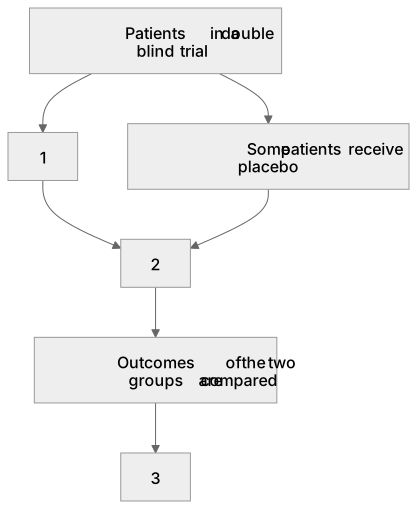
1Box 1
2Box 2
3Box 3
There is more to this lesson
The full lesson goes on to check your understanding and help you earn the marks. Create a free account to carry on, with your progress saved.
A week of Premium from your first lesson · Then the free plan continues · No card, no charge
Test your understanding of Discovery and development of drugs: In double blind trials, some patients are given a placebo.
Active recall beats re-reading. Take an instant quiz now to test what you’ve learned and lock it into long-term memory.
A week of Premium from your first lesson · Then the free plan continues · No card, no charge