AQA · GCSE · Combined Science
Course version: 8464 · Version from Sept 2018
Most new drugs are synthesised by chemists in the pharmaceutical industry.…
Full specification wording
Discovery and development of drugs: Most new drugs are synthesised by chemists in the pharmaceutical industry. However, the starting point may still be a chemical extracted from a plant.
Modern drug discovery usually begins with a target molecule that chemists design and synthesise in a laboratory.
Checked against the AQA 8464 specification (opens in a new tab) on .
- Point 6 of 13
- 4 key terms
Study notes
From the checked teaching notes for this specification point.
The idea
Modern drug discovery usually begins with a target molecule that chemists design and synthesise in a laboratory. Pharmaceutical chemists make many related compounds, test them for useful activity and modify structures to improve effectiveness and reduce side effects. Even so, nature remains an important source of starting points. A chemical extracted from a plant may be purified, its structure determined, and then used as a template for synthesis or chemical modification. For example, willow bark contains salicin, which inspired aspirin, and the rosy periwinkle yields alkaloids used in some cancer treatments. The process involves identifying a lead compound, testing it, and then developing a safe, effective medicine through trials.
What earns the marks
- State that most new drugs are synthesised by chemists in the pharmaceutical industry.
- Describe that chemists design and make new compounds, often by chemical synthesis in a laboratory.
- Explain that a starting point for a new drug may be a chemical extracted from a plant.
- Give a named example, such as salicin from willow bark leading to aspirin, or an alkaloid from the rosy periwinkle.
- Outline that the extracted chemical can be purified, tested and then modified or used as a template for synthesis.
- Recognise that synthesis allows many similar compounds to be made and tested to find the most effective and safest drug.
Common mistakes and how to put them right
Saying all new drugs come directly from plants.
Put it right: Most are synthesised by chemists, but plants can provide starting chemicals.
Confusing synthesis with extraction.
Put it right: Synthesis means making a compound by chemical reactions; extraction means obtaining it from a natural source.
Claiming that a plant chemical is automatically a safe medicine.
Put it right: It must be tested and developed before use.
Writing that pharmaceutical chemists only copy plant chemicals exactly.
Put it right: They often modify the structure to improve the drug.
Exam tips
- Use the phrase 'starting point' to show that a plant chemical may lead to a synthesised drug rather than being the final medicine.
- Name one plant example accurately, such as willow bark and aspirin, to support your answer.
- Distinguish clearly between synthesis in the pharmaceutical industry and extraction from a plant.
- If asked to compare, mention that synthesis allows many variations to be made and tested.
Try the lesson
The start of the Discovery and development of drugs: Most new drugs are synthesised by chemists in the pharmaceutical industry. However, the starting point may still be a chemical extracted from a plant. lesson, made from checked teaching notes for this specification point.
Have a go first
Most new drugs are synthesised by chemists in the pharmaceutical industry. Which statement best describes how a plant chemical is typically used in drug development?
Listen
Modern drug discovery usually begins with a target molecule that chemists design and synthesise in a laboratory. Pharmaceutical chemists make many related compounds, test them for useful activity and modify structures to improve effectiveness and reduce side effects. Even so, nature remains an important source of starting points. A chemical extracted from a plant may be purified, its structure determined, and then used as a template for synthesis or chemical modification. For example, willow bark contains salicin, which inspired aspirin, and the rosy periwinkle yields alkaloids used in some cancer treatments. The process involves identifying a lead compound, testing it, and then developing a safe, effective medicine through trials. A strong answer earns marks for these points. State that most new drugs are synthesised by chemists in the pharmaceutical industry. Describe that chemists design and make new compounds, often by chemical synthesis in a laboratory. Explain that a starting point for a new drug may be a chemical extracted from a plant. Give a named example, such as salicin from willow bark leading to aspirin, or an alkaloid from the rosy periwinkle. A common slip: saying all new drugs come directly from plants. Instead, most are synthesised by chemists, but plants can provide starting chemicals. Exam tip: Use the phrase 'starting point' to show that a plant chemical may lead to a synthesised drug rather than being the final medicine.
See it
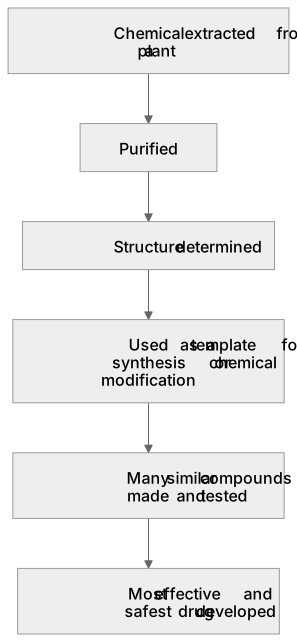
Put it in order
Put these steps in the order they happen.
- 1. Structure determined
- 2. Purified
- 3. Chemical extracted from a plant
- 4. Most effective and safest drug developed
- 5. Many similar compounds made and tested
- 6. Used as a template for synthesis or chemical modification
Key words
Say what each word means before you turn the card.
Drug synthesis in the pharmaceutical industry
Try answering aloud or in your head before turning the card.
Plant-derived starting chemicals
Try answering aloud or in your head before turning the card.
Lead compounds and drug development
Try answering aloud or in your head before turning the card.
Testing and modifying drug molecules
Try answering aloud or in your head before turning the card.
See every definition
- Drug synthesis in the pharmaceutical industry
- Most new drugs are synthesised by chemists in the pharmaceutical industry, meaning they are made by chemical reactions.
- Plant-derived starting chemicals
- A starting point for a new drug may still be a chemical extracted from a plant.
- Lead compounds and drug development
- The process involves identifying a lead compound, testing it, and then developing a safe, effective medicine through trials.
- Testing and modifying drug molecules
- Pharmaceutical chemists make many related compounds, test them for useful activity and modify structures to improve effectiveness and reduce side effects.
Label the diagram
Some boxes have lost their names. Pick the right name for each number.
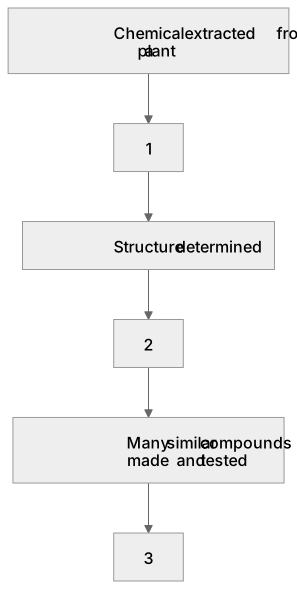
1Box 1
2Box 2
3Box 3
There is more to this lesson
The full lesson goes on to check your understanding and help you earn the marks. Create a free account to carry on, with your progress saved.
A week of Premium from your first lesson · Then the free plan continues · No card, no charge
Test your understanding of Discovery and development of drugs: Most new drugs are synthesised by chemists in the pharmaceutical industry. However, the starting point may still be a chemical extracted from a plant.
Active recall beats re-reading. Take an instant quiz now to test what you’ve learned and lock it into long-term memory.
A week of Premium from your first lesson · Then the free plan continues · No card, no charge