AQA · GCSE · Combined Science
Course version: 8464 · Version from Sept 2018
Penicillin was discovered by Alexander Fleming from the Penicillium mould.
Full specification wording
Discovery and development of drugs: Penicillin was discovered by Alexander Fleming from the Penicillium mould.
In 1928 Alexander Fleming noticed that a mould contaminating a culture plate of bacteria had killed the bacteria around it.
Checked against the AQA 8464 specification (opens in a new tab) on .
- Point 5 of 13
- 4 key terms
Study notes
From the checked teaching notes for this specification point.
The idea
In 1928 Alexander Fleming noticed that a mould contaminating a culture plate of bacteria had killed the bacteria around it. He identified the mould as Penicillium and named the antibacterial substance it produced penicillin. This was the first antibiotic discovered. Fleming did not purify penicillin or turn it into a usable medicine; that required later work by Florey and Chain, who mass-produced it during the 1940s. The discovery shows how a chance observation, followed by careful scientific investigation, can lead to a life-saving drug. Penicillin works by interfering with bacterial cell wall formation, so it kills bacteria without directly damaging human cells. It is effective only against bacteria, not viruses, and some bacteria have evolved resistance, so antibiotics must be used carefully.
What earns the marks
- State that Alexander Fleming discovered penicillin in 1928 from the Penicillium mould.
- Describe that the mould produced a substance that killed bacteria growing on the culture plate.
- Name penicillin as an antibiotic that kills bacteria and is used to treat bacterial infections.
- Recognise that Fleming's discovery was a chance observation followed by scientific investigation.
- Explain that penicillin was later developed into a usable medicine by other scientists, such as Florey and Chain.
- Distinguish between discovery (Fleming) and development or mass production (later scientists).
Common mistakes and how to put them right
Saying Fleming invented or mass-produced penicillin.
Put it right: Fleming discovered penicillin; Florey and Chain later developed it into a medicine.
Claiming penicillin kills viruses.
Put it right: Penicillin is an antibiotic and acts only on bacteria, not viruses.
Stating that Fleming deliberately set out to find an antibiotic.
Put it right: The discovery followed an accidental contamination of a culture plate.
Writing that penicillin was discovered from a bacterium.
Put it right: It was produced by the Penicillium mould.
Exam tips
- Link the scientist to the specific action: Fleming observed, identified the mould and named penicillin.
- Use the word antibiotic correctly and state that it treats bacterial infections.
- If asked about drug development, separate discovery from later purification, testing and mass production.
- Check that you have not written that Fleming made penicillin a usable medicine; credit usually depends on the correct role.
Try the lesson
The start of the Discovery and development of drugs: Penicillin was discovered by Alexander Fleming from the Penicillium mould. lesson, made from checked teaching notes for this specification point.
Have a go first
Which scientist is credited with discovering penicillin from the Penicillium mould?
Listen
In 1928 Alexander Fleming noticed that a mould contaminating a culture plate of bacteria had killed the bacteria around it. He identified the mould as Penicillium and named the antibacterial substance it produced penicillin. This was the first antibiotic discovered. Fleming did not purify penicillin or turn it into a usable medicine; that required later work by Florey and Chain, who mass-produced it during the 1940s. The discovery shows how a chance observation, followed by careful scientific investigation, can lead to a life-saving drug. Penicillin works by interfering with bacterial cell wall formation, so it kills bacteria without directly damaging human cells. It is effective only against bacteria, not viruses, and some bacteria have evolved resistance, so antibiotics must be used carefully. A strong answer earns marks for these points. State that Alexander Fleming discovered penicillin in 1928 from the Penicillium mould. Describe that the mould produced a substance that killed bacteria growing on the culture plate. Name penicillin as an antibiotic that kills bacteria and is used to treat bacterial infections. Recognise that Fleming's discovery was a chance observation followed by scientific investigation. A common slip: saying Fleming invented or mass-produced penicillin. Instead, Fleming discovered penicillin; Florey and Chain later developed it into a medicine. Exam tip: Link the scientist to the specific action: Fleming observed, identified the mould and named penicillin.
See it
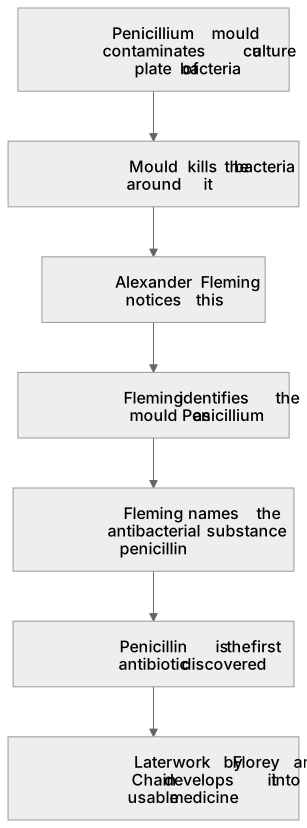
Put it in order
Put these steps in the order they happen.
- 1. Later work by Florey and Chain develops it into a usable medicine
- 2. Penicillin is the first antibiotic discovered
- 3. Alexander Fleming notices this
- 4. Fleming names the antibacterial substance penicillin
- 5. Penicillium mould contaminates a culture plate of bacteria
- 6. Mould kills the bacteria around it
- 7. Fleming identifies the mould as Penicillium
Key words
Say what each word means before you turn the card.
Discovery of antibiotics
Try answering aloud or in your head before turning the card.
Role of Alexander Fleming
Try answering aloud or in your head before turning the card.
Penicillium mould
Try answering aloud or in your head before turning the card.
Bacterial infections and antibiotic action
Try answering aloud or in your head before turning the card.
See every definition
- Discovery of antibiotics
- Penicillin was the first antibiotic discovered, found by Alexander Fleming from the Penicillium mould.
- Role of Alexander Fleming
- He noticed a mould contaminating a culture plate of bacteria had killed the bacteria around it, identified the mould as Penicillium and named the substance penicillin.
- Penicillium mould
- The mould that produced a substance killing bacteria growing on a culture plate, named penicillin by Fleming.
- Bacterial infections and antibiotic action
- Penicillin kills bacteria without directly damaging human cells and is effective only against bacteria, not viruses.
Label the diagram
Some boxes have lost their names. Pick the right name for each number.
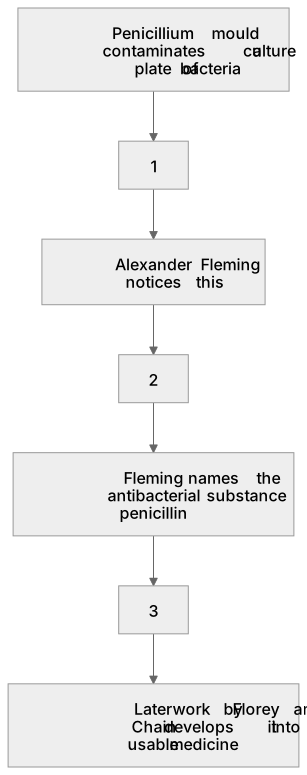
1Box 1
2Box 2
3Box 3
There is more to this lesson
The full lesson goes on to check your understanding and help you earn the marks. Create a free account to carry on, with your progress saved.
A week of Premium from your first lesson · Then the free plan continues · No card, no charge
Test your understanding of Discovery and development of drugs: Penicillin was discovered by Alexander Fleming from the Penicillium mould.
Active recall beats re-reading. Take an instant quiz now to test what you’ve learned and lock it into long-term memory.
A week of Premium from your first lesson · Then the free plan continues · No card, no charge