AQA · GCSE · Combined Science
Course version: 8464 · Version from Sept 2018
Students should be able to describe the process of discovery and…
Full specification wording
Discovery and development of drugs: Students should be able to describe the process of discovery and development of potential new medicines, including preclinical and clinical testing.
New medicines begin with a potential drug, often found by screening thousands of compounds or by modifying a known active molecule.
Checked against the AQA 8464 specification (opens in a new tab) on .
- Point 1 of 13
- 3 key terms
Study notes
From the checked teaching notes for this specification point.
The idea
New medicines begin with a potential drug, often found by screening thousands of compounds or by modifying a known active molecule. Preclinical testing happens before any human exposure: laboratory studies on cells and tissues establish whether the substance works, and tests on animals such as mice or rats assess toxicity, dosage and side effects. If results are promising, clinical testing follows in three stages. Small groups of healthy volunteers check safety and dose; larger groups of patients check effectiveness and side effects; then many patients in trials compare the new drug with existing treatments or a placebo to confirm efficacy. Regulators review the evidence before a licence is granted.
What earns the marks
- Preclinical testing occurs before human trials and uses cells, tissues and whole animals to assess efficacy, toxicity and safe dosage.
- Clinical testing involves healthy volunteers first to check safety and tolerance, then patients to assess effectiveness and side effects.
- Later clinical trials compare the new medicine with existing treatments or a placebo, often using double-blind methods to reduce bias.
- Regulatory approval and licensing follow successful trials before a medicine can be prescribed.
- The whole process is long, costly and strictly regulated to protect participants and patients.
Common mistakes and how to put them right
Thinking clinical testing starts with patients.
Put it right: The first clinical stage normally uses healthy volunteers to check safety, so correct this by stating the sequence safety first, then effectiveness.
Confusing preclinical and clinical stages.
Put it right: Preclinical means laboratory and animal work before humans, so correct this by linking each stage to whether humans are involved.
Assuming a drug is approved once it works in cells.
Put it right: Regulators need evidence from trials, so correct this by adding that licensing follows successful clinical testing.
Exam tips
- Use the words preclinical and clinical correctly and in order, because examiners look for the sequence.
- Give a reason for each stage, such as checking toxicity before human exposure or comparing with a placebo to judge effectiveness.
- Link the stages to the purpose of protecting patients, which shows understanding rather than a list.
Try the lesson
The start of the Discovery and development of drugs: Students should be able to describe the process of discovery and development of potential new medicines, including preclinical and clinical testing. lesson, made from checked teaching notes for this specification point.
Have a go first
In the development of a new medicine, what is tested during preclinical testing?
Listen
New medicines begin with a potential drug, often found by screening thousands of compounds or by modifying a known active molecule. Preclinical testing happens before any human exposure: laboratory studies on cells and tissues establish whether the substance works, and tests on animals such as mice or rats assess toxicity, dosage and side effects. If results are promising, clinical testing follows in three stages. Small groups of healthy volunteers check safety and dose; larger groups of patients check effectiveness and side effects; then many patients in trials compare the new drug with existing treatments or a placebo to confirm efficacy. Regulators review the evidence before a licence is granted. A strong answer earns marks for these points. Preclinical testing occurs before human trials and uses cells, tissues and whole animals to assess efficacy, toxicity and safe dosage. Clinical testing involves healthy volunteers first to check safety and tolerance, then patients to assess effectiveness and side effects. Later clinical trials compare the new medicine with existing treatments or a placebo, often using double-blind methods to reduce bias. Regulatory approval and licensing follow successful trials before a medicine can be prescribed. Exam tip: Use the words preclinical and clinical correctly and in order, because examiners look for the sequence.
See it
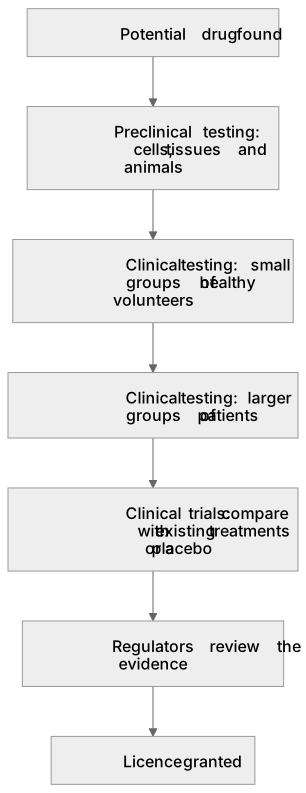
Put it in order
Put these steps in the order they happen.
- 1. Licence granted
- 2. Regulators review the evidence
- 3. Clinical testing: small groups of healthy volunteers
- 4. Clinical trials: compare with existing treatments or a placebo
- 5. Potential drug found
- 6. Preclinical testing: cells, tissues and animals
- 7. Clinical testing: larger groups of patients
Key words
Say what each word means before you turn the card.
Preclinical testing
Try answering aloud or in your head before turning the card.
Clinical testing
Try answering aloud or in your head before turning the card.
Regulation and licensing
Try answering aloud or in your head before turning the card.
See every definition
- Preclinical testing
- Laboratory studies on cells and tissues and tests on animals that happen before any human exposure to assess efficacy, toxicity and safe dosage.
- Clinical testing
- Testing that follows promising preclinical results, starting with small groups of healthy volunteers to check safety and dose, then patients to check effectiveness and side effects.
- Regulation and licensing
- Regulators review the evidence from trials before a licence is granted, and the whole process is strictly regulated to protect participants and patients.
Label the diagram
Some boxes have lost their names. Pick the right name for each number.
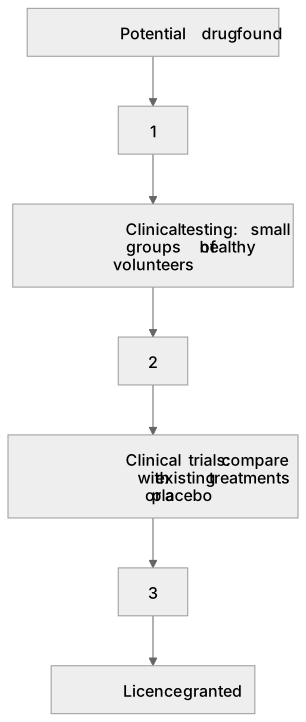
1Box 1
2Box 2
3Box 3
There is more to this lesson
The full lesson goes on to check your understanding and help you earn the marks. Create a free account to carry on, with your progress saved.
A week of Premium from your first lesson · Then the free plan continues · No card, no charge
Test your understanding of Discovery and development of drugs: Students should be able to describe the process of discovery and development of potential new medicines, including preclinical and clinical testing.
Active recall beats re-reading. Take an instant quiz now to test what you’ve learned and lock it into long-term memory.
A week of Premium from your first lesson · Then the free plan continues · No card, no charge