AQA · GCSE · Combined Science
Course version: 8464 · Version from Sept 2018
DNA and the genome: search for genes linked to different types of disease
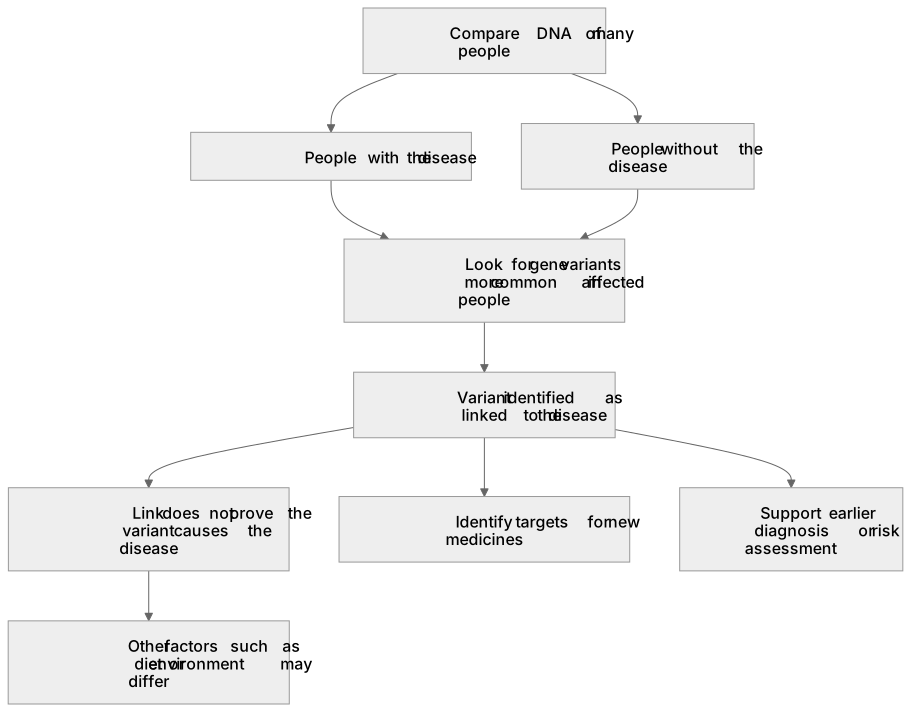
Scientists can compare the DNA of many people to find gene variants that are more common in people with a particular disease.
Checked against the AQA 8464 specification (opens in a new tab) on .
- Point 6 of 8
- 3 key terms
Study notes
From the checked teaching notes for this specification point.
The idea
Scientists can compare the DNA of many people to find gene variants that are more common in people with a particular disease. This is a search for correlations: a gene variant is identified as linked to a disease when it appears more often in affected people than in unaffected people. For example, researchers might compare the genomes of thousands of people with type 2 diabetes and thousands without it, then look for variants that are over-represented in the first group. A link does not prove that the variant causes the disease, because other factors such as diet or environment may also differ. The search helps identify targets for new medicines and can support earlier diagnosis or risk assessment.
What earns the marks
- Describes comparing DNA sequences or gene variants between people with and without a disease.
- Explains that a gene is linked to a disease when a variant is more common in affected individuals.
- Recognises that a statistical link does not by itself prove causation.
- Gives a valid purpose, such as identifying drug targets, improving diagnosis or estimating risk.
- Uses a specific disease example, such as type 2 diabetes or breast cancer, to illustrate the method.
Common mistakes and how to put them right
Claiming that finding a linked gene proves the gene causes the disease.
Put it right: State that the evidence shows an association that may involve other factors.
Confusing the search for linked genes with gene therapy.
Put it right: The search identifies candidate genes, whereas gene therapy aims to treat a disorder.
Describing only one person's genome.
Put it right: The method relies on comparing data from many people in different groups.
Exam tips
- Use comparative language such as more common in people with the disease than without it.
- Name a disease and state what the researchers compare, so the method is clear.
- Add a sentence about why the link is useful, for example to guide development of medicines.
Try the lesson
The start of the DNA and the genome: search for genes linked to different types of disease lesson, made from checked teaching notes for this specification point.
Have a go first
What is the main purpose of searching for genes linked to different types of disease?
Listen
Scientists can compare the DNA of many people to find gene variants that are more common in people with a particular disease. This is a search for correlations: a gene variant is identified as linked to a disease when it appears more often in affected people than in unaffected people. For example, researchers might compare the genomes of thousands of people with type 2 diabetes and thousands without it, then look for variants that are over-represented in the first group. A link does not prove that the variant causes the disease, because other factors such as diet or environment may also differ. The search helps identify targets for new medicines and can support earlier diagnosis or risk assessment. A strong answer earns marks for these points. Describes comparing DNA sequences or gene variants between people with and without a disease. Explains that a gene is linked to a disease when a variant is more common in affected individuals. Recognises that a statistical link does not by itself prove causation. Gives a valid purpose, such as identifying drug targets, improving diagnosis or estimating risk. A common slip: Claiming that finding a linked gene proves the gene causes the disease. Instead, state that the evidence shows an association that may involve other factors. Exam tip: Use comparative language such as more common in people with the disease than without it.
See it
Key words
Say what each word means before you turn the card.
Disease-associated gene variants
Try answering aloud or in your head before turning the card.
Correlation and causation
Try answering aloud or in your head before turning the card.
Medical applications of genetics
Try answering aloud or in your head before turning the card.
See every definition
- Disease-associated gene variants
- Gene variants that are more common in people with a particular disease than in people without it.
- Correlation and causation
- A statistical link does not prove that the variant causes the disease, because other factors such as diet or environment may also differ.
- Medical applications of genetics
- The search helps identify targets for new medicines and can support earlier diagnosis or risk assessment.
Label the diagram
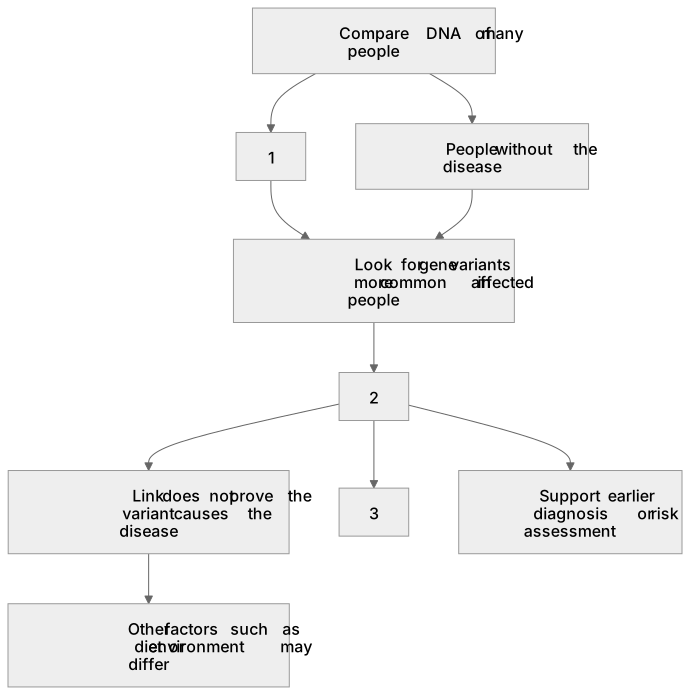
Some boxes have lost their names. Pick the right name for each number.
1Box 1
2Box 2
3Box 3
There is more to this lesson
The full lesson goes on to check your understanding and help you earn the marks. Create a free account to carry on, with your progress saved.
A week of Premium from your first lesson · Then the free plan continues · No card, no charge
Test your understanding of DNA and the genome: search for genes linked to different types of disease
Active recall beats re-reading. Take an instant quiz now to test what you’ve learned and lock it into long-term memory.
A week of Premium from your first lesson · Then the free plan continues · No card, no charge