AQA · GCSE · Combined Science
Course version: 8464 · Version from Sept 2018
The genome of an organism is the entire genetic material of that organism.…
Full specification wording
DNA and the genome: The genome of an organism is the entire genetic material of that organism. The whole human genome has now been studied and this will have great importance for medicine in the future.
The genome is the complete set of genetic material in an organism.
Checked against the AQA 8464 specification (opens in a new tab) on .
- Point 4 of 8
- 4 key terms
Study notes
From the checked teaching notes for this specification point.
The idea
The genome is the complete set of genetic material in an organism. In humans this means all the DNA in the 46 chromosomes of a body cell, including the roughly 20 000 protein-coding genes plus non-coding DNA. The Human Genome Project sequenced the whole human genome, base by base, and the reference sequence is now available. Understanding it matters for medicine: it helps identify genes linked to inherited disorders such as cystic fibrosis, supports genetic testing and counselling, guides the design of medicines matched to a patient's genotype, and reveals how some diseases arise. It also raises ethical questions about privacy and insurance.
What earns the marks
- Defines the genome as the entire genetic material of an organism, not just the genes that code for proteins.
- States that the human genome is contained in the DNA of the chromosomes, 46 in a typical human body cell.
- Recalls that the whole human genome has been sequenced and that the sequence is stored as a reference.
- Explains at least one medical benefit, such as identifying genes linked to inherited disorders, enabling genetic testing, or matching medicines to a patient's genotype.
- Recognises that the genome includes non-coding DNA as well as protein-coding genes.
- Uses the term genome accurately rather than confusing it with a single gene or a chromosome.
Common mistakes and how to put them right
Saying the genome is a single gene or one chromosome.
Put it right: It is the entire genetic material of the organism.
Claiming the genome is only the protein-coding DNA.
Put it right: It includes non-coding DNA too.
Stating that studying the genome will cure all diseases.
Put it right: It improves understanding, testing and treatment options, but does not guarantee cures.
Exam tips
- Define genome in one precise sentence before adding medical examples.
- Link each medical benefit to a named situation, such as testing for a faulty allele linked to cystic fibrosis.
- If asked about the future, use cautious wording such as 'could help' or 'may allow' rather than absolute claims.
Try the lesson
The start of the DNA and the genome: The genome of an organism is the entire genetic material of that organism. The whole human genome has now been studied and this will have great importance for medicine in the future. lesson, made from checked teaching notes for this specification point.
Have a go first
What name is given to the entire genetic material of an organism?
Listen
The genome is the complete set of genetic material in an organism. In humans this means all the DNA in the 46 chromosomes of a body cell, including the roughly 20 000 protein-coding genes plus non-coding DNA. The Human Genome Project sequenced the whole human genome, base by base, and the reference sequence is now available. Understanding it matters for medicine: it helps identify genes linked to inherited disorders such as cystic fibrosis, supports genetic testing and counselling, guides the design of medicines matched to a patient's genotype, and reveals how some diseases arise. It also raises ethical questions about privacy and insurance. A strong answer earns marks for these points. Defines the genome as the entire genetic material of an organism, not just the genes that code for proteins. States that the human genome is contained in the DNA of the chromosomes, 46 in a typical human body cell. Recalls that the whole human genome has been sequenced and that the sequence is stored as a reference. Explains at least one medical benefit, such as identifying genes linked to inherited disorders, enabling genetic testing, or matching medicines to a patient's genotype. A common slip: Saying the genome is a single gene or one chromosome. Instead, it is the entire genetic material of the organism. Exam tip: Define genome in one precise sentence before adding medical examples.
See it
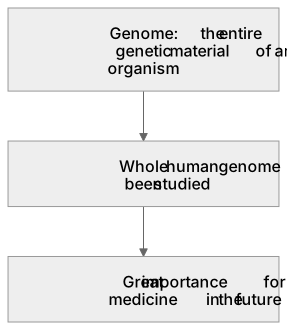
Put it in order
Put these steps in the order they happen.
- 1. Whole human genome has been studied
- 2. Great importance for medicine in the future
- 3. Genome: the entire genetic material of an organism
Key words
Say what each word means before you turn the card.
Genome
Try answering aloud or in your head before turning the card.
Human genome
Try answering aloud or in your head before turning the card.
Medical applications of genetics
Try answering aloud or in your head before turning the card.
Ethics of genetic information
Try answering aloud or in your head before turning the card.
See every definition
- Genome
- The entire genetic material of an organism, including non-coding DNA as well as protein-coding genes.
- Human genome
- The whole human genome has now been studied and sequenced, base by base, and stored as a reference sequence.
- Medical applications of genetics
- Understanding the genome will have great importance for medicine in the future, such as identifying genes linked to inherited disorders and matching medicines to a patient's genotype.
- Ethics of genetic information
- Studying the genome raises ethical questions about privacy and insurance.
Label the diagram
Some boxes have lost their names. Pick the right name for each number.
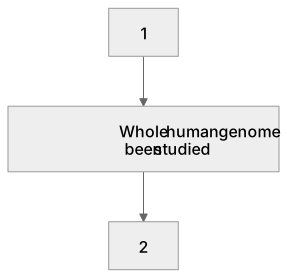
1Box 1
2Box 2
There is more to this lesson
The full lesson goes on to check your understanding and help you earn the marks. Create a free account to carry on, with your progress saved.
A week of Premium from your first lesson · Then the free plan continues · No card, no charge
Test your understanding of DNA and the genome: The genome of an organism is the entire genetic material of that organism. The whole human genome has now been studied and this will have great importance for medicine in the future.
Active recall beats re-reading. Take an instant quiz now to test what you’ve learned and lock it into long-term memory.
A week of Premium from your first lesson · Then the free plan continues · No card, no charge