AQA · GCSE · Combined Science
Course version: 8464 · Version from Sept 2018
Extinctions occur when there are no remaining individuals of a species…
Full specification wording
Extinction: Extinctions occur when there are no remaining individuals of a species still alive.
Extinction is the permanent loss of a species: it occurs when there are no remaining individuals of that species still alive anywhere.
Checked against the AQA 8464 specification (opens in a new tab) on .
- Point 1 of 2
- 4 key terms
Study notes
From the checked teaching notes for this specification point.
The idea
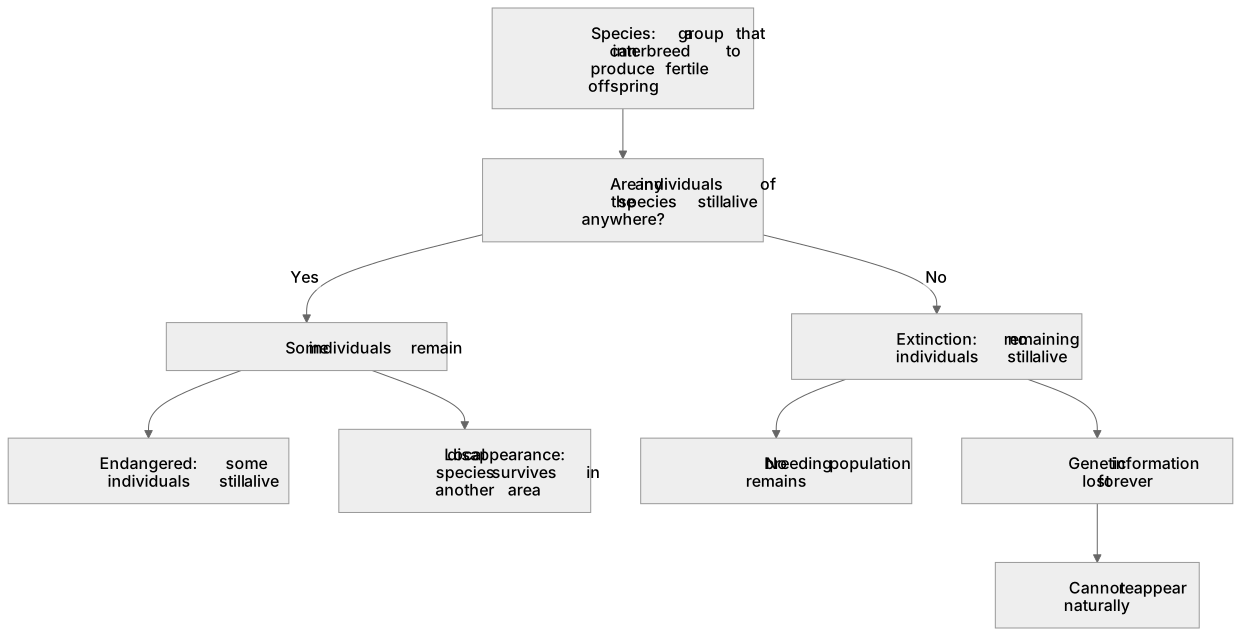
Extinction is the permanent loss of a species: it occurs when there are no remaining individuals of that species still alive anywhere. A species is a group of organisms that can interbreed to produce fertile offspring, so extinction means every member of that group has died and no breeding population remains. For example, if the last pair of a bird species dies without producing surviving offspring, the species is extinct. Extinction differs from a local disappearance, where individuals survive elsewhere, and from endangerment, where some individuals remain. Once a species is extinct, its genetic information is lost forever and it cannot reappear naturally.
What earns the marks
- States that extinction means no individuals of the species remain alive anywhere.
- Distinguishes extinction from endangerment, where some individuals of the species are still alive.
- Distinguishes extinction from local disappearance, where the species survives in another area.
- Uses the idea of a species as a breeding group, so extinction occurs when no breeding population remains.
- Applies the definition to an example, such as the death of the last known individual of a species.
Common mistakes and how to put them right
Saying a species is extinct when it is only endangered.
Put it right by noting that endangered species still have living individuals.
Confusing extinction with a local disappearance.
Put it right by checking whether any individuals survive elsewhere.
Thinking an extinct species can reappear naturally.
Put it right by explaining that extinction is permanent because the genetic information is lost.
Exam tips
- Define extinction precisely using the phrase 'no remaining individuals of a species still alive'.
- Contrast extinction with endangerment in one sentence to show secure understanding.
- Use a named or described example to make the definition concrete.
Try the lesson
The start of the Extinction: Extinctions occur when there are no remaining individuals of a species still alive. lesson, made from checked teaching notes for this specification point.
Have a go first
A species of bird is described as extinct. Which statement best describes the meaning of extinct?
Listen
Extinction is the permanent loss of a species: it occurs when there are no remaining individuals of that species still alive anywhere. A species is a group of organisms that can interbreed to produce fertile offspring, so extinction means every member of that group has died and no breeding population remains. For example, if the last pair of a bird species dies without producing surviving offspring, the species is extinct. Extinction differs from a local disappearance, where individuals survive elsewhere, and from endangerment, where some individuals remain. Once a species is extinct, its genetic information is lost forever and it cannot reappear naturally. A strong answer earns marks for these points. States that extinction means no individuals of the species remain alive anywhere. Distinguishes extinction from endangerment, where some individuals of the species are still alive. Distinguishes extinction from local disappearance, where the species survives in another area. Uses the idea of a species as a breeding group, so extinction occurs when no breeding population remains. A common slip: Saying a species is extinct when it is only endangered. Instead, noting that endangered species still have living individuals. Exam tip: Define extinction precisely using the phrase 'no remaining individuals of a species still alive'.
See it
Key words
Say what each word means before you turn the card.
Extinction
Try answering aloud or in your head before turning the card.
Endangerment
Try answering aloud or in your head before turning the card.
Local disappearance
Try answering aloud or in your head before turning the card.
Species
Try answering aloud or in your head before turning the card.
See every definition
- Extinction
- Occurs when there are no remaining individuals of a species still alive anywhere.
- Endangerment
- A situation where some individuals of the species remain alive, unlike extinction.
- Local disappearance
- A situation where individuals survive elsewhere, differing from extinction.
- Species
- A group of organisms that can interbreed to produce fertile offspring, so extinction means no breeding population remains.
Label the diagram
Some boxes have lost their names. Pick the right name for each number.
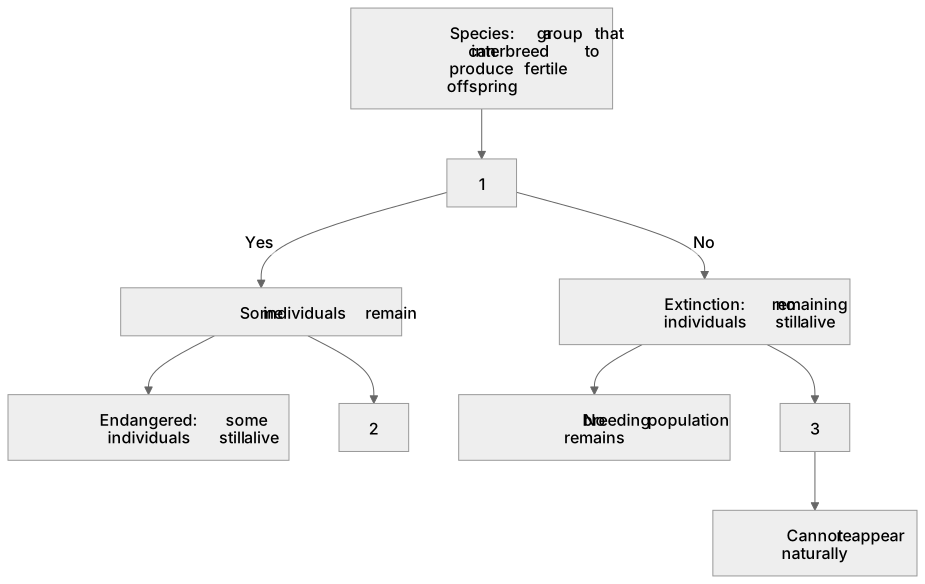
1Box 1
2Box 2
3Box 3
There is more to this lesson
The full lesson goes on to check your understanding and help you earn the marks. Create a free account to carry on, with your progress saved.
A week of Premium from your first lesson · Then the free plan continues · No card, no charge
Test your understanding of Extinction: Extinctions occur when there are no remaining individuals of a species still alive.
Active recall beats re-reading. Take an instant quiz now to test what you’ve learned and lock it into long-term memory.
A week of Premium from your first lesson · Then the free plan continues · No card, no charge