AQA · GCSE · Combined Science
Course version: 8464 · Version from Sept 2018
Students should be able to describe factors which may contribute to the…
Full specification wording
Extinction: Students should be able to describe factors which may contribute to the extinction of a species.
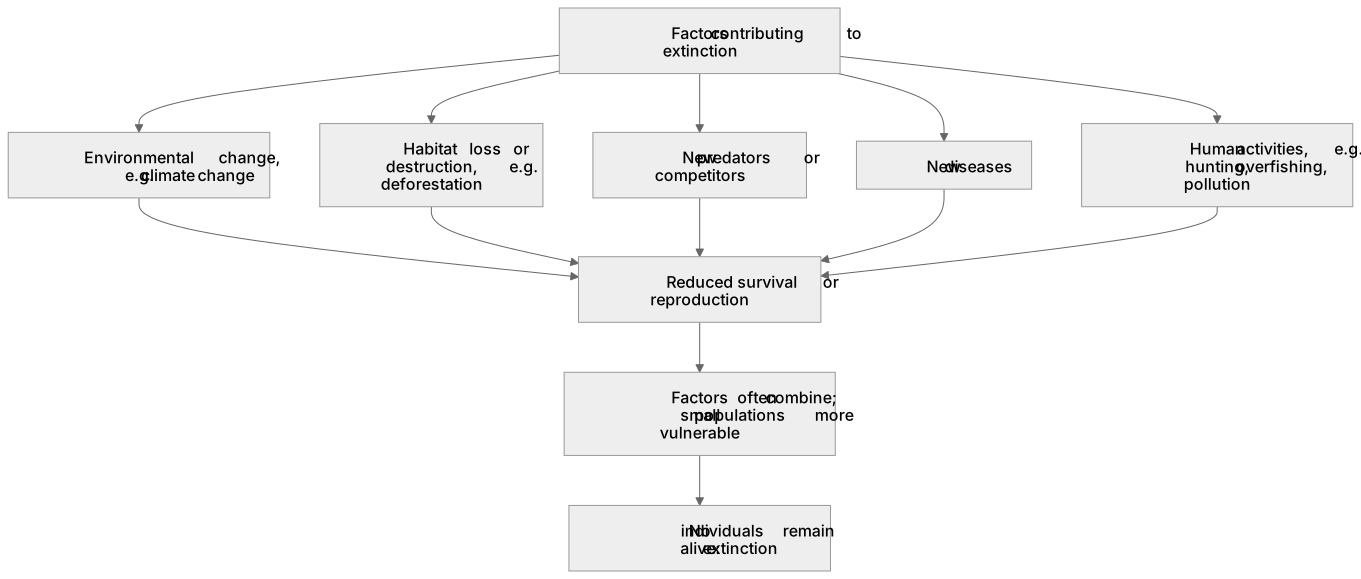
Many factors can contribute to extinction by reducing a species' population until no individuals remain alive.
Checked against the AQA 8464 specification (opens in a new tab) on .
- Point 2 of 2
- 4 key terms
Study notes
From the checked teaching notes for this specification point.
The idea
Many factors can contribute to extinction by reducing a species' population until no individuals remain alive. These include environmental changes such as climate change, habitat loss and pollution; new predators or competitors; new diseases; and hunting or overexploitation by humans. A single factor may be enough, but often several combine. For example, deforestation removes nesting sites and food, while a new predator or disease may then kill the survivors. Small populations are especially at risk because they have less genetic variation and are more vulnerable to chance events. Describing factors means explaining how each one reduces numbers or survival until the species dies out.
What earns the marks
- Describes environmental change, such as climate change, as a factor that can make conditions unsuitable for a species.
- Describes habitat loss or destruction, such as deforestation, as removing food, shelter or breeding sites.
- Describes the introduction of new predators or competitors that reduce survival or resources.
- Describes new diseases that can spread rapidly through a population and cause many deaths.
- Describes human activities such as hunting, overfishing or pollution that reduce population numbers.
- Explains that several factors can act together and that small populations are more vulnerable.
Common mistakes and how to put them right
Listing factors without explaining how they lead to extinction.
Put it right by linking each factor to reduced survival or reproduction.
Assuming only one factor can cause extinction.
Put it right by noting that factors often combine.
Confusing extinction with a temporary population decrease.
Put it right by explaining that extinction requires no individuals to remain alive.
Exam tips
- Use the command word 'describe' by giving a clear account of each factor and its effect.
- Include at least three different factors to show breadth.
- Link each factor to a reduction in the number of individuals until none remain.
Try the lesson
The start of the Extinction: Students should be able to describe factors which may contribute to the extinction of a species. lesson, made from checked teaching notes for this specification point.
Have a go first
Which factor may contribute to the extinction of a species by destroying the places where it lives?
Listen
Many factors can contribute to extinction by reducing a species' population until no individuals remain alive. These include environmental changes such as climate change, habitat loss and pollution; new predators or competitors; new diseases; and hunting or overexploitation by humans. A single factor may be enough, but often several combine. For example, deforestation removes nesting sites and food, while a new predator or disease may then kill the survivors. Small populations are especially at risk because they have less genetic variation and are more vulnerable to chance events. Describing factors means explaining how each one reduces numbers or survival until the species dies out. A strong answer earns marks for these points. Describes environmental change, such as climate change, as a factor that can make conditions unsuitable for a species. Describes habitat loss or destruction, such as deforestation, as removing food, shelter or breeding sites. Describes the introduction of new predators or competitors that reduce survival or resources. Describes new diseases that can spread rapidly through a population and cause many deaths. A common slip: Listing factors without explaining how they lead to extinction. Instead, linking each factor to reduced survival or reproduction. Exam tip: Use the command word 'describe' by giving a clear account of each factor and its effect.
See it
Key words
Say what each word means before you turn the card.
Environmental change
Try answering aloud or in your head before turning the card.
Habitat loss
Try answering aloud or in your head before turning the card.
Human impact
Try answering aloud or in your head before turning the card.
Vulnerability of small populations
Try answering aloud or in your head before turning the card.
See every definition
- Environmental change
- A change such as climate change that can make conditions unsuitable for a species.
- Habitat loss
- Loss or destruction of habitat, such as deforestation, which removes food, shelter or breeding sites.
- Human impact
- Human activities such as hunting, overfishing or pollution that reduce population numbers.
- Vulnerability of small populations
- Small populations are more vulnerable because they have less genetic variation and are more exposed to chance events.
Label the diagram
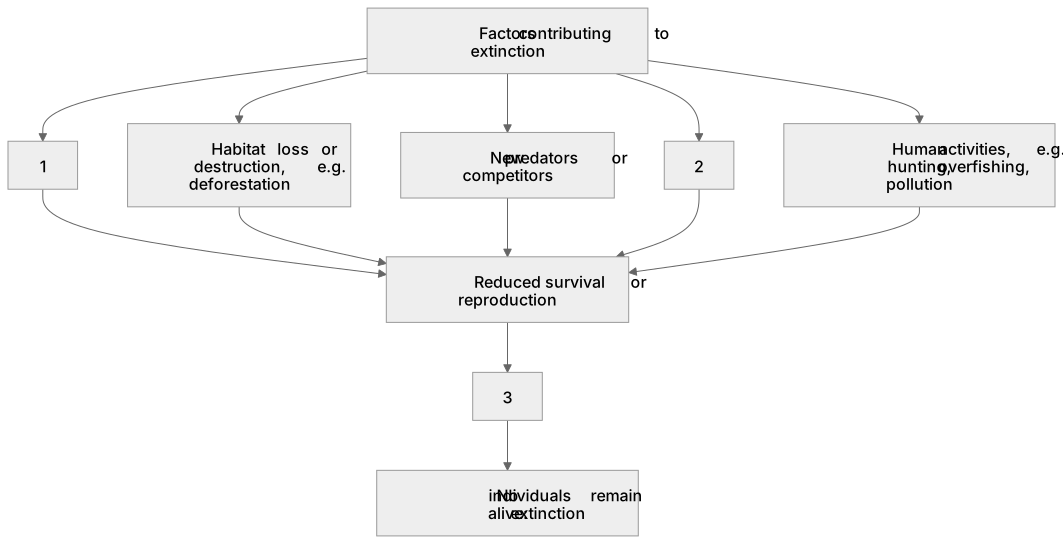
Some boxes have lost their names. Pick the right name for each number.
1Box 1
2Box 2
3Box 3
There is more to this lesson
The full lesson goes on to check your understanding and help you earn the marks. Create a free account to carry on, with your progress saved.
A week of Premium from your first lesson · Then the free plan continues · No card, no charge
Test your understanding of Extinction: Students should be able to describe factors which may contribute to the extinction of a species.
Active recall beats re-reading. Take an instant quiz now to test what you’ve learned and lock it into long-term memory.
A week of Premium from your first lesson · Then the free plan continues · No card, no charge