AQA · GCSE · Combined Science
Course version: 8464 · Version from Sept 2018
Adverse road conditions include wet or icy conditions. Poor condition of…
Full specification wording
Factors affecting braking distance 1: Adverse road conditions include wet or icy conditions. Poor condition of the vehicle is limited to the vehicle's brakes or tyres.
Adverse road conditions include wet or icy conditions, but can also include snow or mud.
Checked against the AQA 8464 specification (opens in a new tab) on .
- Point 2 of 4
- 2 key terms
Study notes
From the checked teaching notes for this specification point.
The idea
Adverse road conditions include wet or icy conditions, but can also include snow or mud. These conditions reduce the friction between the tyres and the road. On a wet road, a film of water weakens the grip; on ice, the surface is extremely slippery, so grip is even lower. Poor vehicle condition is strictly limited to the brakes or the tyres. Worn brake pads or discs reduce the braking force. Worn tyres (lacking tread) or under-inflated tyres have poor grip and reduce braking effectiveness. In these cases, the braking force or friction is smaller than it should be, so the vehicle decelerates more slowly and the braking distance increases. Other factors, such as driver tiredness or alcohol, affect thinking distance rather than braking distance.
What earns the marks
- State that adverse road conditions include wet or icy conditions, which reduce friction between the tyres and the road surface.
- State that poor vehicle condition in this specification is limited to the brakes and the tyres.
- Explain that worn brakes reduce the braking force applied to the wheels.
- Explain that worn or under-inflated tyres reduce grip and braking effectiveness, leading to an increased braking distance.
- Differentiate between factors affecting braking distance (e.g., road and vehicle conditions) and those affecting thinking distance (e.g., tiredness, alcohol).
- Conclude that reduced friction or braking force results in a lower deceleration, meaning the vehicle travels further before stopping.
Common mistakes and how to put them right
Stating that under-inflated tyres reduce the contact area with the road.
Put it right by noting that under-inflation actually increases contact area but distorts the tread profile, reducing grip and braking effectiveness.
Including a faulty engine, dirty windscreen or poor suspension as poor vehicle condition.
Put it right by limiting poor vehicle condition to brakes or tyres as per the specification.
Exam tips
- Use the exact wording 'brakes or tyres' when discussing poor vehicle condition, as the specification limits it to these.
- For each condition, name the effect on friction or braking force and then state the effect on braking distance.
- If a question asks about stopping distance, clearly separate the thinking-distance factors from the braking-distance factors.
Try the lesson
The start of the Factors affecting braking distance 1: Adverse road conditions include wet or icy conditions. Poor condition of the vehicle is limited to the vehicle's brakes or tyres. lesson, made from checked teaching notes for this specification point.
Have a go first
Which of these is an adverse road condition that increases braking distance?
Listen
Adverse road conditions include wet or icy conditions, but can also include snow or mud. These conditions reduce the friction between the tyres and the road. On a wet road, a film of water weakens the grip; on ice, the surface is extremely slippery, so grip is even lower. Poor vehicle condition is strictly limited to the brakes or the tyres. Worn brake pads or discs reduce the braking force. Worn tyres (lacking tread) or under-inflated tyres have poor grip and reduce braking effectiveness. In these cases, the braking force or friction is smaller than it should be, so the vehicle decelerates more slowly and the braking distance increases. Other factors, such as driver tiredness or alcohol, affect thinking distance rather than braking distance. A strong answer earns marks for these points. State that adverse road conditions include wet or icy conditions, which reduce friction between the tyres and the road surface. State that poor vehicle condition in this specification is limited to the brakes and the tyres. Explain that worn brakes reduce the braking force applied to the wheels. Explain that worn or under-inflated tyres reduce grip and braking effectiveness, leading to an increased braking distance. A common slip: Believing adverse road conditions are strictly limited to wet or icy conditions. Instead, recognising the specification says they 'include' wet or icy conditions, so snow or mud are also valid. Exam tip: Use the exact wording 'brakes or tyres' when discussing poor vehicle condition, as the specification limits it to these.
See it
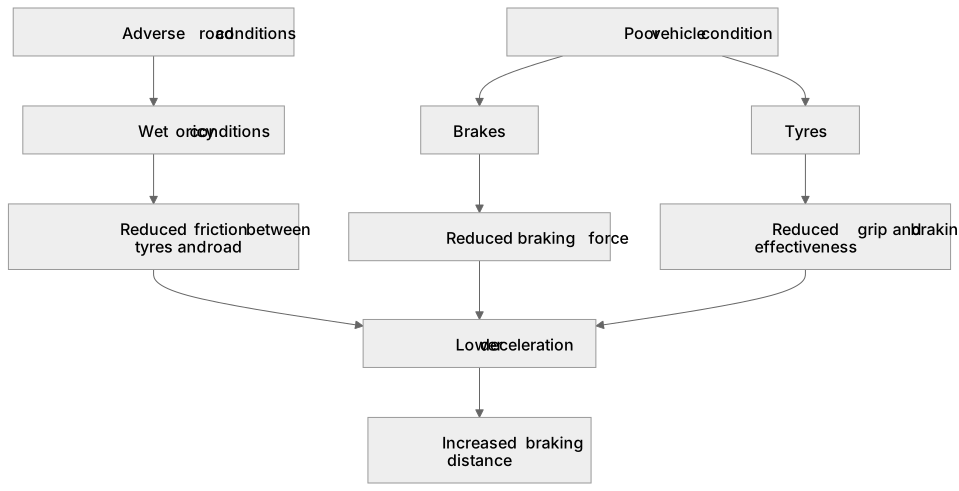
Key words
Say what each word means before you turn the card.
Adverse road conditions
Try answering aloud or in your head before turning the card.
Poor vehicle condition
Try answering aloud or in your head before turning the card.
See every definition
- Adverse road conditions
- Conditions that include wet or icy conditions, and can also include snow or mud, which reduce the friction between the tyres and the road.
- Poor vehicle condition
- A condition strictly limited to the vehicle's brakes or tyres, where worn brakes reduce the braking force and worn or under-inflated tyres have poor grip.
Label the diagram
Some boxes have lost their names. Pick the right name for each number.
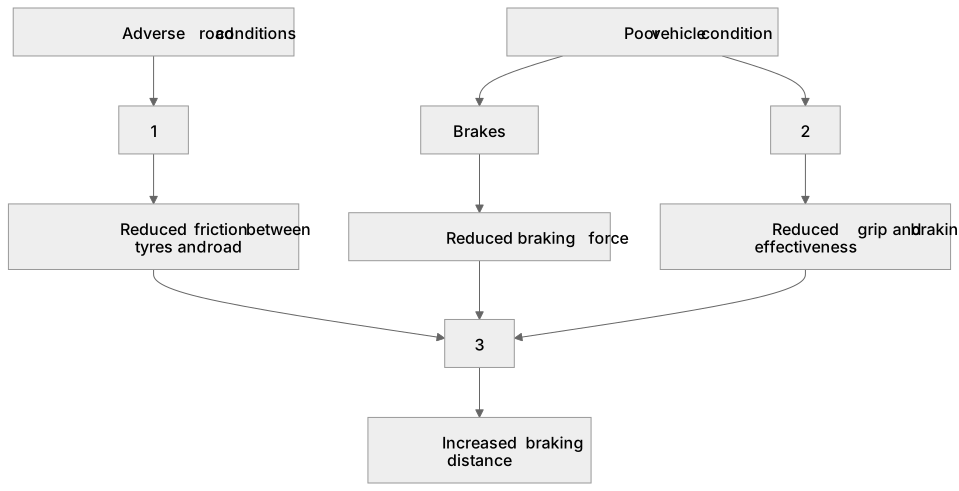
1Box 1
2Box 2
3Box 3
There is more to this lesson
The full lesson goes on to check your understanding and help you earn the marks. Create a free account to carry on, with your progress saved.
A week of Premium from your first lesson · Then the free plan continues · No card, no charge
Test your understanding of Factors affecting braking distance 1: Adverse road conditions include wet or icy conditions. Poor condition of the vehicle is limited to the vehicle's brakes or tyres.
Active recall beats re-reading. Take an instant quiz now to test what you’ve learned and lock it into long-term memory.
A week of Premium from your first lesson · Then the free plan continues · No card, no charge