AQA · GCSE · Combined Science
Course version: 8464 · Version from Sept 2018
The braking distance of a vehicle can be affected by adverse road and…
Full specification wording
Factors affecting braking distance 1: The braking distance of a vehicle can be affected by adverse road and weather conditions and poor condition of the vehicle.
Braking distance is the distance travelled between the driver applying the brakes and the vehicle coming to rest.
Checked against the AQA 8464 specification (opens in a new tab) on .
- Point 1 of 4
- 3 key terms
Study notes
From the checked teaching notes for this specification point.
The idea
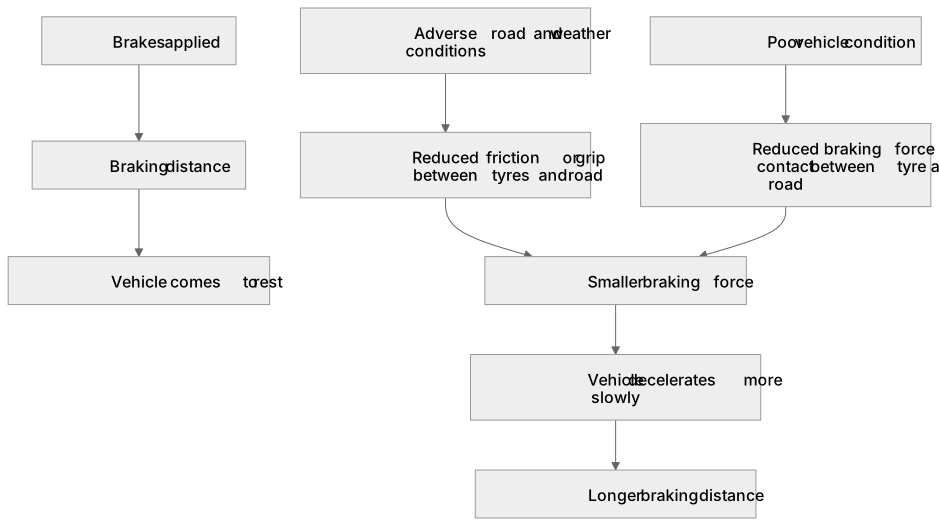
Braking distance is the distance travelled between the driver applying the brakes and the vehicle coming to rest. It is not the same as thinking distance, which is covered before the brakes are applied. Braking distance depends on how quickly the brakes can remove the vehicle's kinetic energy, so it increases whenever the friction between the tyres and the road is reduced or the braking system is less effective. Adverse road and weather conditions, such as a wet or icy surface, reduce friction, so the tyres grip less and the vehicle takes longer to stop. Poor vehicle condition, such as worn brake pads or badly worn or under-inflated tyres, also reduces the braking force available.
For example: On ice the same car at the same speed can have a much longer braking distance than on dry tarmac.
What earns the marks
- Braking distance is the distance travelled from the point the brakes are applied until the vehicle stops.
- Adverse road and weather conditions reduce the friction or grip between the tyres and the road surface.
- Reduced grip means the braking force is smaller, so the vehicle decelerates more slowly and travels further before stopping.
- Poor vehicle condition, such as worn brakes or worn or under-inflated tyres, reduces the braking force or the contact between tyre and road.
- A correct comparison should keep speed and reaction time the same and change only the road, weather or vehicle condition.
- Braking distance is a component of stopping distance, which is thinking distance plus braking distance.
Common mistakes and how to put them right
Confusing braking distance with stopping distance.
Put it right: Braking distance starts when the brakes are applied, whereas stopping distance also includes the thinking distance travelled before braking.
Thinking that ice increases friction.
Put it right: Ice reduces friction, so the braking force is smaller and the braking distance is longer.
Assuming that a heavier vehicle always has a shorter braking distance.
Put it right: Extra mass increases kinetic energy to be removed, and poor brakes or tyres can make braking distance longer.
Exam tips
- Define braking distance precisely before explaining the effect, so the examiner can see you are not describing thinking distance.
- Link each factor to a change in friction or braking force, then to a change in deceleration and distance.
- When comparing conditions, state that speed and reaction time are controlled so the comparison is fair.
Try the lesson
The start of the Factors affecting braking distance 1: The braking distance of a vehicle can be affected by adverse road and weather conditions and poor condition of the vehicle. lesson, made from checked teaching notes for this specification point.
Have a go first
A car is travelling along a road when the driver applies the brakes. Which of these conditions would increase the braking distance of the car?
Listen
Braking distance is the distance travelled between the driver applying the brakes and the vehicle coming to rest. It is not the same as thinking distance, which is covered before the brakes are applied. Braking distance depends on how quickly the brakes can remove the vehicle's kinetic energy, so it increases whenever the friction between the tyres and the road is reduced or the braking system is less effective. Adverse road and weather conditions, such as a wet or icy surface, reduce friction, so the tyres grip less and the vehicle takes longer to stop. Poor vehicle condition, such as worn brake pads or badly worn or under-inflated tyres, also reduces the braking force available. For example, on ice the same car at the same speed can have a much longer braking distance than on dry tarmac. A strong answer earns marks for these points. Braking distance is the distance travelled from the point the brakes are applied until the vehicle stops. Adverse road and weather conditions reduce the friction or grip between the tyres and the road surface. Reduced grip means the braking force is smaller, so the vehicle decelerates more slowly and travels further before stopping. Poor vehicle condition, such as worn brakes or worn or under-inflated tyres, reduces the braking force or the contact between tyre and road. Exam tip: Define braking distance precisely before explaining the effect, so the examiner can see you are not describing thinking distance.
See it
Key words
Say what each word means before you turn the card.
Braking distance
Try answering aloud or in your head before turning the card.
Adverse road and weather conditions
Try answering aloud or in your head before turning the card.
Poor vehicle condition
Try answering aloud or in your head before turning the card.
See every definition
- Braking distance
- The distance travelled between the driver applying the brakes and the vehicle coming to rest.
- Adverse road and weather conditions
- Conditions such as a wet or icy surface that reduce friction, so the tyres grip less and the vehicle takes longer to stop.
- Poor vehicle condition
- Condition such as worn brake pads or badly worn or under-inflated tyres, which reduces the braking force available.
Label the diagram
Some boxes have lost their names. Pick the right name for each number.
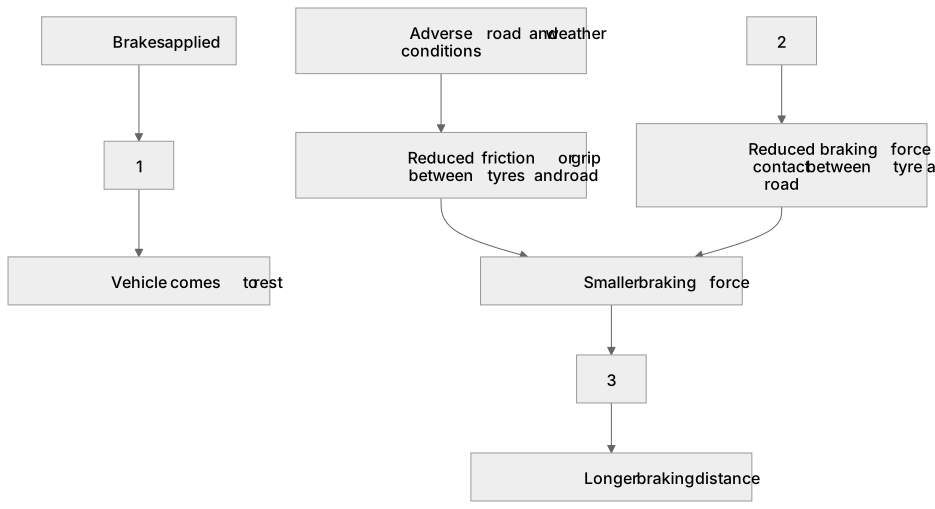
1Box 1
2Box 2
3Box 3
There is more to this lesson
The full lesson goes on to check your understanding and help you earn the marks. Create a free account to carry on, with your progress saved.
A week of Premium from your first lesson · Then the free plan continues · No card, no charge
Test your understanding of Factors affecting braking distance 1: The braking distance of a vehicle can be affected by adverse road and weather conditions and poor condition of the vehicle.
Active recall beats re-reading. Take an instant quiz now to test what you’ve learned and lock it into long-term memory.
A week of Premium from your first lesson · Then the free plan continues · No card, no charge