AQA · GCSE · Combined Science
Course version: 8464 · Version from Sept 2018
Thyroxine levels are controlled by negative feedback. WS 1.2, MS 2c
Full specification wording
Feedback systems (HT only): Thyroxine levels are controlled by negative feedback. WS 1.2, MS 2c
Thyroxine concentration in the blood is kept within a narrow range by negative feedback.
Checked against the AQA 8464 specification (opens in a new tab) on .
- Point 4 of 4
- 4 key terms
Study notes
From the checked teaching notes for this specification point.
The idea
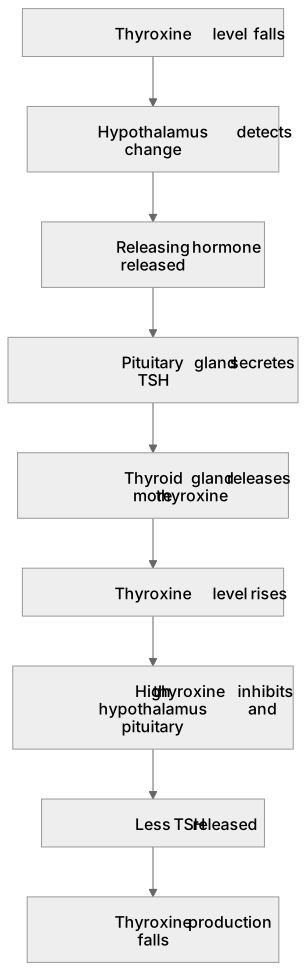
Thyroxine concentration in the blood is kept within a narrow range by negative feedback. When the level falls, the hypothalamus detects the change and releases a releasing hormone; the pituitary gland responds by secreting thyroid-stimulating hormone (TSH), which makes the thyroid gland release more thyroxine. As thyroxine rises, it inhibits the hypothalamus and pituitary, so less TSH is released and thyroxine production falls. This loop prevents thyroxine drifting too high or too low. For example, in cold conditions thyroxine can rise to increase heat production, and the resulting high level then switches off further release. This mechanism is Higher Tier only.
What earns the marks
- Identifies the hypothalamus and pituitary gland as the control centres and the thyroid gland as the effector.
- States that low thyroxine stimulates release of a hypothalamic releasing hormone and then TSH from the pituitary.
- Explains that TSH stimulates the thyroid gland to secrete more thyroxine, raising its blood concentration.
- Explains that rising thyroxine inhibits the hypothalamus and pituitary, reducing TSH release so thyroxine falls.
- Describes the loop as negative feedback because the response reverses the initial change in thyroxine level.
- Applies the loop to a context, such as increased heat production in the cold, and explains how the level returns towards normal.
Common mistakes and how to put them right
Saying thyroxine stimulates its own release.
Put it right: Describe inhibition by high thyroxine and stimulation by low thyroxine.
Omitting the pituitary or TSH and jumping straight from hypothalamus to thyroid.
Put it right: Include hypothalamus to pituitary to TSH to thyroid in the sequence.
Calling the loop positive feedback.
Put it right: Define negative feedback as a response that counteracts the original change.
Exam tips
- Write the loop as a numbered sequence so the direction of each effect is unambiguous.
- Use the words stimulates and inhibits precisely; swapping them reverses the whole mechanism.
- Keep in mind that negative feedback control of thyroxine is Higher Tier only, so ensure you can explain the full pathway.
Try the lesson
The start of the Feedback systems (HT only): Thyroxine levels are controlled by negative feedback. WS 1.2, MS 2c lesson, made from checked teaching notes for this specification point.
Have a go first
What type of control keeps thyroxine levels within a normal range?
Listen
Thyroxine concentration in the blood is kept within a narrow range by negative feedback. When the level falls, the hypothalamus detects the change and releases a releasing hormone; the pituitary gland responds by secreting thyroid-stimulating hormone (TSH), which makes the thyroid gland release more thyroxine. As thyroxine rises, it inhibits the hypothalamus and pituitary, so less TSH is released and thyroxine production falls. This loop prevents thyroxine drifting too high or too low. For example, in cold conditions thyroxine can rise to increase heat production, and the resulting high level then switches off further release. This mechanism is Higher Tier only. A strong answer earns marks for these points. Identifies the hypothalamus and pituitary gland as the control centres and the thyroid gland as the effector. States that low thyroxine stimulates release of a hypothalamic releasing hormone and then TSH from the pituitary. Explains that TSH stimulates the thyroid gland to secrete more thyroxine, raising its blood concentration. Explains that rising thyroxine inhibits the hypothalamus and pituitary, reducing TSH release so thyroxine falls. A common slip: Saying thyroxine stimulates its own release: high thyroxine actually inhibits the hypothalamus and pituitary. Instead, describe inhibition by high thyroxine and stimulation by low thyroxine. Exam tip: Write the loop as a numbered sequence so the direction of each effect is unambiguous.
See it
Key words
Say what each word means before you turn the card.
Negative feedback
Try answering aloud or in your head before turning the card.
Hypothalamus, pituitary and thyroid axis
Try answering aloud or in your head before turning the card.
Hormonal signalling and control
Try answering aloud or in your head before turning the card.
Stability of internal conditions
Try answering aloud or in your head before turning the card.
See every definition
- Negative feedback
- A response that counteracts the original change, so the loop opposes a change rather than amplifying it.
- Hypothalamus, pituitary and thyroid axis
- The hypothalamus detects a change and releases a releasing hormone, the pituitary secretes TSH, and the thyroid gland releases more thyroxine.
- Hormonal signalling and control
- TSH is the key intermediate signal, making the thyroid gland release more thyroxine, while high thyroxine inhibits the hypothalamus and pituitary.
- Stability of internal conditions
- Thyroxine concentration in the blood is kept within a narrow range, preventing it drifting too high or too low.
Label the diagram
Some boxes have lost their names. Pick the right name for each number.
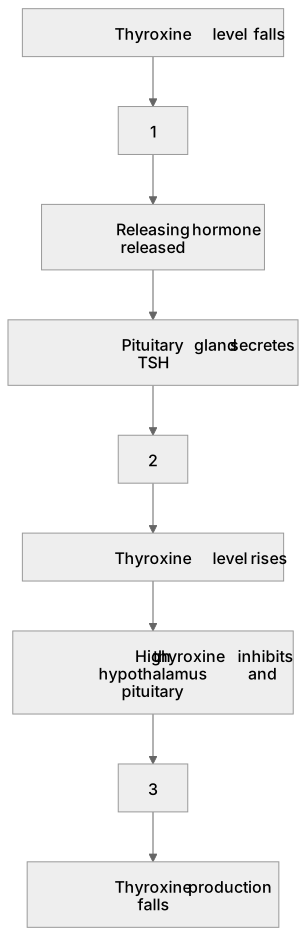
1Box 1
2Box 2
3Box 3
There is more to this lesson
The full lesson goes on to check your understanding and help you earn the marks. Create a free account to carry on, with your progress saved.
A week of Premium from your first lesson · Then the free plan continues · No card, no charge
Test your understanding of Feedback systems (HT only): Thyroxine levels are controlled by negative feedback. WS 1.2, MS 2c
Active recall beats re-reading. Take an instant quiz now to test what you’ve learned and lock it into long-term memory.
A week of Premium from your first lesson · Then the free plan continues · No card, no charge