AQA · GCSE · Combined Science
Course version: 8464 · Version from Sept 2018
Forces and elasticity: F = k e
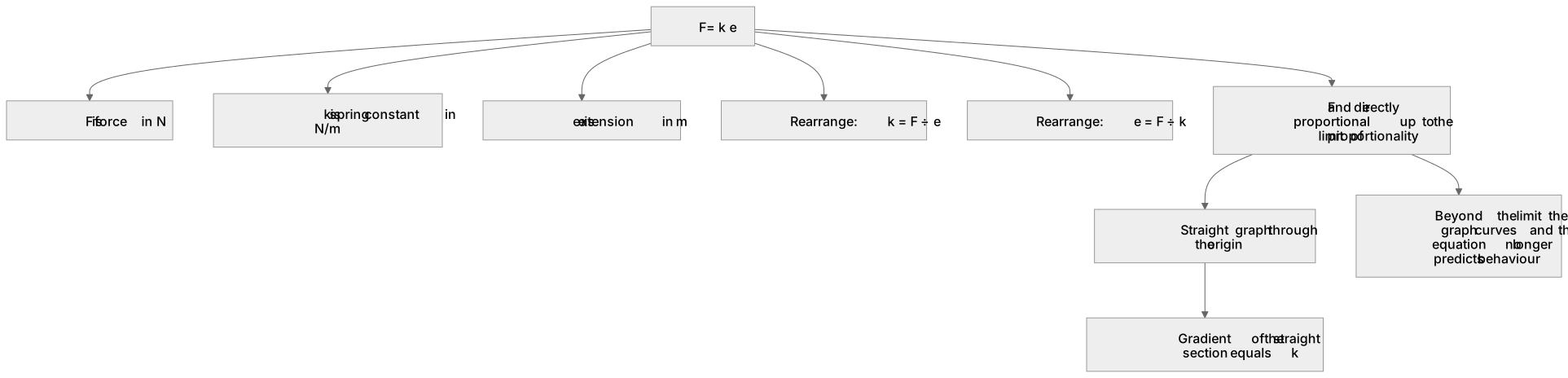
This is the symbolic form of Hooke's law: F is the force in newtons (N), k is the spring constant in newtons per metre (N/m) and e is the extension in metres (m).
Checked against the AQA 8464 specification (opens in a new tab) on .
- Point 6 of 19
- 4 key terms
Study notes
From the checked teaching notes for this specification point.
The idea
This is the symbolic form of Hooke's law: F is the force in newtons (N), k is the spring constant in newtons per metre (N/m) and e is the extension in metres (m). The equation says that, for a spring or elastic object obeying Hooke's law, force and extension are directly proportional, so doubling the force doubles the extension. The spring constant k is the force needed per metre of extension; a spring with k = 50 N/m needs 50 N to stretch it by 1 m, or 3.0 N to stretch it by 0.06 m. Rearranged, k = F ÷ e and e = F ÷ k. The relationship is linear only up to the limit of proportionality; beyond that the force–extension graph curves and the equation no longer predicts behaviour. On such a graph, the gradient of the straight section equals k.
What earns the marks
- Recall and use F = k e, identifying F as force in N, k as spring constant in N/m and e as extension in m.
- Rearrange the equation to k = F ÷ e or e = F ÷ k and substitute values correctly.
- Convert extension to metres before calculating, since the spring constant is expressed per metre.
- Recognise that F and e are directly proportional only up to the limit of proportionality, shown by a straight graph through the origin.
- Use the gradient of a force–extension graph to find the spring constant, choosing a large triangle on the linear region.
- Explain that a larger k indicates a stiffer spring, because more force is needed to produce the same extension.
Common mistakes and how to put them right
Confusing k with the gradient's reciprocal.
Put it right: Gradient = ΔF ÷ Δe, which equals k in N/m.
Treating e as the total length of the spring.
Put it right: e is the increase in length, found by subtracting the original length.
Mixing units, such as using newtons with centimetres.
Put it right: Convert all lengths to metres so that k comes out in N/m.
Exam tips
- Quote the equation in symbols first, then substitute numbers with units to make your method clear to the examiner.
- If the answer looks unrealistic, such as a spring constant of 0.5 N/m for a stiff spring, recheck whether you divided by extension in metres.
- For graph questions, state that the straight line through the origin shows direct proportionality and that the gradient gives k.
Try the lesson
The start of the Forces and elasticity: F = k e lesson, made from checked teaching notes for this specification point.
Have a go first
A spring has a spring constant k of 20 N/m. It is stretched by an extension e of 0.5 m. Using F = k e, what is the force F applied to the spring?
Listen
This is the symbolic form of Hooke's law: F is the force in newtons (N), k is the spring constant in newtons per metre (N/m) and e is the extension in metres (m). The equation says that, for a spring or elastic object obeying Hooke's law, force and extension are directly proportional, so doubling the force doubles the extension. The spring constant k is the force needed per metre of extension; a spring with k = 50 N/m needs 50 N to stretch it by 1 m, or 3.0 N to stretch it by 0.06 m. Rearranged, k = F ÷ e and e = F ÷ k. The relationship is linear only up to the limit of proportionality; beyond that the force–extension graph curves and the equation no longer predicts behaviour. On such a graph, the gradient of the straight section equals k. A strong answer earns marks for these points. Recall and use F = k e, identifying F as force in N, k as spring constant in N/m and e as extension in m. Rearrange the equation to k = F ÷ e or e = F ÷ k and substitute values correctly. Convert extension to metres before calculating, since the spring constant is expressed per metre. Recognise that F and e are directly proportional only up to the limit of proportionality, shown by a straight graph through the origin. A common slip: Confusing k with the gradient's reciprocal. Instead, gradient = ΔF ÷ Δe, which equals k in N/m. Exam tip: Quote the equation in symbols first, then substitute numbers with units to make your method clear to the examiner.
See it
Key words
Say what each word means before you turn the card.
Spring constant
Try answering aloud or in your head before turning the card.
Extension
Try answering aloud or in your head before turning the card.
Directly proportional
Try answering aloud or in your head before turning the card.
Limit of proportionality
Try answering aloud or in your head before turning the card.
See every definition
- Spring constant
- The force needed per metre of extension, measured in newtons per metre (N/m).
- Extension
- The increase in length, in metres, found by subtracting the original length from the total length.
- Directly proportional
- A relationship where doubling the force doubles the extension, shown by a straight graph through the origin up to the limit of proportionality.
- Limit of proportionality
- The point beyond which the force–extension graph curves and the equation no longer predicts behaviour.
Label the diagram
Some boxes have lost their names. Pick the right name for each number.
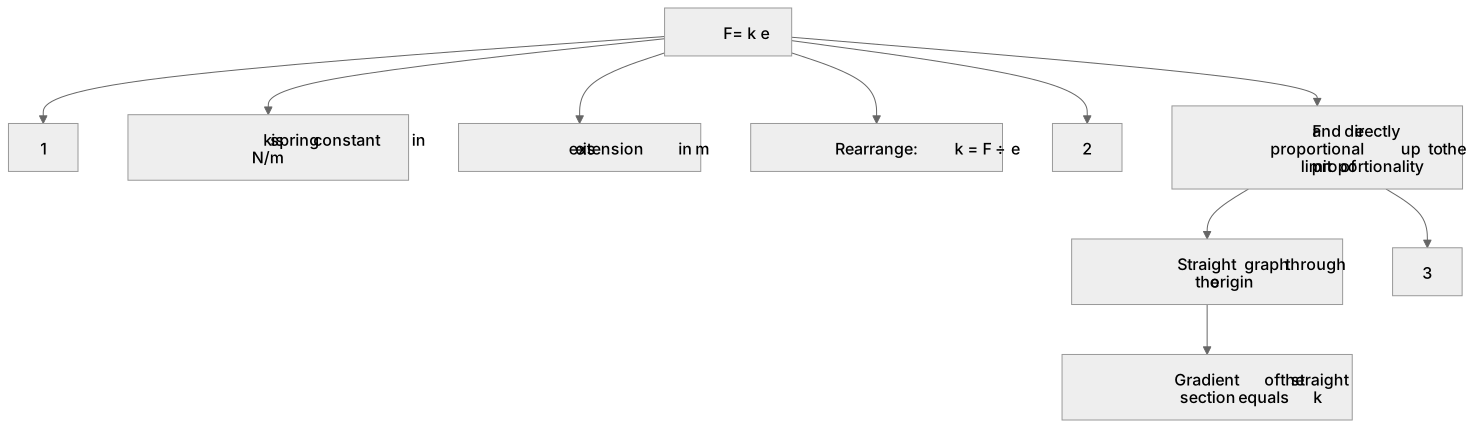
1Box 1
2Box 2
3Box 3
There is more to this lesson
The full lesson goes on to check your understanding and help you earn the marks. Create a free account to carry on, with your progress saved.
A week of Premium from your first lesson · Then the free plan continues · No card, no charge
Test your understanding of Forces and elasticity: F = k e
Active recall beats re-reading. Take an instant quiz now to test what you’ve learned and lock it into long-term memory.
A week of Premium from your first lesson · Then the free plan continues · No card, no charge