AQA · GCSE · Combined Science
Course version: 8464 · Version from Sept 2018
Forces and elasticity: force = spring constant × extension
This relationship describes Hooke's law for a spring or elastic object that returns to its original shape when the stretching force is removed.
Checked against the AQA 8464 specification (opens in a new tab) on .
- Point 5 of 19
- 4 key terms
Study notes
From the checked teaching notes for this specification point.
The idea
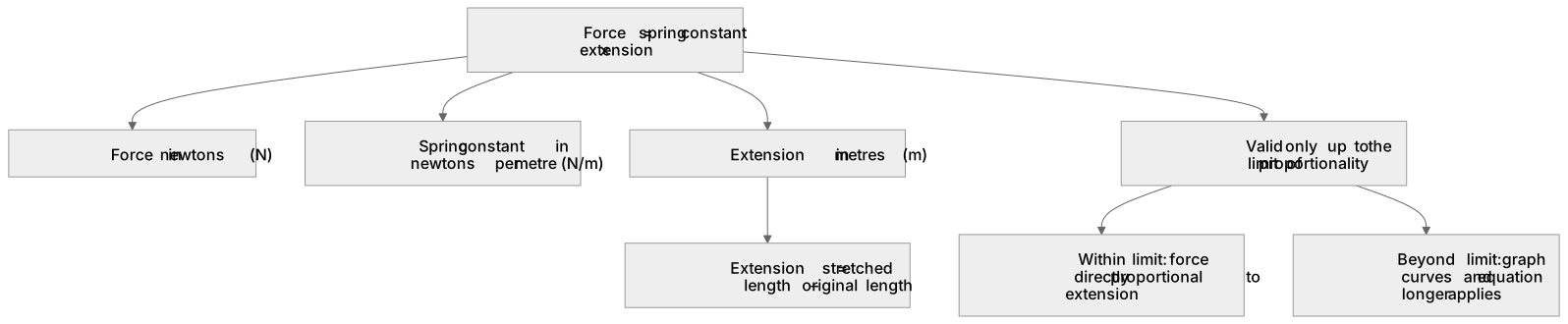
This relationship describes Hooke's law for a spring or elastic object that returns to its original shape when the stretching force is removed. The force is the load applied, measured in newtons (N). The spring constant k measures stiffness in newtons per metre (N/m): a large k means a stiff spring needing a large force for a small extension. Extension e is the increase in length beyond the natural length, in metres (m), so e = stretched length − original length. For example, a spring of natural length 0.20 m stretches to 0.26 m under a 3.0 N load, so e = 0.06 m and k = F ÷ e = 3.0 N ÷ 0.06 m = 50 N/m. The law holds only up to the limit of proportionality; beyond that the graph of force against extension curves and the equation no longer applies.
What earns the marks
- State the equation as force = spring constant × extension and rearrange it as k = F ÷ e or e = F ÷ k when required.
- Identify force in newtons (N), spring constant in newtons per metre (N/m) and extension in metres (m), converting centimetres or millimetres to metres before substituting.
- Calculate extension as stretched length minus original length, not the total stretched length.
- Explain that the equation applies only while the spring obeys Hooke's law, up to the limit of proportionality, where force is directly proportional to extension.
- Interpret a straight-line force–extension graph through the origin: the gradient equals the spring constant.
- Compare springs using k, recognising that a steeper line means a larger spring constant and a stiffer spring.
Common mistakes and how to put them right
Using the total stretched length as the extension.
Put it right: Subtract the original length first, so a spring of natural length 0.20 m stretched to 0.26 m has e = 0.06 m.
Substituting centimetres directly into F = k e.
Put it right: Convert to metres, because 1 cm = 0.01 m, so 6 cm becomes 0.06 m.
Assuming the equation works for any force.
Put it right: Check that the spring is within its limit of proportionality, since beyond that point the force–extension graph curves and F = k e fails.
Exam tips
- Write the equation, substitute the known values with units, then rearrange only after substitution to reduce algebra errors.
- Check that your final unit matches the quantity: N for force, N/m for spring constant and m for extension.
- When a graph is given, read the gradient from a large triangle on the straight section rather than a single point, and state that the line must pass through the origin for Hooke's law.
Try the lesson
The start of the Forces and elasticity: force = spring constant × extension lesson, made from checked teaching notes for this specification point.
Have a go first
A spring has a spring constant of 20 N/m. What force is needed to stretch it by 0.5 m?
Listen
This relationship describes Hooke's law for a spring or elastic object that returns to its original shape when the stretching force is removed. The force is the load applied, measured in newtons (N). The spring constant k measures stiffness in newtons per metre (N/m): a large k means a stiff spring needing a large force for a small extension. Extension e is the increase in length beyond the natural length, in metres (m), so e = stretched length − original length. For example, a spring of natural length 0.20 m stretches to 0.26 m under a 3.0 N load, so e = 0.06 m and k = F ÷ e = 3.0 N ÷ 0.06 m = 50 N/m. The law holds only up to the limit of proportionality; beyond that the graph of force against extension curves and the equation no longer applies. A strong answer earns marks for these points. State the equation as force = spring constant × extension and rearrange it as k = F ÷ e or e = F ÷ k when required. Identify force in newtons (N), spring constant in newtons per metre (N/m) and extension in metres (m), converting centimetres or millimetres to metres before substituting. Calculate extension as stretched length minus original length, not the total stretched length. Explain that the equation applies only while the spring obeys Hooke's law, up to the limit of proportionality, where force is directly proportional to extension. A common slip: Using the total stretched length as the extension. Instead, subtract the original length first, so a spring of natural length 0.20 m stretched to 0.26 m has e = 0.06 m. Exam tip: Write the equation, substitute the known values with units, then rearrange only after substitution to reduce algebra errors.
See it
Key words
Say what each word means before you turn the card.
Hooke's law
Try answering aloud or in your head before turning the card.
Spring constant
Try answering aloud or in your head before turning the card.
Extension
Try answering aloud or in your head before turning the card.
Limit of proportionality
Try answering aloud or in your head before turning the card.
See every definition
- Hooke's law
- The relationship force = spring constant × extension for a spring or elastic object that returns to its original shape when the stretching force is removed.
- Spring constant
- A measure of stiffness in newtons per metre (N/m), where a large value means a stiff spring needing a large force for a small extension.
- Extension
- The increase in length beyond the natural length, in metres (m), calculated as stretched length minus original length.
- Limit of proportionality
- The point up to which the law holds; beyond it the graph of force against extension curves and the equation no longer applies.
Label the diagram
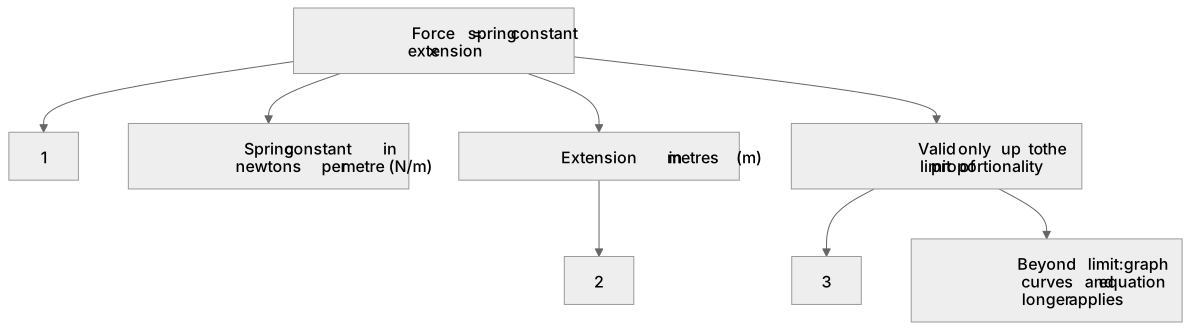
Some boxes have lost their names. Pick the right name for each number.
1Box 1
2Box 2
3Box 3
There is more to this lesson
The full lesson goes on to check your understanding and help you earn the marks. Create a free account to carry on, with your progress saved.
A week of Premium from your first lesson · Then the free plan continues · No card, no charge
Test your understanding of Forces and elasticity: force = spring constant × extension
Active recall beats re-reading. Take an instant quiz now to test what you’ve learned and lock it into long-term memory.
A week of Premium from your first lesson · Then the free plan continues · No card, no charge