AQA · GCSE · Combined Science
Course version: 8464 · Version from Sept 2018
From parts of organisms that have not decayed because one or more of the…
Full specification wording
Fossils: from parts of organisms that have not decayed because one or more of the conditions needed for decay are absent
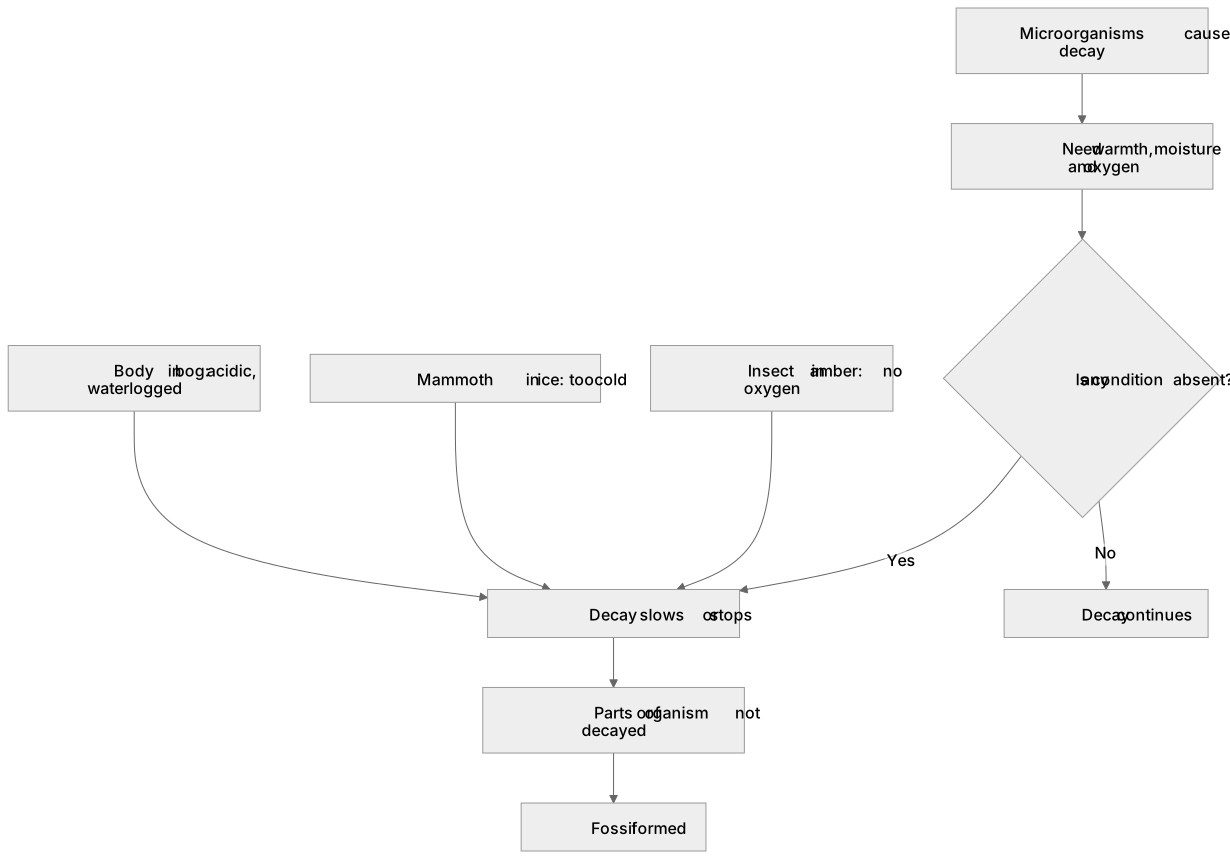
Decay is carried out by microorganisms, which need warmth, moisture and oxygen to break down dead material.
Checked against the AQA 8464 specification (opens in a new tab) on .
- Point 3 of 8
- 4 key terms
Study notes
From the checked teaching notes for this specification point.
The idea
Decay is carried out by microorganisms, which need warmth, moisture and oxygen to break down dead material. If any one of these conditions is missing, decay slows or stops, so parts of an organism can survive for a very long time and become fossils. This explains exceptional preservation: an insect trapped in amber is sealed from oxygen and microorganisms; a mammoth frozen in permafrost is too cold for decomposers; a body in a bog may be preserved because acidic, waterlogged conditions prevent microbial activity. The fossil record is therefore biased towards organisms that were buried rapidly in conditions where decay could not occur.
What earns the marks
- Decay is caused by microorganisms such as bacteria and fungi, not by the organism simply 'drying out' on its own.
- Microorganisms need warmth, moisture and oxygen; removing any one of these conditions prevents or greatly slows decay.
- Absence of oxygen, very low temperature, or very dry conditions can each preserve parts of an organism.
- Examples include insects in amber, mammoths in ice, and soft tissue preserved in acidic bogs.
- Preservation is more likely when the organism is buried quickly, which limits exposure to decomposers.
- Fossils formed this way are rare and give an incomplete record of past life.
Common mistakes and how to put them right
Thinking decay stops only when an organism is completely frozen.
Put it right: Any missing condition, such as lack of oxygen or moisture, can prevent decay.
Confusing 'not decayed' with 'never alive'.
Put it right: The preserved parts are still the remains of once-living organisms.
Assuming all fossils are bones or shells.
Put it right: Amber, ice and bog deposits can preserve soft parts such as skin, hair or whole insects.
Exam tips
- Name the specific missing condition in the example you are given, such as 'no oxygen' for an insect in amber.
- Link each example back to the microorganisms that would normally cause decay.
- Use comparative language such as 'slows' or 'prevents' rather than saying decay 'never happens' in all conditions.
Try the lesson
The start of the Fossils: from parts of organisms that have not decayed because one or more of the conditions needed for decay are absent lesson, made from checked teaching notes for this specification point.
Have a go first
A fossil is formed from part of an organism that has not decayed. Which condition would prevent decay?
Listen
Decay is carried out by microorganisms, which need warmth, moisture and oxygen to break down dead material. If any one of these conditions is missing, decay slows or stops, so parts of an organism can survive for a very long time and become fossils. This explains exceptional preservation: an insect trapped in amber is sealed from oxygen and microorganisms; a mammoth frozen in permafrost is too cold for decomposers; a body in a bog may be preserved because acidic, waterlogged conditions prevent microbial activity. The fossil record is therefore biased towards organisms that were buried rapidly in conditions where decay could not occur. A strong answer earns marks for these points. Decay is caused by microorganisms such as bacteria and fungi, not by the organism simply 'drying out' on its own. Microorganisms need warmth, moisture and oxygen; removing any one of these conditions prevents or greatly slows decay. Absence of oxygen, very low temperature, or very dry conditions can each preserve parts of an organism. Examples include insects in amber, mammoths in ice, and soft tissue preserved in acidic bogs. A common slip: Thinking decay stops only when an organism is completely frozen. Instead, any missing condition, such as lack of oxygen or moisture, can prevent decay. Exam tip: Name the specific missing condition in the example you are given, such as 'no oxygen' for an insect in amber.
See it
Key words
Say what each word means before you turn the card.
Decomposition and decay
Try answering aloud or in your head before turning the card.
Conditions needed by microorganisms
Try answering aloud or in your head before turning the card.
Fossil formation and preservation
Try answering aloud or in your head before turning the card.
Evidence for evolution and the fossil record
Try answering aloud or in your head before turning the card.
See every definition
- Decomposition and decay
- Carried out by microorganisms, which break down dead material.
- Conditions needed by microorganisms
- Warmth, moisture and oxygen are needed to break down dead material.
- Fossil formation and preservation
- Parts of organisms that have not decayed because one or more of the conditions needed for decay are absent.
- Evidence for evolution and the fossil record
- Fossils formed this way are rare and give an incomplete record of past life.
Label the diagram
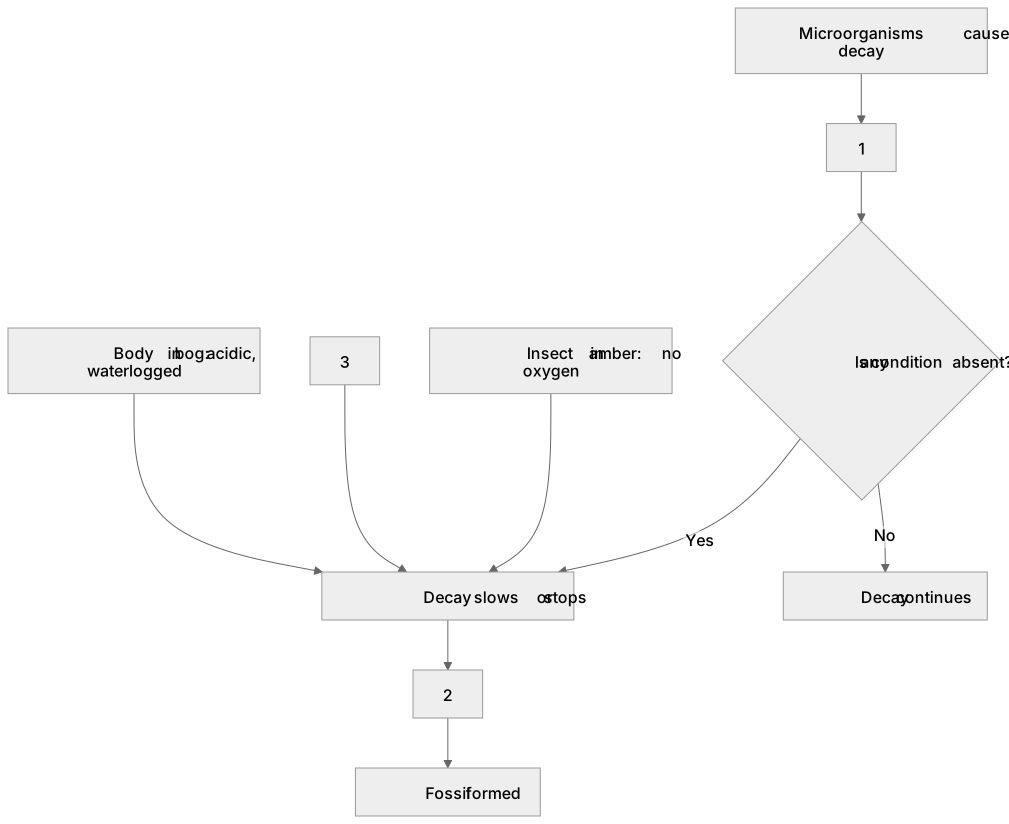
Some boxes have lost their names. Pick the right name for each number.
1Box 1
2Box 2
3Box 3
There is more to this lesson
The full lesson goes on to check your understanding and help you earn the marks. Create a free account to carry on, with your progress saved.
A week of Premium from your first lesson · Then the free plan continues · No card, no charge
Test your understanding of Fossils: from parts of organisms that have not decayed because one or more of the conditions needed for decay are absent
Active recall beats re-reading. Take an instant quiz now to test what you’ve learned and lock it into long-term memory.
A week of Premium from your first lesson · Then the free plan continues · No card, no charge