AQA · GCSE · Combined Science
Course version: 8464 · Version from Sept 2018
Fossils: when parts of the organism are replaced by minerals as they decay
Full specification wording
Fossils: when parts of the organism are replaced by minerals as they decay
Some fossils form when hard parts such as bone, shell or wood are slowly replaced by minerals.
Checked against the AQA 8464 specification (opens in a new tab) on .
- Point 4 of 8
Study notes
From the checked teaching notes for this specification point.
The idea
Some fossils form when hard parts such as bone, shell or wood are slowly replaced by minerals. As the original material decays or dissolves, mineral-rich water seeps into the remains and minerals such as calcium carbonate or silica are deposited in the spaces. Over long periods the minerals harden and preserve the shape and structure of the original part, even though its chemical composition has changed. This produces the familiar stony fossils found in sedimentary rock. The process requires burial, water carrying dissolved minerals, and long periods of time, and it usually preserves hard parts rather than soft tissue.
What earns the marks
- Hard parts such as bones, shells and teeth are the most likely to be mineralised.
- Mineral-rich water must reach the buried remains for replacement to occur.
- As the original material decays or dissolves, minerals are deposited in its place.
- The minerals harden over a long period, preserving the shape and structure of the original part.
- The resulting fossil is made of rock minerals, not the original biological material.
Common mistakes and how to put them right
Saying the organism turns into rock instantly.
Put it right: Mineral replacement happens gradually over a very long time.
Thinking soft parts are usually preserved this way.
Put it right: Hard parts such as bone and shell are much more likely to be replaced by minerals.
Believing the original material remains unchanged.
Put it right: The original material decays or dissolves and is replaced by minerals.
Exam tips
- Use the phrase 'mineral-rich water' to show you know what carries the minerals into the remains.
- Describe the sequence: burial, decay or dissolving, mineral deposition, hardening.
- Link the process to sedimentary rock, where most mineral-replaced fossils are found.
Try the lesson
The start of the Fossils: when parts of the organism are replaced by minerals as they decay lesson, made from checked teaching notes for this specification point.
Have a go first
Which type of fossil forms when parts of an organism are replaced by minerals as they decay?
Listen
Some fossils form when hard parts such as bone, shell or wood are slowly replaced by minerals. As the original material decays or dissolves, mineral-rich water seeps into the remains and minerals such as calcium carbonate or silica are deposited in the spaces. Over long periods the minerals harden and preserve the shape and structure of the original part, even though its chemical composition has changed. This produces the familiar stony fossils found in sedimentary rock. The process requires burial, water carrying dissolved minerals, and long periods of time, and it usually preserves hard parts rather than soft tissue. A strong answer earns marks for these points. Hard parts such as bones, shells and teeth are the most likely to be mineralised. Mineral-rich water must reach the buried remains for replacement to occur. As the original material decays or dissolves, minerals are deposited in its place. The minerals harden over a long period, preserving the shape and structure of the original part. A common slip: Saying the organism turns into rock instantly. Instead, mineral replacement happens gradually over a very long time. Exam tip: Use the phrase 'mineral-rich water' to show you know what carries the minerals into the remains.
See it
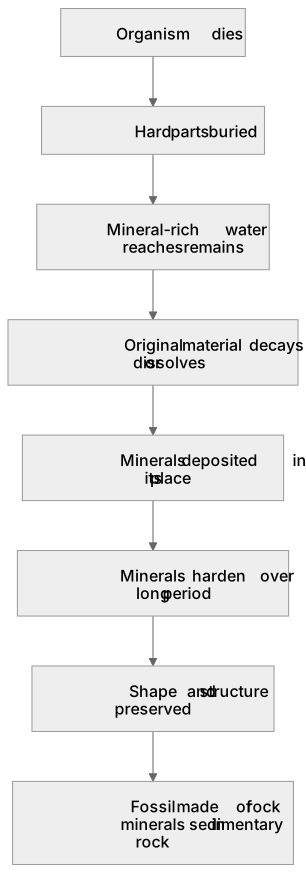
Put it in order
Put these steps in the order they happen.
- 1. Minerals deposited in its place
- 2. Fossil made of rock minerals in sedimentary rock
- 3. Minerals harden over a long period
- 4. Organism dies
- 5. Hard parts buried
- 6. Shape and structure preserved
- 7. Mineral-rich water reaches remains
- 8. Original material decays or dissolves
Label the diagram
Some boxes have lost their names. Pick the right name for each number.
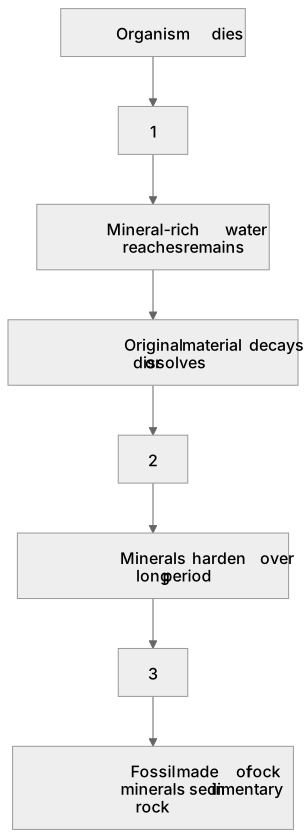
1Box 1
2Box 2
3Box 3
There is more to this lesson
The full lesson goes on to check your understanding and help you earn the marks. Create a free account to carry on, with your progress saved.
A week of Premium from your first lesson · Then the free plan continues · No card, no charge
Test your understanding of Fossils: when parts of the organism are replaced by minerals as they decay
Active recall beats re-reading. Take an instant quiz now to test what you’ve learned and lock it into long-term memory.
A week of Premium from your first lesson · Then the free plan continues · No card, no charge