AQA · GCSE · Combined Science
Course version: 8464 · Version from Sept 2018
Many early forms of life were soft-bodied, which means that they have left…
Full specification wording
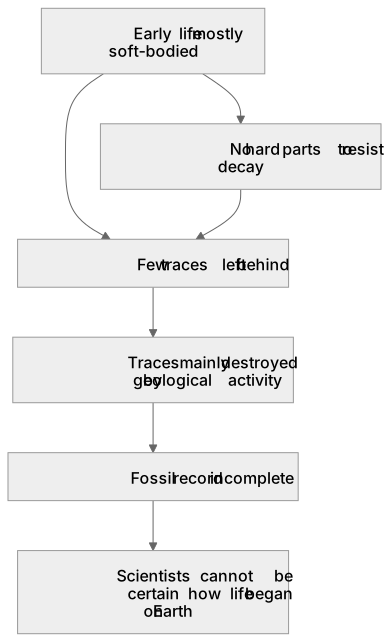
Fossils: Many early forms of life were soft-bodied, which means that they have left few traces behind. What traces there were have been mainly destroyed by geological activity. This is why scientists cannot be certain about how life began on Earth.
The fossil record is incomplete, especially for the earliest life.
Checked against the AQA 8464 specification (opens in a new tab) on .
- Point 6 of 8
- 4 key terms
Study notes
From the checked teaching notes for this specification point.
The idea
The fossil record is incomplete, especially for the earliest life. Early organisms were largely soft-bodied, so they had no hard shells, bones or teeth to resist decay and fossilise. Their remains were usually broken down before they could be buried, so few traces formed. Even those rare traces have mostly been destroyed by geological activity: heat and pressure from burial, melting of rock, and plate movements can erase fossils over billions of years. As a result, the evidence available for the origin of life is fragmentary. Scientists can propose hypotheses, such as life forming in deep-sea vents or shallow pools, but they cannot be certain, because the direct evidence has largely been lost.
What earns the marks
- Soft-bodied organisms decay quickly and lack hard parts, so they fossilise far less often than organisms with shells or skeletons.
- Fewer fossils form when there are no hard parts to resist decay and scavenging before burial.
- Geological activity such as heat, pressure, melting and plate movement destroys many fossils over long periods.
- The earliest fossils are therefore rare and fragmentary, leaving gaps in the fossil record.
- Because the evidence is incomplete, scientists cannot be certain exactly how or where life began on Earth.
- Scientific explanations of the origin of life remain hypotheses supported by indirect evidence rather than direct fossil proof.
Common mistakes and how to put them right
Saying no early life fossils exist at all.
Put it right by saying few traces survive, not none.
Claiming soft-bodied organisms cannot fossilise.
Put it right by explaining that fossilisation is much less likely, not impossible.
Treating a hypothesis about the origin of life as proven fact.
Put it right by linking uncertainty to missing and destroyed evidence.
Exam tips
- Link each reason for uncertainty to a mechanism: soft bodies decay, and geological activity destroys rock and fossils.
- Use the phrase fossil record is incomplete when explaining why scientists cannot be certain.
- Distinguish evidence from explanation: state what is missing, then say why that limits certainty.
Try the lesson
The start of the Fossils: Many early forms of life were soft-bodied, which means that they have left few traces behind. What traces there were have been mainly destroyed by geological activity. This is why scientists cannot be certain about how life began on Earth. lesson, made from checked teaching notes for this specification point.
Have a go first
Why have soft-bodied early forms of life left few fossils?
Listen
The fossil record is incomplete, especially for the earliest life. Early organisms were largely soft-bodied, so they had no hard shells, bones or teeth to resist decay and fossilise. Their remains were usually broken down before they could be buried, so few traces formed. Even those rare traces have mostly been destroyed by geological activity: heat and pressure from burial, melting of rock, and plate movements can erase fossils over billions of years. As a result, the evidence available for the origin of life is fragmentary. Scientists can propose hypotheses, such as life forming in deep-sea vents or shallow pools, but they cannot be certain, because the direct evidence has largely been lost. A strong answer earns marks for these points. Soft-bodied organisms decay quickly and lack hard parts, so they fossilise far less often than organisms with shells or skeletons. Fewer fossils form when there are no hard parts to resist decay and scavenging before burial. Geological activity such as heat, pressure, melting and plate movement destroys many fossils over long periods. The earliest fossils are therefore rare and fragmentary, leaving gaps in the fossil record. A common slip: Saying no early life fossils exist at all. Instead, saying few traces survive, not none. Exam tip: Link each reason for uncertainty to a mechanism: soft bodies decay, and geological activity destroys rock and fossils.
See it
Key words
Say what each word means before you turn the card.
Incomplete fossil record
Try answering aloud or in your head before turning the card.
Decay and preservation
Try answering aloud or in your head before turning the card.
Geological change over time
Try answering aloud or in your head before turning the card.
Scientific uncertainty and hypotheses
Try answering aloud or in your head before turning the card.
See every definition
- Incomplete fossil record
- The fossil record is incomplete because early soft-bodied life left few traces and geological activity destroyed most of them.
- Decay and preservation
- Soft-bodied organisms decay quickly and lack hard parts, so they fossilise far less often than organisms with shells or skeletons.
- Geological change over time
- Geological activity such as heat, pressure, melting and plate movement destroys many fossils over long periods.
- Scientific uncertainty and hypotheses
- Because the evidence is incomplete, scientists cannot be certain how life began and explanations remain hypotheses supported by indirect evidence.
Label the diagram
Some boxes have lost their names. Pick the right name for each number.
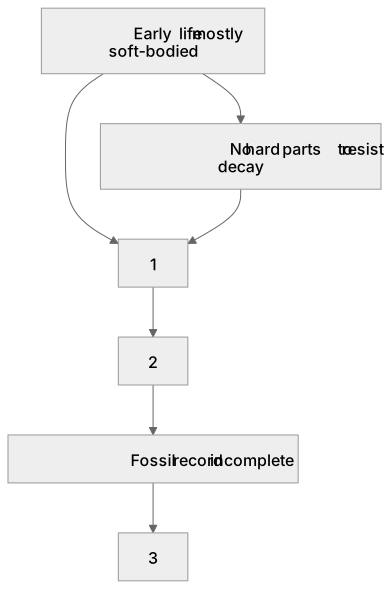
1Box 1
2Box 2
3Box 3
There is more to this lesson
The full lesson goes on to check your understanding and help you earn the marks. Create a free account to carry on, with your progress saved.
A week of Premium from your first lesson · Then the free plan continues · No card, no charge
Test your understanding of Fossils: Many early forms of life were soft-bodied, which means that they have left few traces behind. What traces there were have been mainly destroyed by geological activity. This is why scientists cannot be certain about how life began on Earth.
Active recall beats re-reading. Take an instant quiz now to test what you’ve learned and lock it into long-term memory.
A week of Premium from your first lesson · Then the free plan continues · No card, no charge