AQA · GCSE · Combined Science
Course version: 8464 · Version from Sept 2018
We can learn from fossils how much or how little different organisms have…
Full specification wording
Fossils: We can learn from fossils how much or how little different organisms have changed as life developed on Earth.
Fossils are preserved remains or traces of organisms from the past, and comparing them with living species reveals the extent of change over geological time.
Checked against the AQA 8464 specification (opens in a new tab) on .
- Point 7 of 8
- 4 key terms
Study notes
From the checked teaching notes for this specification point.
The idea
Fossils are preserved remains or traces of organisms from the past, and comparing them with living species reveals the extent of change over geological time. Some lineages show little change: horsehoe crabs in rocks hundreds of millions of years old closely resemble modern forms, so they are often called living fossils. Others show major change: comparing ancient whale fossils with modern whales reveals the gradual loss of hind limbs and the shift to flippers. Fossils also document extinction, showing that many organisms no longer exist. By arranging fossils by rock age, we can see whether a body plan stayed stable or was modified, and how life on Earth developed.
What earns the marks
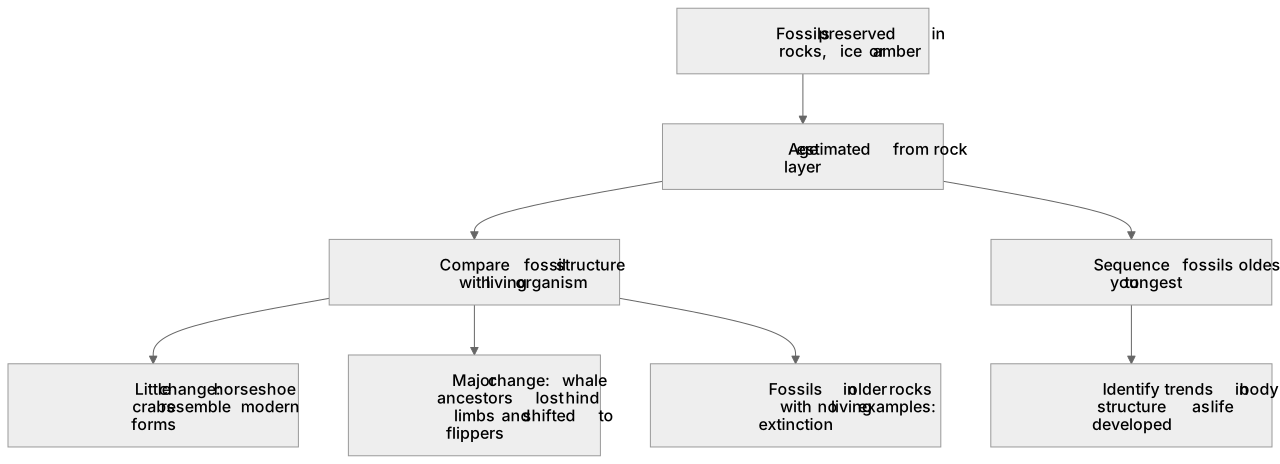
- Fossils are remains or traces of organisms preserved in rocks, ice or amber, and their age can be estimated from the rock layer in which they are found.
- Comparing the structure of a fossil with a living organism shows whether the body plan has changed a lot or only a little over time.
- Organisms such as horseshoe crabs have changed very little over hundreds of millions of years, whereas whale ancestors show major changes in limb structure.
- Fossils provide evidence that some species became extinct, because their fossils appear in older rocks but no living examples exist.
- Sequencing fossils from oldest to youngest allows trends in body structure to be identified as life developed on Earth.
Common mistakes and how to put them right
Thinking every fossil is a complete skeleton.
Put it right: Most fossils are fragments, impressions or traces, so conclusions are based on the features preserved.
Assuming all organisms change at the same rate.
Put it right: Some lineages remain similar for long periods while others change substantially.
Believing fossils show the exact age of an organism without evidence.
Put it right: Age is inferred from the rock layer or dating methods, not from the fossil alone.
Exam tips
- When describing change, name the specific feature compared, such as limb bones or shell shape, rather than saying the organism 'changed'.
- Use the command word: 'describe' needs features and trends, while 'explain' needs a reason linking the fossil evidence to change over time.
- Quote data from any chart or table, such as 'the fossil is 300 million years old', to support your comparison.
Try the lesson
The start of the Fossils: We can learn from fossils how much or how little different organisms have changed as life developed on Earth. lesson, made from checked teaching notes for this specification point.
Have a go first
The fossil record of horses shows a sequence of species over 50 million years. Older fossils show small animals with four toes, while more recent fossils show larger animals with a single hoof. What does this fossil evidence demonstrate about the evolution of horses?
Listen
Fossils are preserved remains or traces of organisms from the past, and comparing them with living species reveals the extent of change over geological time. Some lineages show little change: horsehoe crabs in rocks hundreds of millions of years old closely resemble modern forms, so they are often called living fossils. Others show major change: comparing ancient whale fossils with modern whales reveals the gradual loss of hind limbs and the shift to flippers. Fossils also document extinction, showing that many organisms no longer exist. By arranging fossils by rock age, we can see whether a body plan stayed stable or was modified, and how life on Earth developed. A strong answer earns marks for these points. Fossils are remains or traces of organisms preserved in rocks, ice or amber, and their age can be estimated from the rock layer in which they are found. Comparing the structure of a fossil with a living organism shows whether the body plan has changed a lot or only a little over time. Organisms such as horseshoe crabs have changed very little over hundreds of millions of years, whereas whale ancestors show major changes in limb structure. Fossils provide evidence that some species became extinct, because their fossils appear in older rocks but no living examples exist. Exam tip: When describing change, name the specific feature compared, such as limb bones or shell shape, rather than saying the organism 'changed'.
See it
Key words
Say what each word means before you turn the card.
Fossils
Try answering aloud or in your head before turning the card.
Extinction
Try answering aloud or in your head before turning the card.
Change over geological time
Try answering aloud or in your head before turning the card.
Comparing fossil and living structures
Try answering aloud or in your head before turning the card.
See every definition
- Fossils
- Remains or traces of organisms preserved in rocks, ice or amber, whose age can be estimated from the rock layer in which they are found.
- Extinction
- When species no longer exist, shown by fossils appearing in older rocks but no living examples existing.
- Change over geological time
- Whether a body plan stayed stable or was modified, seen by arranging fossils by rock age as life developed on Earth.
- Comparing fossil and living structures
- Showing whether the body plan has changed a lot or only a little over time by comparing the structure of a fossil with a living organism.
Label the diagram
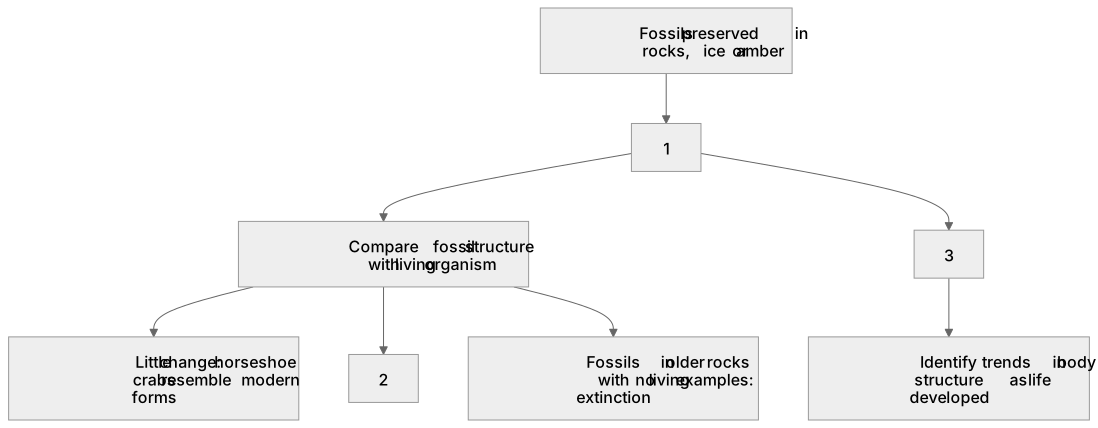
Some boxes have lost their names. Pick the right name for each number.
1Box 1
2Box 2
3Box 3
There is more to this lesson
The full lesson goes on to check your understanding and help you earn the marks. Create a free account to carry on, with your progress saved.
A week of Premium from your first lesson · Then the free plan continues · No card, no charge
Test your understanding of Fossils: We can learn from fossils how much or how little different organisms have changed as life developed on Earth.
Active recall beats re-reading. Take an instant quiz now to test what you’ve learned and lock it into long-term memory.
A week of Premium from your first lesson · Then the free plan continues · No card, no charge