AQA · GCSE · Combined Science
Course version: 8464 · Version from Sept 2018
Concerns about GM crops include the effect on populations of wild flowers…
Full specification wording
Genetic engineering: Concerns about GM crops include the effect on populations of wild flowers and insects. Some people feel the effects of eating GM crops on human health have not been fully explored.
Genetic engineering can insert a desirable gene, such as one giving herbicide resistance, into a crop plant.
Checked against the AQA 8464 specification (opens in a new tab) on .
- Point 7 of 12
Study notes
From the checked teaching notes for this specification point.
The idea
Genetic engineering can insert a desirable gene, such as one giving herbicide resistance, into a crop plant. This raises two distinct concerns. Ecologically, if farmers spray a herbicide that kills only weeds, wild flowers decline, so insects that feed on them or use them for shelter lose food and habitat, and their populations fall; this can then reduce populations of birds and other animals that eat those insects, so food chains and biodiversity are affected. For human health, some people argue that the long-term effects of eating GM food are not fully known, because testing may not cover many years or all groups of people, and because a new protein might rarely cause an allergic reaction. Others point to evidence that approved GM foods are safe. A balanced answer explains both concerns and the reasoning behind them.
What earns the marks
- Identifies that GM crops may be engineered to be resistant to a herbicide, so spraying kills weeds but leaves the crop alive.
- Explains that fewer wild flowers means less food and shelter for insects, so insect populations decline.
- Links the decline in insects to knock-on effects on other organisms, such as birds that feed on insects, reducing biodiversity.
- States the human health concern that the long-term effects of eating GM crops have not been fully explored.
- Explains why some people are uncertain, for example possible allergic reactions to new proteins or limited evidence over many years.
- Recognises that other people consider approved GM foods safe, showing awareness of both sides of the debate.
Common mistakes and how to put them right
Saying only that GM crops are 'bad for the environment' without naming the effect on wild flowers or insects.
Put it right by stating the specific population change and its cause.
Confusing genetic engineering with natural selection or with selective breeding.
Put it right by stating that a gene is transferred directly between organisms.
Claiming that all GM foods are proven to harm human health.
Put it right by saying that some people feel the long-term effects have not been fully explored, which is a concern rather than a proven harm.
Exam tips
- Read the command word carefully: 'give' needs brief points, while 'explain' needs a cause-and-effect chain from herbicide use to falling insect populations.
- Use the phrase 'populations of wild flowers and insects' explicitly, because the statement names these groups.
- For the health concern, write about uncertainty and lack of full exploration rather than asserting that GM food is unsafe.
Try the lesson
The start of the Genetic engineering: Concerns about GM crops include the effect on populations of wild flowers and insects. Some people feel the effects of eating GM crops on human health have not been fully explored. lesson, made from checked teaching notes for this specification point.
Have a go first
Which of these is a valid concern that some people have about the growing of genetically modified (GM) crops?
Listen
Genetic engineering can insert a desirable gene, such as one giving herbicide resistance, into a crop plant. This raises two distinct concerns. Ecologically, if farmers spray a herbicide that kills only weeds, wild flowers decline, so insects that feed on them or use them for shelter lose food and habitat, and their populations fall; this can then reduce populations of birds and other animals that eat those insects, so food chains and biodiversity are affected. For human health, some people argue that the long-term effects of eating GM food are not fully known, because testing may not cover many years or all groups of people, and because a new protein might rarely cause an allergic reaction. Others point to evidence that approved GM foods are safe. A balanced answer explains both concerns and the reasoning behind them. A strong answer earns marks for these points. Identifies that GM crops may be engineered to be resistant to a herbicide, so spraying kills weeds but leaves the crop alive. Explains that fewer wild flowers means less food and shelter for insects, so insect populations decline. Links the decline in insects to knock-on effects on other organisms, such as birds that feed on insects, reducing biodiversity. States the human health concern that the long-term effects of eating GM crops have not been fully explored. A common slip: Saying only that GM crops are 'bad for the environment' without naming the effect on wild flowers or insects. Instead, stating the specific population change and its cause. Exam tip: Read the command word carefully: 'give' needs brief points, while 'explain' needs a cause-and-effect chain from herbicide use to falling insect populations.
See it
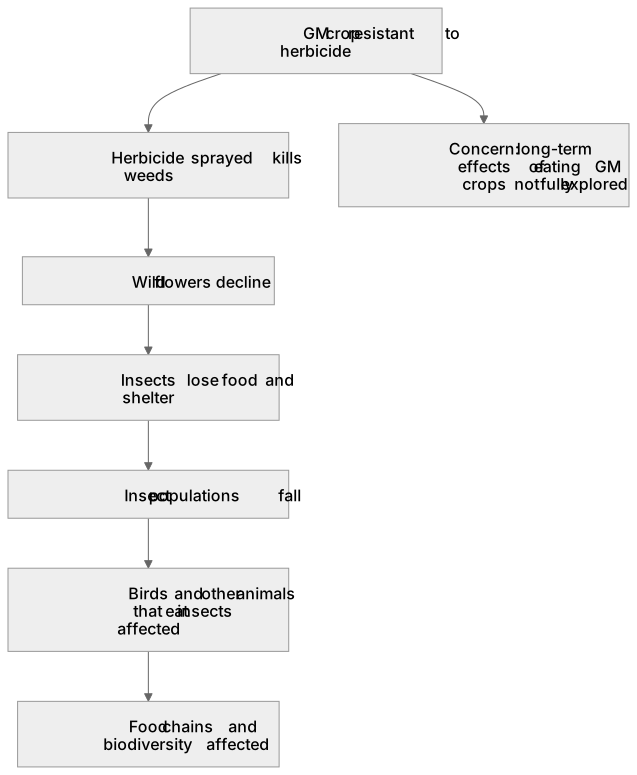
Label the diagram
Some boxes have lost their names. Pick the right name for each number.
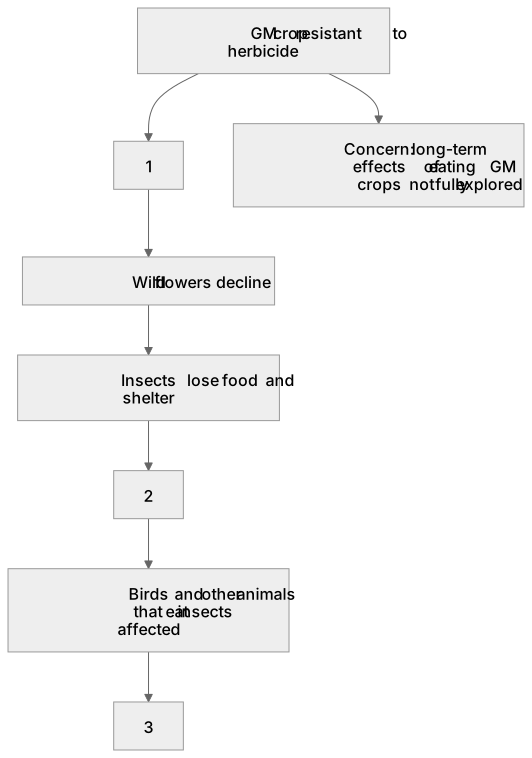
1Box 1
2Box 2
3Box 3
There is more to this lesson
The full lesson goes on to check your understanding and help you earn the marks. Create a free account to carry on, with your progress saved.
A week of Premium from your first lesson · Then the free plan continues · No card, no charge
Test your understanding of Genetic engineering: Concerns about GM crops include the effect on populations of wild flowers and insects. Some people feel the effects of eating GM crops on human health have not been fully explored.
Active recall beats re-reading. Take an instant quiz now to test what you’ve learned and lock it into long-term memory.
A week of Premium from your first lesson · Then the free plan continues · No card, no charge