AQA · GCSE · Combined Science
Course version: 8464 · Version from Sept 2018
Students should be able to describe genetic engineering as a process which…
Full specification wording
Genetic engineering: Students should be able to describe genetic engineering as a process which involves modifying the genome of an organism by introducing a gene from another organism to give a desired characteristic.
Genetic engineering changes an organism's genome by transferring a gene from a donor organism so the recipient gains a desired characteristic.
Checked against the AQA 8464 specification (opens in a new tab) on .
- Point 1 of 12
- 4 key terms
Study notes
From the checked teaching notes for this specification point.
The idea
Genetic engineering changes an organism's genome by transferring a gene from a donor organism so the recipient gains a desired characteristic. The gene is cut out using enzymes, then inserted into a vector, often a bacterial plasmid, which carries it into the recipient cell. The recipient's genome is thereby modified and, when the gene is expressed, the new protein gives the wanted feature. For example, the human insulin gene can be inserted into a bacterium, which then produces human insulin. The process therefore has three linked ideas: modifying the genome, introducing a gene from another organism, and obtaining a desired characteristic.
What earns the marks
- Genetic engineering alters the genetic material of an organism, so its genome is modified.
- A gene is taken from a donor organism and introduced into a different recipient organism.
- The transferred gene is usually carried by a vector, commonly a bacterial plasmid.
- Enzymes are used to cut the gene from the donor DNA and to insert it into the vector.
- The recipient cell expresses the new gene, producing a protein that gives the desired characteristic.
- A valid example is the human insulin gene inserted into bacteria so they make human insulin.
Common mistakes and how to put them right
Saying the recipient organism 'grows' a new gene rather than receiving a gene from another organism.
Put it right by stating the gene is transferred from a donor.
Confusing genetic engineering with selective breeding.
Put it right by noting that genetic engineering moves a gene between organisms, whereas selective breeding chooses parents that already carry the desired alleles.
Describing the gene as entering the cell on its own.
Put it right by explaining that a vector such as a plasmid carries the gene into the recipient cell.
Exam tips
- Name the vector and the enzymes when describing the method, as these show the process rather than just the outcome.
- Finish with the desired characteristic and a named example, such as disease resistance or insulin production, to show the purpose of the modification.
Try the lesson
The start of the Genetic engineering: Students should be able to describe genetic engineering as a process which involves modifying the genome of an organism by introducing a gene from another organism to give a desired characteristic. lesson, made from checked teaching notes for this specification point.
Have a go first
Which statement best describes genetic engineering?
Listen
Genetic engineering changes an organism's genome by transferring a gene from a donor organism so the recipient gains a desired characteristic. The gene is cut out using enzymes, then inserted into a vector, often a bacterial plasmid, which carries it into the recipient cell. The recipient's genome is thereby modified and, when the gene is expressed, the new protein gives the wanted feature. For example, the human insulin gene can be inserted into a bacterium, which then produces human insulin. The process therefore has three linked ideas: modifying the genome, introducing a gene from another organism, and obtaining a desired characteristic. A strong answer earns marks for these points. Genetic engineering alters the genetic material of an organism, so its genome is modified. A gene is taken from a donor organism and introduced into a different recipient organism. The transferred gene is usually carried by a vector, commonly a bacterial plasmid. Enzymes are used to cut the gene from the donor DNA and to insert it into the vector. A common slip: Saying the recipient organism 'grows' a new gene rather than receiving a gene from another organism. Instead, stating the gene is transferred from a donor. Exam tip: Name the vector and the enzymes when describing the method, as these show the process rather than just the outcome.
See it
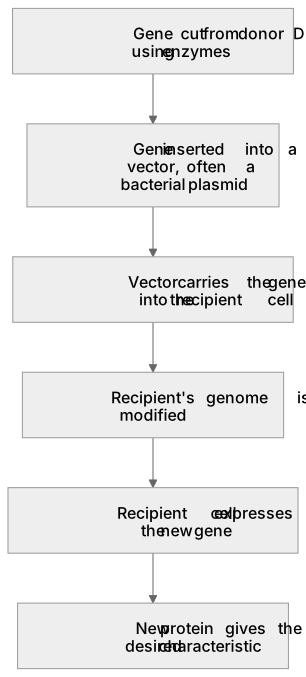
Put it in order
Put these steps in the order they happen.
- 1. Vector carries the gene into the recipient cell
- 2. Gene inserted into a vector, often a bacterial plasmid
- 3. Gene cut from donor DNA using enzymes
- 4. New protein gives the desired characteristic
- 5. Recipient cell expresses the new gene
- 6. Recipient's genome is modified
Key words
Say what each word means before you turn the card.
Genetic engineering
Try answering aloud or in your head before turning the card.
Vector
Try answering aloud or in your head before turning the card.
Enzymes
Try answering aloud or in your head before turning the card.
Desired characteristic
Try answering aloud or in your head before turning the card.
See every definition
- Genetic engineering
- A process which involves modifying the genome of an organism by introducing a gene from another organism to give a desired characteristic.
- Vector
- Something that carries the gene into the recipient cell, commonly a bacterial plasmid.
- Enzymes
- Used to cut the gene from the donor DNA and to insert it into the vector.
- Desired characteristic
- The wanted feature given when the recipient cell expresses the new gene, producing a protein.
Label the diagram
Some boxes have lost their names. Pick the right name for each number.
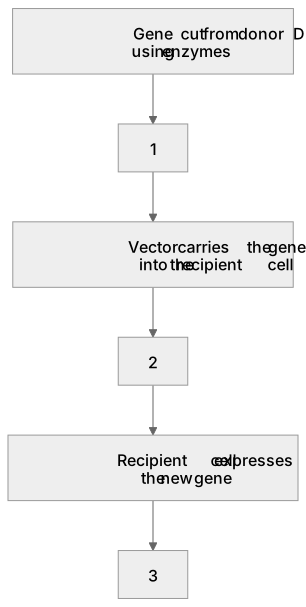
1Box 1
2Box 2
3Box 3
There is more to this lesson
The full lesson goes on to check your understanding and help you earn the marks. Create a free account to carry on, with your progress saved.
A week of Premium from your first lesson · Then the free plan continues · No card, no charge
Test your understanding of Genetic engineering: Students should be able to describe genetic engineering as a process which involves modifying the genome of an organism by introducing a gene from another organism to give a desired characteristic.
Active recall beats re-reading. Take an instant quiz now to test what you’ve learned and lock it into long-term memory.
A week of Premium from your first lesson · Then the free plan continues · No card, no charge