AQA · GCSE · Combined Science
Course version: 8464 · Version from Sept 2018
Plant crops have been genetically engineered to be resistant to diseases…
Full specification wording
Genetic engineering: Plant crops have been genetically engineered to be resistant to diseases or to produce bigger better fruits.
Genetic engineering has been applied to crop plants to give characteristics useful to farmers and consumers.
Checked against the AQA 8464 specification (opens in a new tab) on .
- Point 2 of 12
- 4 key terms
Study notes
From the checked teaching notes for this specification point.
The idea
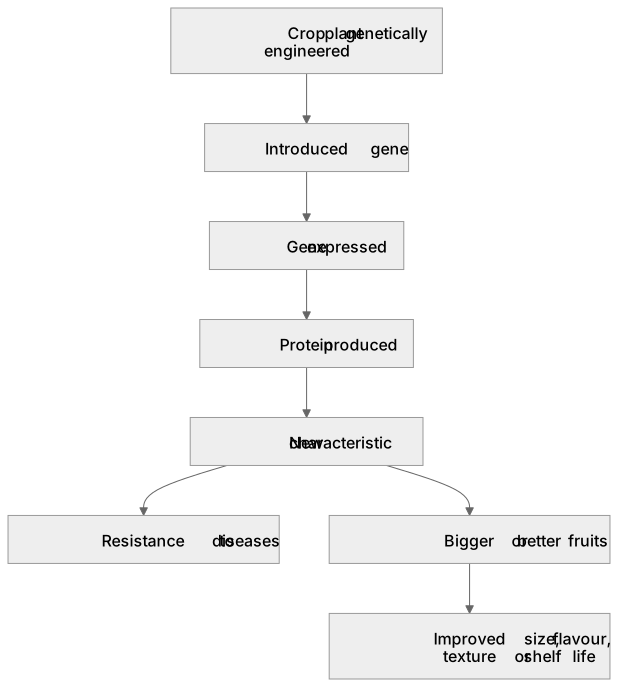
Genetic engineering has been applied to crop plants to give characteristics useful to farmers and consumers. One aim is disease resistance: a gene from another organism is introduced so the plant can resist a pathogen that would otherwise reduce yield. Another aim is improved fruit, where introduced genes lead to larger fruit or better quality, such as improved flavour, texture or shelf life. For example, a gene giving resistance to a fungal disease could be transferred into a crop so fewer plants are lost. The desired characteristic results because the introduced gene is expressed, making a protein that produces the new trait.
What earns the marks
- Crop plants can be genetically engineered so they are resistant to diseases.
- Disease resistance reduces losses caused by pathogens and can improve crop yield.
- Crop plants can also be genetically engineered to produce bigger or better fruits.
- 'Better' fruit can include improved size, flavour, texture or shelf life.
- The improvement arises because the introduced gene is expressed and produces a protein giving the new characteristic.
- A named crop example, such as a disease-resistant or improved-fruit crop, can illustrate the application.
Common mistakes and how to put them right
Claiming genetic engineering makes plants immune to all diseases.
Put it right by saying resistance to particular diseases is produced.
Treating bigger fruit as the only possible improvement.
Put it right by including better quality, such as improved flavour or shelf life.
Saying the plant chooses to change.
Put it right by stating the change comes from a gene introduced by genetic engineering.
Exam tips
- State the specific advantage, such as resistance to a named disease or improved fruit quality, rather than writing only 'better plants'.
- Link each example back to the process by mentioning the introduced gene and its expression.
- Use British spellings and clear crop examples so the answer stays focused on plant applications.
Try the lesson
The start of the Genetic engineering: Plant crops have been genetically engineered to be resistant to diseases or to produce bigger better fruits. lesson, made from checked teaching notes for this specification point.
Have a go first
Which of these is a reason why plant crops have been genetically engineered?
Listen
Genetic engineering has been applied to crop plants to give characteristics useful to farmers and consumers. One aim is disease resistance: a gene from another organism is introduced so the plant can resist a pathogen that would otherwise reduce yield. Another aim is improved fruit, where introduced genes lead to larger fruit or better quality, such as improved flavour, texture or shelf life. For example, a gene giving resistance to a fungal disease could be transferred into a crop so fewer plants are lost. The desired characteristic results because the introduced gene is expressed, making a protein that produces the new trait. A strong answer earns marks for these points. Crop plants can be genetically engineered so they are resistant to diseases. Disease resistance reduces losses caused by pathogens and can improve crop yield. Crop plants can also be genetically engineered to produce bigger or better fruits. Better' fruit can include improved size, flavour, texture or shelf life. A common slip: Claiming genetic engineering makes plants immune to all diseases. Instead, saying resistance to particular diseases is produced. Exam tip: State the specific advantage, such as resistance to a named disease or improved fruit quality, rather than writing only 'better plants'.
See it
Key words
Say what each word means before you turn the card.
Disease resistance in crops
Try answering aloud or in your head before turning the card.
Improved fruit characteristics
Try answering aloud or in your head before turning the card.
Gene expression producing new traits
Try answering aloud or in your head before turning the card.
Agricultural applications of genetic engineering
Try answering aloud or in your head before turning the card.
See every definition
- Disease resistance in crops
- Crop plants can be genetically engineered so they are resistant to diseases, which reduces losses caused by pathogens and can improve crop yield.
- Improved fruit characteristics
- Crop plants can be genetically engineered to produce bigger or better fruits, where better can include improved size, flavour, texture or shelf life.
- Gene expression producing new traits
- The improvement arises because the introduced gene is expressed and produces a protein giving the new characteristic.
- Agricultural applications of genetic engineering
- Genetic engineering has been applied to crop plants to give characteristics useful to farmers and consumers, such as disease resistance or improved fruit.
Label the diagram
Some boxes have lost their names. Pick the right name for each number.
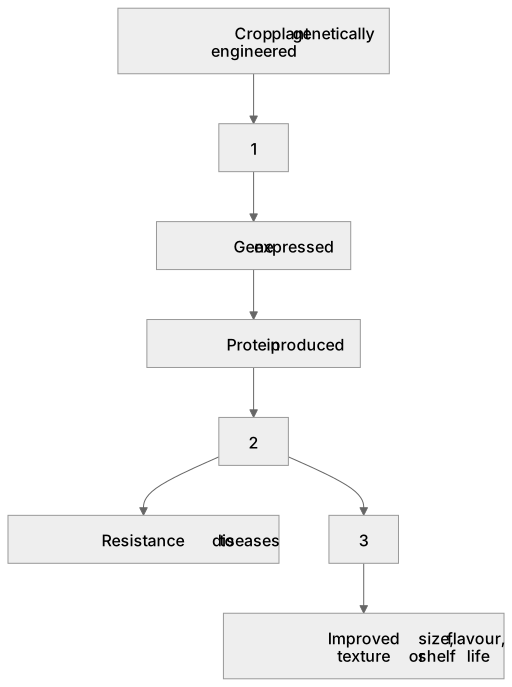
1Box 1
2Box 2
3Box 3
There is more to this lesson
The full lesson goes on to check your understanding and help you earn the marks. Create a free account to carry on, with your progress saved.
A week of Premium from your first lesson · Then the free plan continues · No card, no charge
Test your understanding of Genetic engineering: Plant crops have been genetically engineered to be resistant to diseases or to produce bigger better fruits.
Active recall beats re-reading. Take an instant quiz now to test what you’ve learned and lock it into long-term memory.
A week of Premium from your first lesson · Then the free plan continues · No card, no charge