AQA · GCSE · Combined Science
Course version: 8464 · Version from Sept 2018
Students should be able to complete a Punnett square diagram and extract…
Full specification wording
Genetic inheritance: Students should be able to complete a Punnett square diagram and extract and interpret information from genetic crosses and family trees.
A Punnett square is a grid that predicts the possible allele combinations in offspring.
Checked against the AQA 8464 specification (opens in a new tab) on .
- Point 19 of 20
- 2 key terms
Study notes
From the checked teaching notes for this specification point.
The idea
A Punnett square is a grid that predicts the possible allele combinations in offspring. Write the two alleles of one parent across the top and the two alleles of the other parent down the side, then fill each cell by combining the row and column alleles, keeping dominant alleles capitalised, for example Tt × Tt gives TT, Tt, Tt and tt. From the completed square you can state the ratio of genotypes and phenotypes, such as 3 tall to 1 short. Family trees show the same inheritance over generations: squares are males, circles are females, shaded symbols show the trait, and you deduce genotypes by working from affected offspring back to parents, remembering that a recessive trait can appear in a child only if both parents carry the allele.
What earns the marks
- Correctly sets out parental alleles along the top and side of the grid before filling any cells.
- Fills each cell by combining the row allele with the column allele, using capital letters for dominant alleles and lower case for recessive alleles.
- States genotype outcomes as a ratio or fraction, for example 1 TT : 2 Tt : 1 tt, and links these to the observable phenotypes.
- Uses a family tree to identify the genotype of an individual by tracing the trait through parents and offspring, including identifying carriers of a recessive allele.
- Explains that a recessive phenotype appears only when both alleles are recessive, so unaffected parents can have an affected child only if both are heterozygous.
- Interprets a completed cross to answer a question about the probability or proportion of offspring showing a particular characteristic.
Common mistakes and how to put them right
Writing alleles as a single letter without distinguishing dominant and recessive, for example using T for both.
Put it right: Use an upper-case letter for the dominant allele and the matching lower-case letter for the recessive allele.
Filling the grid by copying one parent's alleles down a column instead of combining row and column alleles.
Put it right: Each cell must contain one allele from each parent.
Assuming a shaded symbol in a family tree always means the individual is homozygous dominant.
Put it right: A shaded symbol shows the recessive phenotype only when the trait is recessive, so its genotype must be checked against the parents.
Exam tips
- Draw the grid with a ruler and write the parental alleles outside the grid before filling cells, so the marker can follow your method.
- After completing the square, always state what the genotypes mean for the phenotype, because interpretation carries credit as well as construction.
- In family tree questions, label each known genotype on the diagram before deducing unknown ones, and check that each deduction is consistent with every affected and unaffected individual.
Try the lesson
The start of the Genetic inheritance: Students should be able to complete a Punnett square diagram and extract and interpret information from genetic crosses and family trees. lesson, made from checked teaching notes for this specification point.
Have a go first
In a genetic cross, one parent has the homozygous dominant genotype (BB) and the other parent has the homozygous recessive genotype (bb). What will be the genotype of all the offspring?
Listen
A Punnett square is a grid that predicts the possible allele combinations in offspring. Write the two alleles of one parent across the top and the two alleles of the other parent down the side, then fill each cell by combining the row and column alleles, keeping dominant alleles capitalised, for example Tt × Tt gives TT, Tt, Tt and tt. From the completed square you can state the ratio of genotypes and phenotypes, such as 3 tall to 1 short. Family trees show the same inheritance over generations: squares are males, circles are females, shaded symbols show the trait, and you deduce genotypes by working from affected offspring back to parents, remembering that a recessive trait can appear in a child only if both parents carry the allele. A strong answer earns marks for these points. Correctly sets out parental alleles along the top and side of the grid before filling any cells. Fills each cell by combining the row allele with the column allele, using capital letters for dominant alleles and lower case for recessive alleles. States genotype outcomes as a ratio or fraction, for example 1 TT : 2 Tt : 1 tt, and links these to the observable phenotypes. Uses a family tree to identify the genotype of an individual by tracing the trait through parents and offspring, including identifying carriers of a recessive allele. A common slip: Writing alleles as a single letter without distinguishing dominant and recessive, for example using T for both. Instead, use an upper-case letter for the dominant allele and the matching lower-case letter for the recessive allele. Exam tip: Draw the grid with a ruler and write the parental alleles outside the grid before filling cells, so the marker can follow your method.
See it
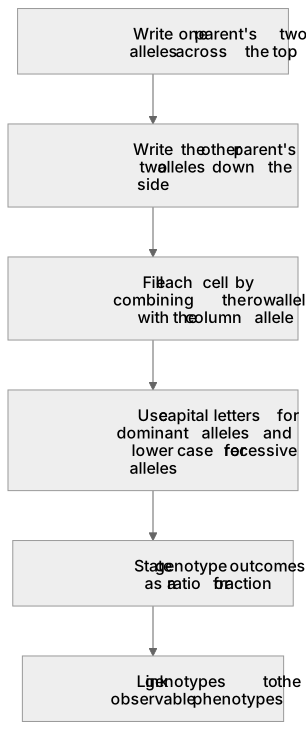
Put it in order
Put these steps in the order they happen.
- 1. Fill each cell by combining the row allele with the column allele
- 2. Write the other parent's two alleles down the side
- 3. Write one parent's two alleles across the top
- 4. Link genotypes to the observable phenotypes
- 5. State genotype outcomes as a ratio or fraction
- 6. Use capital letters for dominant alleles and lower case for recessive alleles
Key words
Say what each word means before you turn the card.
Punnett square
Try answering aloud or in your head before turning the card.
Family tree
Try answering aloud or in your head before turning the card.
See every definition
- Punnett square
- A grid that predicts the possible allele combinations in offspring by combining the row and column alleles.
- Family tree
- A diagram showing inheritance over generations, with squares for males, circles for females and shaded symbols showing the trait.
Label the diagram
Some boxes have lost their names. Pick the right name for each number.
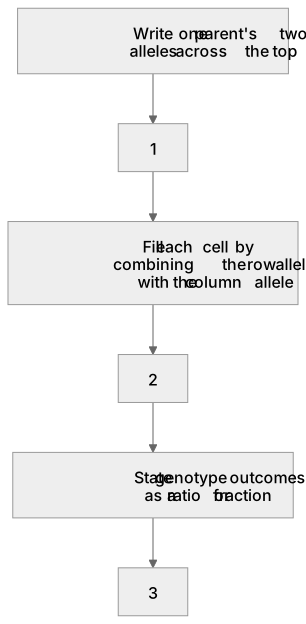
1Box 1
2Box 2
3Box 3
There is more to this lesson
The full lesson goes on to check your understanding and help you earn the marks. Create a free account to carry on, with your progress saved.
A week of Premium from your first lesson · Then the free plan continues · No card, no charge
Test your understanding of Genetic inheritance: Students should be able to complete a Punnett square diagram and extract and interpret information from genetic crosses and family trees.
Active recall beats re-reading. Take an instant quiz now to test what you’ve learned and lock it into long-term memory.
A week of Premium from your first lesson · Then the free plan continues · No card, no charge