AQA · GCSE · Combined Science
Course version: 8464 · Version from Sept 2018
Students should be able to use direct proportion and simple ratios to…
Full specification wording
Genetic inheritance: Students should be able to use direct proportion and simple ratios to express the outcome of a genetic cross.
The outcome of a genetic cross can be expressed as a ratio or as a proportion.
Checked against the AQA 8464 specification (opens in a new tab) on .
- Point 18 of 20
- 4 key terms
Study notes
From the checked teaching notes for this specification point.
The idea
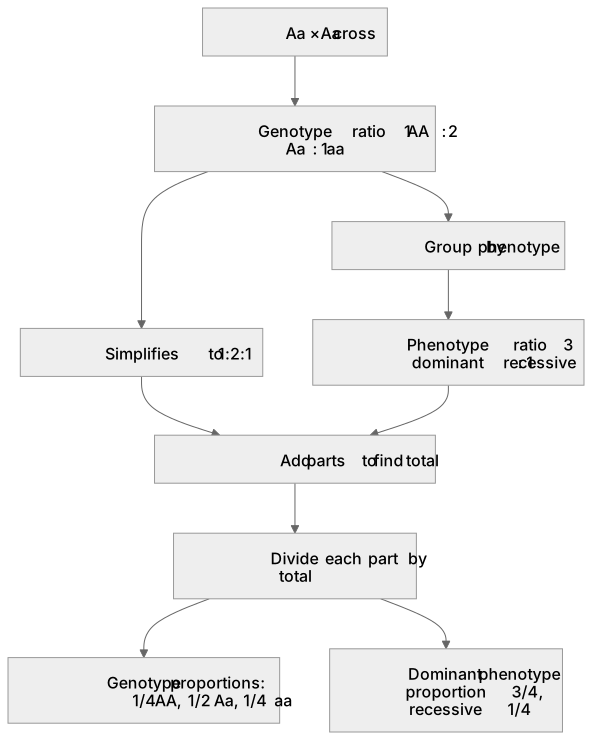
The outcome of a genetic cross can be expressed as a ratio or as a proportion. In a monohybrid cross between two heterozygotes (Aa × Aa), the genotype ratio is 1 AA : 2 Aa : 1 aa, which simplifies to 1:2:1, and the phenotype ratio for a dominant trait is 3 dominant : 1 recessive. Direct proportion converts these ratios into fractions or percentages of the total: 1:2:1 means 1/4 AA, 1/2 Aa and 1/4 aa, while 3:1 means 3/4 dominant and 1/4 recessive. To use direct proportion, add the parts of the ratio to find the total, then divide each part by the total. For example, in a ratio of 3:1 the total is 4, so the proportions are 3/4 and 1/4. Ratios compare parts to parts, whereas proportions compare a part to the whole.
What earns the marks
- A genetic cross outcome can be written as a ratio comparing the numbers of each genotype or phenotype, such as 1:2:1 or 3:1.
- Direct proportion converts a ratio into a fraction or percentage of the total by adding the parts to find the total and dividing each part by that total.
- For Aa × Aa, the genotype ratio 1:2:1 gives proportions of 1/4 AA, 1/2 Aa and 1/4 aa, and the dominant phenotype proportion is 3/4.
- Ratios compare parts with parts, while proportions compare a part with the whole, so the same cross can be expressed in either form.
- Expected ratios describe large numbers of offspring; actual small samples may differ because fertilisation is random.
Common mistakes and how to put them right
Writing the phenotype ratio as 1:2:1 instead of 3:1 when dominance makes AA and Aa look the same.
Put it right: Group genotypes by phenotype before writing the ratio.
Adding the ratio parts incorrectly, for example treating 3:1 as 3/1 rather than 3/4 and 1/4.
Put it right: Add the parts to find the total, then divide each part by the total.
Mixing up ratio and proportion, such as saying the proportion of recessive offspring is 1:4.
Put it right: Write proportions as fractions, decimals or percentages, not with a colon.
Exam tips
- Show the total number of parts when converting a ratio to a proportion so the examiner can follow your method.
- Label ratios clearly as genotype or phenotype, because the same cross can give 1:2:1 and 3:1.
- Check whether the question asks for a ratio, a fraction or a percentage, and answer in that form.
Try the lesson
The start of the Genetic inheritance: Students should be able to use direct proportion and simple ratios to express the outcome of a genetic cross. lesson, made from checked teaching notes for this specification point.
Have a go first
A genetic cross gives 3 dominant to 1 recessive. What fraction of the offspring are expected to show the recessive phenotype?
Listen
The outcome of a genetic cross can be expressed as a ratio or as a proportion. In a monohybrid cross between two heterozygotes (Aa × Aa), the genotype ratio is 1 AA : 2 Aa : 1 aa, which simplifies to 1:2:1, and the phenotype ratio for a dominant trait is 3 dominant : 1 recessive. Direct proportion converts these ratios into fractions or percentages of the total: 1:2:1 means 1/4 AA, 1/2 Aa and 1/4 aa, while 3:1 means 3/4 dominant and 1/4 recessive. To use direct proportion, add the parts of the ratio to find the total, then divide each part by the total. For example, in a ratio of 3:1 the total is 4, so the proportions are 3/4 and 1/4. Ratios compare parts to parts, whereas proportions compare a part to the whole. A strong answer earns marks for these points. A genetic cross outcome can be written as a ratio comparing the numbers of each genotype or phenotype, such as 1:2:1 or 3:1. Direct proportion converts a ratio into a fraction or percentage of the total by adding the parts to find the total and dividing each part by that total. For Aa × Aa, the genotype ratio 1:2:1 gives proportions of 1/4 AA, 1/2 Aa and 1/4 aa, and the dominant phenotype proportion is 3/4. Ratios compare parts with parts, while proportions compare a part with the whole, so the same cross can be expressed in either form. A common slip: Writing the phenotype ratio as 1:2:1 instead of 3:1 when dominance makes AA and Aa look the same. Instead, group genotypes by phenotype before writing the ratio. Exam tip: Show the total number of parts when converting a ratio to a proportion so the examiner can follow your method.
See it
Key words
Say what each word means before you turn the card.
Ratio
Try answering aloud or in your head before turning the card.
Proportion
Try answering aloud or in your head before turning the card.
Direct proportion
Try answering aloud or in your head before turning the card.
Expected ratios
Try answering aloud or in your head before turning the card.
See every definition
- Ratio
- A way of comparing parts with parts, such as the numbers of each genotype or phenotype in a genetic cross.
- Proportion
- A comparison of a part with the whole, written as a fraction, decimal or percentage rather than with a colon.
- Direct proportion
- A method that converts a ratio into a fraction or percentage of the total by adding the parts to find the total and dividing each part by that total.
- Expected ratios
- Ratios that describe large numbers of offspring, while actual small samples may differ because fertilisation is random.
Label the diagram
Some boxes have lost their names. Pick the right name for each number.
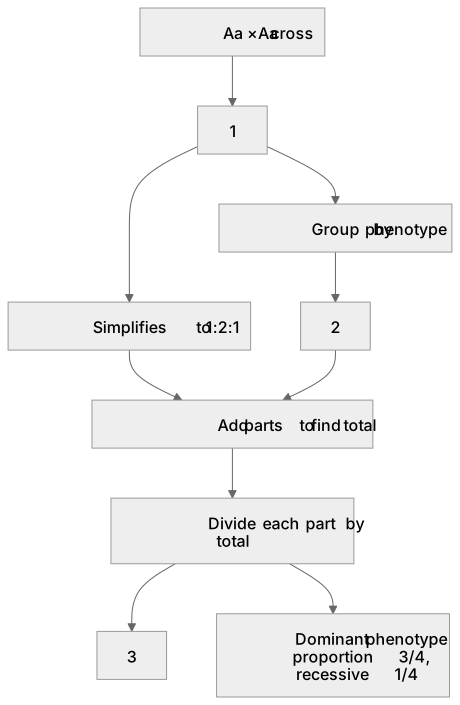
1Box 1
2Box 2
3Box 3
There is more to this lesson
The full lesson goes on to check your understanding and help you earn the marks. Create a free account to carry on, with your progress saved.
A week of Premium from your first lesson · Then the free plan continues · No card, no charge
Test your understanding of Genetic inheritance: Students should be able to use direct proportion and simple ratios to express the outcome of a genetic cross.
Active recall beats re-reading. Take an instant quiz now to test what you’ve learned and lock it into long-term memory.
A week of Premium from your first lesson · Then the free plan continues · No card, no charge