AQA · GCSE · Combined Science
Course version: 8464 · Version from Sept 2018
Students should be able to recognise giant covalent structures from…
Full specification wording
Giant covalent structures: Students should be able to recognise giant covalent structures from diagrams showing their bonding and structure.
A giant covalent structure is a three-dimensional network of atoms joined by covalent bonds, with no separate molecules and no overall charge.
Checked against the AQA 8464 specification (opens in a new tab) on .
- Point 2 of 2
- 4 key terms
Study notes
From the checked teaching notes for this specification point.
The idea
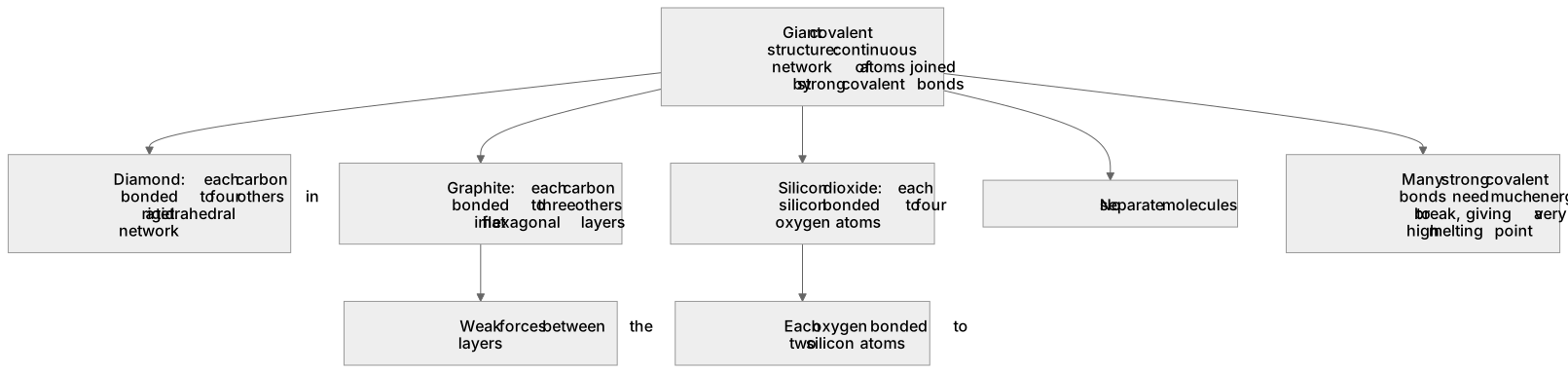
A giant covalent structure is a three-dimensional network of atoms joined by covalent bonds, with no separate molecules and no overall charge. In a diagram, look for a continuous repeating lattice where every atom is bonded to a fixed number of neighbours, such as carbon in diamond bonded to four others in a tetrahedral pattern, or in graphite bonded to three others in flat hexagonal layers. Silicon dioxide shows silicon bonded to four oxygen atoms and each oxygen bonded to two silicon atoms. Recognising the structure means identifying the repeating unit, counting bonds per atom, and noting whether layers or a rigid three-dimensional network are present. This matters because the bonding explains the very high melting points, hardness or softness, and electrical behaviour of these substances.
What earns the marks
- Identify a giant covalent structure as a continuous three-dimensional network of atoms joined by strong covalent bonds, not as a collection of separate small molecules.
- Recognise diamond from a diagram showing each carbon atom covalently bonded to four other carbon atoms in a rigid tetrahedral network.
- Recognise graphite from a diagram showing each carbon atom bonded to three others in flat hexagonal layers, with weak forces between the layers.
- Recognise silicon dioxide from a diagram showing silicon atoms each bonded to four oxygen atoms and oxygen atoms each bonded to two silicon atoms.
- Use the diagram to explain a property, for example many strong covalent bonds need much energy to break, giving a very high melting point.
- Distinguish giant covalent structures from simple molecular structures, where diagrams show small discrete groups of atoms with weak intermolecular forces between them.
Common mistakes and how to put them right
Treating a giant covalent diagram as a molecule and writing a molecular formula such as C₆₀.
Put it right: State that the diagram shows a repeating lattice with no fixed small number of atoms.
Saying graphite is soft because its covalent bonds are weak.
Put it right: The covalent bonds within each layer are strong, but the layers slide because the forces between layers are weak.
Assuming all giant covalent substances conduct electricity.
Put it right: Diamond and silicon dioxide do not conduct because they have no free electrons or ions, whereas graphite conducts because each carbon has a delocalised electron.
Exam tips
- When shown a diagram, first count how many atoms each atom is bonded to; this quickly separates diamond-like networks from layer structures.
- Link each structural feature to a named property in the same sentence, for example 'each carbon bonds to four others, so the network is rigid and the melting point is very high'.
- Use the terms 'giant covalent', 'lattice' and 'strong covalent bonds' accurately, and avoid saying 'molecules' for these structures.
Try the lesson
The start of the Giant covalent structures: Students should be able to recognise giant covalent structures from diagrams showing their bonding and structure. lesson, made from checked teaching notes for this specification point.
Have a go first
The diagram below shows a small section of a substance's structure:
C / \ C C / \ / \ C C C
The lines represent covalent bonds. The pattern repeats in all directions. What type of structure does this represent?
Listen
A giant covalent structure is a three-dimensional network of atoms joined by covalent bonds, with no separate molecules and no overall charge. In a diagram, look for a continuous repeating lattice where every atom is bonded to a fixed number of neighbours, such as carbon in diamond bonded to four others in a tetrahedral pattern, or in graphite bonded to three others in flat hexagonal layers. Silicon dioxide shows silicon bonded to four oxygen atoms and each oxygen bonded to two silicon atoms. Recognising the structure means identifying the repeating unit, counting bonds per atom, and noting whether layers or a rigid three-dimensional network are present. This matters because the bonding explains the very high melting points, hardness or softness, and electrical behaviour of these substances. A strong answer earns marks for these points. Identify a giant covalent structure as a continuous three-dimensional network of atoms joined by strong covalent bonds, not as a collection of separate small molecules. Recognise diamond from a diagram showing each carbon atom covalently bonded to four other carbon atoms in a rigid tetrahedral network. Recognise graphite from a diagram showing each carbon atom bonded to three others in flat hexagonal layers, with weak forces between the layers. Recognise silicon dioxide from a diagram showing silicon atoms each bonded to four oxygen atoms and oxygen atoms each bonded to two silicon atoms. A common slip: Treating a giant covalent diagram as a molecule and writing a molecular formula such as C₆₀. Instead, state that the diagram shows a repeating lattice with no fixed small number of atoms. Exam tip: When shown a diagram, first count how many atoms each atom is bonded to; this quickly separates diamond-like networks from layer structures.
See it
Key words
Say what each word means before you turn the card.
Giant covalent structure
Try answering aloud or in your head before turning the card.
Bonding and structure
Try answering aloud or in your head before turning the card.
Structure-property relationships
Try answering aloud or in your head before turning the card.
Recognition and interpretation of diagrams
Try answering aloud or in your head before turning the card.
See every definition
- Giant covalent structure
- A three-dimensional network of atoms joined by covalent bonds, with no separate molecules and no overall charge.
- Bonding and structure
- The way atoms are joined by covalent bonds and arranged in a continuous repeating lattice, which can be recognised from diagrams.
- Structure-property relationships
- The bonding explains the very high melting points, hardness or softness, and electrical behaviour of these substances.
- Recognition and interpretation of diagrams
- Identifying the repeating unit, counting bonds per atom, and noting whether layers or a rigid three-dimensional network are present.
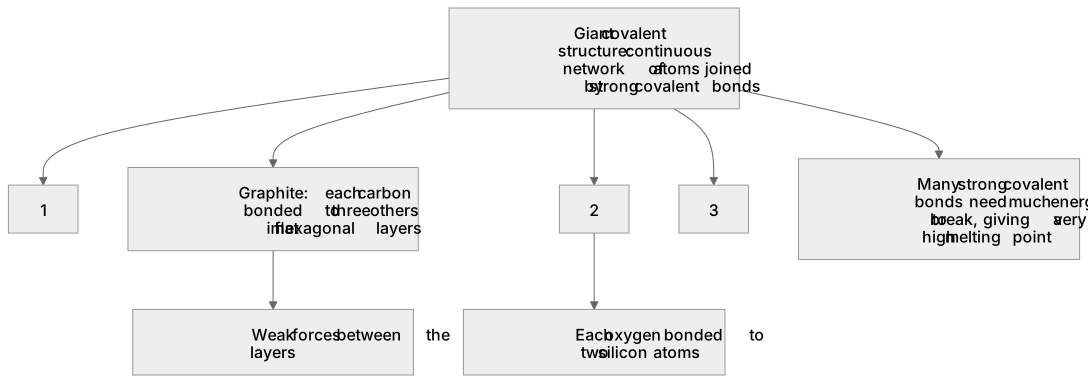
Label the diagram
Some boxes have lost their names. Pick the right name for each number.
1Box 1
2Box 2
3Box 3
There is more to this lesson
The full lesson goes on to check your understanding and help you earn the marks. Create a free account to carry on, with your progress saved.
A week of Premium from your first lesson · Then the free plan continues · No card, no charge
Test your understanding of Giant covalent structures: Students should be able to recognise giant covalent structures from diagrams showing their bonding and structure.
Active recall beats re-reading. Take an instant quiz now to test what you’ve learned and lock it into long-term memory.
A week of Premium from your first lesson · Then the free plan continues · No card, no charge