AQA · GCSE · Combined Science
Course version: 8464 · Version from Sept 2018
Substances that consist of giant covalent structures are solids with very…
Full specification wording
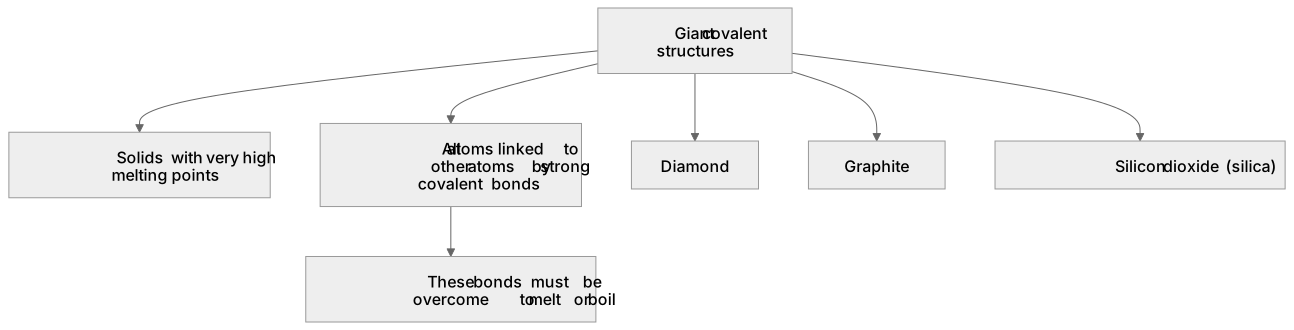
Giant covalent structures: Substances that consist of giant covalent structures are solids with very high melting points. All of the atoms in these structures are linked to other atoms by strong covalent bonds. These bonds must be overcome to melt or boil these substances. Diamond and graphite (forms of carbon) and silicon dioxide (silica) are examples of giant covalent structures.
Giant covalent structures are lattices of many atoms joined by strong covalent bonds in a continuous network.
Checked against the AQA 8464 specification (opens in a new tab) on .
- Point 1 of 2
- 4 key terms
Study notes
From the checked teaching notes for this specification point.
The idea
Giant covalent structures are lattices of many atoms joined by strong covalent bonds in a continuous network. Because these bonds extend throughout the structure, melting or boiling requires breaking many strong covalent bonds, so the substances are solids with very high melting points. Diamond, graphite and silicon dioxide are examples. In diamond, each carbon atom bonds to four others in a tetrahedral network. In graphite, each carbon bonds to three others in layers, with weak forces between layers. In silicon dioxide, each silicon atom bonds to four oxygen atoms and each oxygen to two silicon atoms. The key idea is that the strong covalent bonds must be overcome to melt or boil the substance.
What earns the marks
- State that giant covalent structures are solids with very high melting points because many strong covalent bonds must be broken.
- Describe the continuous network of atoms linked by strong covalent bonds in diamond, graphite and silicon dioxide.
- Explain that melting or boiling requires overcoming these strong covalent bonds, not just weakening intermolecular forces.
- Recognise diamond as a giant covalent structure where each carbon atom bonds to four others.
- Recognise graphite as a giant covalent structure where each carbon atom bonds to three others in layers.
- Recognise silicon dioxide as a giant covalent structure of silicon and oxygen atoms bonded in a continuous network.
Common mistakes and how to put them right
Saying that giant covalent substances melt easily because they have weak forces between molecules.
Put it right by stating that they have a giant network of strong covalent bonds, so melting points are very high.
Confusing graphite with a simple molecular substance.
Put it right by noting that graphite is a giant covalent structure with layers of covalently bonded carbon atoms.
Thinking that only some bonds break when a giant covalent substance melts.
Put it right by explaining that many strong covalent bonds must be overcome throughout the structure.
Exam tips
- Link the high melting point directly to the need to break many strong covalent bonds, not to intermolecular forces.
- When comparing diamond and graphite, mention the different bonding arrangements: diamond has four bonds per carbon, graphite has three bonds per carbon in layers.
- Use the examples diamond, graphite and silicon dioxide to support your answers about giant covalent structures.
Try the lesson
The start of the Giant covalent structures: Substances that consist of giant covalent structures are solids with very high melting points. All of the atoms in these structures are linked to other atoms by strong covalent bonds. These bonds must be overcome to melt or boil these substances. Diamond and graphite (forms of carbon) and silicon dioxide (silica) are examples of giant covalent structures. lesson, made from checked teaching notes for this specification point.
Have a go first
Which of these substances is an example of a giant covalent structure?
Listen
Giant covalent structures are lattices of many atoms joined by strong covalent bonds in a continuous network. Because these bonds extend throughout the structure, melting or boiling requires breaking many strong covalent bonds, so the substances are solids with very high melting points. Diamond, graphite and silicon dioxide are examples. In diamond, each carbon atom bonds to four others in a tetrahedral network. In graphite, each carbon bonds to three others in layers, with weak forces between layers. In silicon dioxide, each silicon atom bonds to four oxygen atoms and each oxygen to two silicon atoms. The key idea is that the strong covalent bonds must be overcome to melt or boil the substance. A strong answer earns marks for these points. State that giant covalent structures are solids with very high melting points because many strong covalent bonds must be broken. Describe the continuous network of atoms linked by strong covalent bonds in diamond, graphite and silicon dioxide. Explain that melting or boiling requires overcoming these strong covalent bonds, not just weakening intermolecular forces. Recognise diamond as a giant covalent structure where each carbon atom bonds to four others. A common slip: Saying that giant covalent substances melt easily because they have weak forces between molecules. Instead, stating that they have a giant network of strong covalent bonds, so melting points are very high. Exam tip: Link the high melting point directly to the need to break many strong covalent bonds, not to intermolecular forces.
See it
Key words
Say what each word means before you turn the card.
Giant covalent structures
Try answering aloud or in your head before turning the card.
Strong covalent bonds
Try answering aloud or in your head before turning the card.
High melting points
Try answering aloud or in your head before turning the card.
Diamond, graphite and silicon dioxide
Try answering aloud or in your head before turning the card.
See every definition
- Giant covalent structures
- Solids in which all of the atoms are linked to other atoms by strong covalent bonds, giving very high melting points.
- Strong covalent bonds
- Bonds that link all of the atoms in these structures to other atoms and must be overcome to melt or boil the substances.
- High melting points
- The very high melting points of these solids arise because many strong covalent bonds must be overcome to melt or boil them.
- Diamond, graphite and silicon dioxide
- Forms of carbon and silica given as examples of giant covalent structures.
Label the diagram
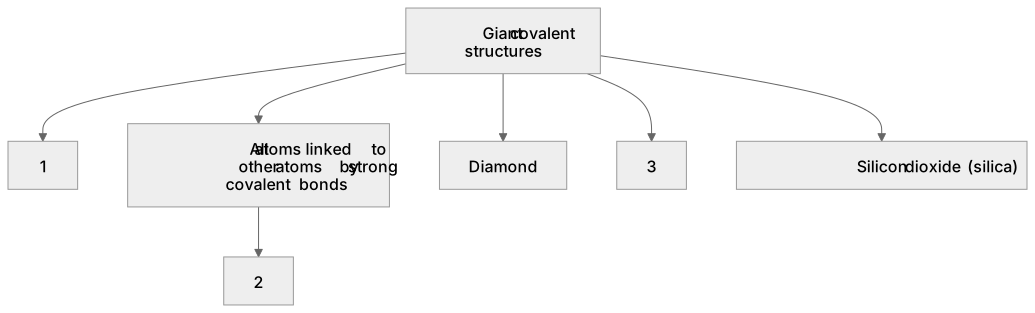
Some boxes have lost their names. Pick the right name for each number.
1Box 1
2Box 2
3Box 3
There is more to this lesson
The full lesson goes on to check your understanding and help you earn the marks. Create a free account to carry on, with your progress saved.
A week of Premium from your first lesson · Then the free plan continues · No card, no charge
Test your understanding of Giant covalent structures: Substances that consist of giant covalent structures are solids with very high melting points. All of the atoms in these structures are linked to other atoms by strong covalent bonds. These bonds must be overcome to melt or boil these substances. Diamond and graphite (forms of carbon) and silicon dioxide (silica) are examples of giant covalent structures.
Active recall beats re-reading. Take an instant quiz now to test what you’ve learned and lock it into long-term memory.
A week of Premium from your first lesson · Then the free plan continues · No card, no charge