AQA · GCSE · Combined Science
Course version: 8464 · Version from Sept 2018
Carbon nanotubes are cylindrical fullerenes with very high length to…
Full specification wording
Graphene and fullerenes: Carbon nanotubes are cylindrical fullerenes with very high length to diameter ratios. Their properties make them useful for nanotechnology, electronics and materials.
Carbon nanotubes are a form of fullerene in which carbon atoms bond in a seamless cylinder, often imagined as a rolled-up sheet of graphene.
Checked against the AQA 8464 specification (opens in a new tab) on .
- Point 4 of 6
- 4 key terms
Study notes
From the checked teaching notes for this specification point.
The idea
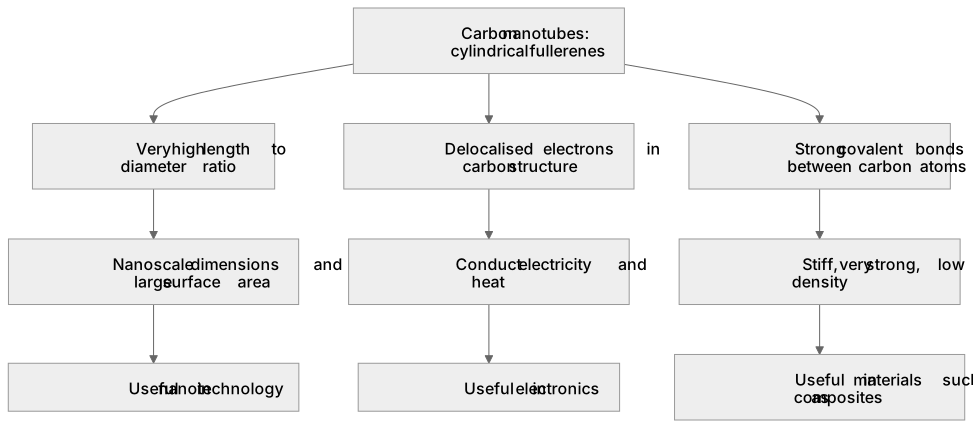
Carbon nanotubes are a form of fullerene in which carbon atoms bond in a seamless cylinder, often imagined as a rolled-up sheet of graphene. Because the tube is only nanometres wide but can be micrometres long, its length to diameter ratio is very high, giving an enormous surface area for its mass. The delocalised electrons along the carbon framework allow tubes to conduct electricity and heat, while the strong covalent carbon-carbon bonds make them stiff and very strong yet low in density. These combined properties explain their use in nanotechnology, in electronics such as nanoscale wiring or components, and in materials such as lightweight composites for sports equipment or vehicles.
What earns the marks
- Carbon nanotubes are fullerenes shaped as cylinders, formed from carbon atoms bonded in a curved hexagonal network.
- Delocalised electrons within the carbon structure allow nanotubes to conduct electricity and thermal energy.
- Strong covalent bonds between carbon atoms give nanotubes high tensile strength and stiffness while their low mass keeps them lightweight.
- Their nanoscale dimensions and large surface area make them suitable for nanotechnology applications.
Common mistakes and how to put them right
Describing nanotubes as molecules with a fixed small formula rather than as very large covalent structures of carbon.
Put it right by stating they are giant covalent fullerene structures.
Confusing nanotubes with graphene sheets or with spherical fullerenes such as buckminsterfullerene.
Put it right by stressing the cylindrical, tube shape.
Claiming nanotubes are weak because they are thin.
Put it right by explaining that strong covalent bonding along the tube gives high strength despite the tiny diameter.
Exam tips
- Link each property directly to a named use, for example electrical conductivity to electronics and high strength with low density to composite materials.
- Use comparative language such as very high length to diameter ratio and nanometre scale to show understanding of size.
- Sketch a simple cylinder of hexagons if a diagram is requested, and label the tube shape and carbon bonding.
Try the lesson
The start of the Graphene and fullerenes: Carbon nanotubes are cylindrical fullerenes with very high length to diameter ratios. Their properties make them useful for nanotechnology, electronics and materials. lesson, made from checked teaching notes for this specification point.
Have a go first
Which shape best describes a carbon nanotube?
Listen
Carbon nanotubes are a form of fullerene in which carbon atoms bond in a seamless cylinder, often imagined as a rolled-up sheet of graphene. Because the tube is only nanometres wide but can be micrometres long, its length to diameter ratio is very high, giving an enormous surface area for its mass. The delocalised electrons along the carbon framework allow tubes to conduct electricity and heat, while the strong covalent carbon-carbon bonds make them stiff and very strong yet low in density. These combined properties explain their use in nanotechnology, in electronics such as nanoscale wiring or components, and in materials such as lightweight composites for sports equipment or vehicles. A strong answer earns marks for these points. Carbon nanotubes are fullerenes shaped as cylinders, formed from carbon atoms bonded in a curved hexagonal network. Delocalised electrons within the carbon structure allow nanotubes to conduct electricity and thermal energy. Strong covalent bonds between carbon atoms give nanotubes high tensile strength and stiffness while their low mass keeps them lightweight. Their nanoscale dimensions and large surface area make them suitable for nanotechnology applications. A common slip: Describing nanotubes as molecules with a fixed small formula rather than as very large covalent structures of carbon. Instead, stating they are giant covalent fullerene structures. Exam tip: Link each property directly to a named use, for example electrical conductivity to electronics and high strength with low density to composite materials.
See it
Key words
Say what each word means before you turn the card.
Carbon nanotubes
Try answering aloud or in your head before turning the card.
Nanotechnology
Try answering aloud or in your head before turning the card.
Electronics
Try answering aloud or in your head before turning the card.
Composite materials
Try answering aloud or in your head before turning the card.
See every definition
- Carbon nanotubes
- Fullerenes shaped as cylinders, formed from carbon atoms bonded in a curved hexagonal network, with a very high length to diameter ratio.
- Nanotechnology
- A field in which the nanoscale dimensions and large surface area of carbon nanotubes make them suitable for use.
- Electronics
- An application area where carbon nanotubes are useful, for example in tiny circuits or conductive components.
- Composite materials
- Materials in which carbon nanotubes are useful because they are strong and light.
Label the diagram
Some boxes have lost their names. Pick the right name for each number.
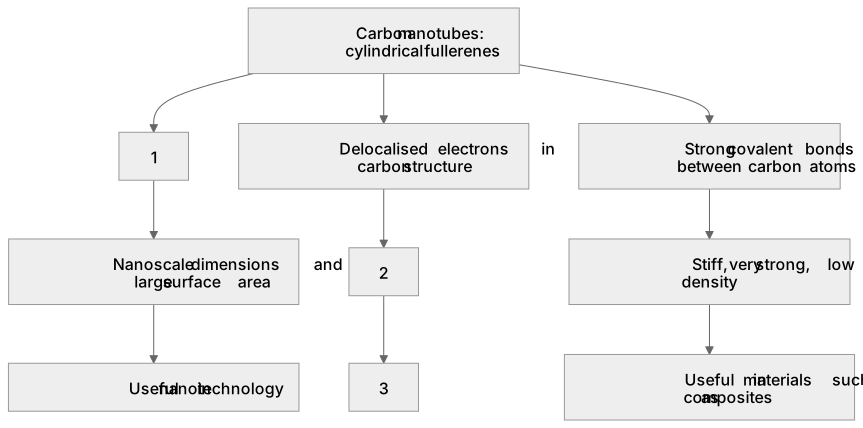
1Box 1
2Box 2
3Box 3
There is more to this lesson
The full lesson goes on to check your understanding and help you earn the marks. Create a free account to carry on, with your progress saved.
A week of Premium from your first lesson · Then the free plan continues · No card, no charge
Test your understanding of Graphene and fullerenes: Carbon nanotubes are cylindrical fullerenes with very high length to diameter ratios. Their properties make them useful for nanotechnology, electronics and materials.
Active recall beats re-reading. Take an instant quiz now to test what you’ve learned and lock it into long-term memory.
A week of Premium from your first lesson · Then the free plan continues · No card, no charge