AQA · GCSE · Combined Science
Course version: 8464 · Version from Sept 2018
Fullerenes are molecules of carbon atoms with hollow shapes. The structure…
Full specification wording
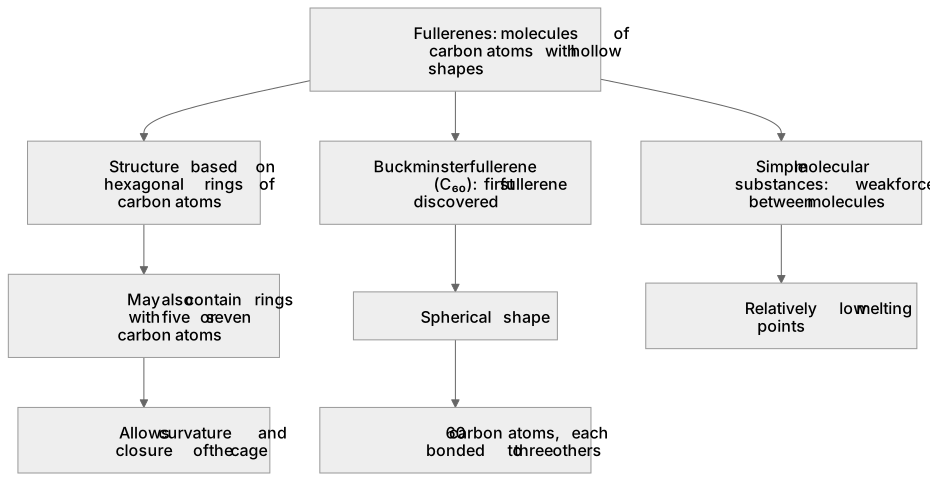
Graphene and fullerenes: Fullerenes are molecules of carbon atoms with hollow shapes. The structure of fullerenes is based on hexagonal rings of carbon atoms but they may also contain rings with five or seven carbon atoms. The first fullerene to be discovered was Buckminsterfullerene (C₆₀) which has a spherical shape.
Fullerenes are molecular forms of carbon with hollow cage-like shapes.
Checked against the AQA 8464 specification (opens in a new tab) on .
- Point 3 of 6
- 3 key terms
Study notes
From the checked teaching notes for this specification point.
The idea
Fullerenes are molecular forms of carbon with hollow cage-like shapes. Their frameworks are built mainly from hexagonal rings of carbon atoms, but pentagonal or heptagonal rings can also be present, which allows the sheet to curve and close into a hollow shape. Buckminsterfullerene, C₆₀, was the first fullerene discovered; it contains 60 carbon atoms arranged in a sphere resembling a football, with each carbon bonded to three others. Because fullerenes are molecules, they have weak forces between separate molecules, so they have relatively low melting points compared with giant covalent carbon structures such as diamond. Their hollow cages can enclose other atoms or ions, which makes them useful in drug delivery and as catalysts.
What earns the marks
- Fullerenes are molecules made only of carbon atoms and have hollow shapes.
- Their frameworks are based on hexagonal rings of carbon atoms.
- Rings with five or seven carbon atoms may also be present, allowing curvature and closure of the cage.
- Buckminsterfullerene, C₆₀, was the first fullerene discovered and has a spherical shape.
- C₆₀ contains 60 carbon atoms, each bonded to three others, forming a football-like cage.
- Fullerenes are simple molecular substances, so weak forces between molecules give relatively low melting points.
Common mistakes and how to put them right
Describing fullerenes as giant covalent structures.
Put it right by stating they are simple molecules with weak forces between molecules.
Saying C₆₀ contains 60 carbon atoms joined by 60 bonds.
Put it right by noting each carbon forms three bonds, so the number of bonds differs from the number of atoms.
Stating that fullerenes contain only hexagonal rings.
Put it right by including the possibility of five- or seven-membered rings that create the hollow curved shape.
Exam tips
- Quote the formula C₆₀ and state that it contains 60 carbon atoms when asked about Buckminsterfullerene.
- Use the phrase 'hollow shape' and mention hexagonal rings plus possible five- or seven-membered rings.
- Contrast fullerenes with diamond and graphite in terms of molecular versus giant covalent structure when comparing properties.
Try the lesson
The start of the Graphene and fullerenes: Fullerenes are molecules of carbon atoms with hollow shapes. The structure of fullerenes is based on hexagonal rings of carbon atoms but they may also contain rings with five or seven carbon atoms. The first fullerene to be discovered was Buckminsterfullerene (C₆₀) which has a spherical shape. lesson, made from checked teaching notes for this specification point.
Have a go first
A fullerene molecule has a structure based on hexagonal rings of carbon atoms. Which other sizes of carbon rings can also be found in the structure of fullerenes?
Listen
Fullerenes are molecular forms of carbon with hollow cage-like shapes. Their frameworks are built mainly from hexagonal rings of carbon atoms, but pentagonal or heptagonal rings can also be present, which allows the sheet to curve and close into a hollow shape. Buckminsterfullerene, C₆₀, was the first fullerene discovered; it contains 60 carbon atoms arranged in a sphere resembling a football, with each carbon bonded to three others. Because fullerenes are molecules, they have weak forces between separate molecules, so they have relatively low melting points compared with giant covalent carbon structures such as diamond. Their hollow cages can enclose other atoms or ions, which makes them useful in drug delivery and as catalysts. A strong answer earns marks for these points. Fullerenes are molecules made only of carbon atoms and have hollow shapes. Their frameworks are based on hexagonal rings of carbon atoms. Rings with five or seven carbon atoms may also be present, allowing curvature and closure of the cage. Buckminsterfullerene, C₆₀, was the first fullerene discovered and has a spherical shape. A common slip: Describing fullerenes as giant covalent structures. Instead, stating they are simple molecules with weak forces between molecules. Exam tip: Quote the formula C₆₀ and state that it contains 60 carbon atoms when asked about Buckminsterfullerene.
See it
Key words
Say what each word means before you turn the card.
Fullerenes
Try answering aloud or in your head before turning the card.
Buckminsterfullerene
Try answering aloud or in your head before turning the card.
Simple molecular substances
Try answering aloud or in your head before turning the card.
See every definition
- Fullerenes
- Molecules of carbon atoms with hollow shapes, based on hexagonal rings but possibly containing rings with five or seven carbon atoms.
- Buckminsterfullerene
- The first fullerene to be discovered, C₆₀, which has a spherical shape.
- Simple molecular substances
- Substances such as fullerenes, which have weak forces between separate molecules and so relatively low melting points compared with giant covalent carbon structures.
Label the diagram
Some boxes have lost their names. Pick the right name for each number.
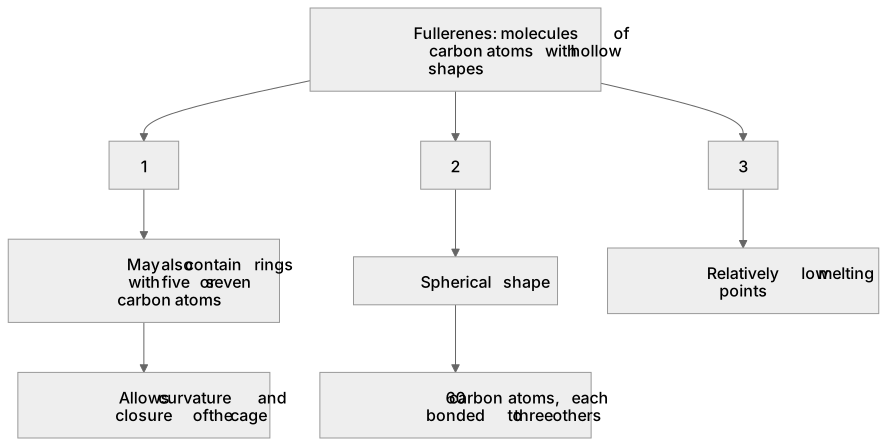
1Box 1
2Box 2
3Box 3
There is more to this lesson
The full lesson goes on to check your understanding and help you earn the marks. Create a free account to carry on, with your progress saved.
A week of Premium from your first lesson · Then the free plan continues · No card, no charge
Test your understanding of Graphene and fullerenes: Fullerenes are molecules of carbon atoms with hollow shapes. The structure of fullerenes is based on hexagonal rings of carbon atoms but they may also contain rings with five or seven carbon atoms. The first fullerene to be discovered was Buckminsterfullerene (C₆₀) which has a spherical shape.
Active recall beats re-reading. Take an instant quiz now to test what you’ve learned and lock it into long-term memory.
A week of Premium from your first lesson · Then the free plan continues · No card, no charge