AQA · GCSE · Combined Science
Course version: 8464 · Version from Sept 2018
Explain how properties of the elements in Group 1 depend on the outer…
Full specification wording
Group 1: explain how properties of the elements in Group 1 depend on the outer shell of electrons of the atoms
Group 1 elements (lithium, sodium, potassium, rubidium, caesium) each have one electron in their outer shell, and this single outer electron controls their properties.
Checked against the AQA 8464 specification (opens in a new tab) on .
- Point 4 of 5
- 4 key terms
Study notes
From the checked teaching notes for this specification point.
The idea
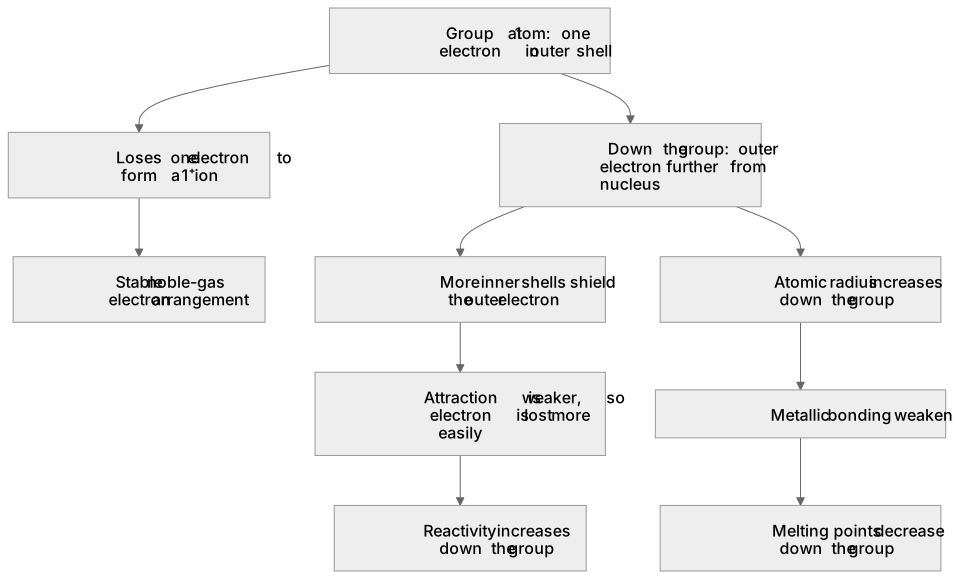
Group 1 elements (lithium, sodium, potassium, rubidium, caesium) each have one electron in their outer shell, and this single outer electron controls their properties. Atoms lose this electron to form 1⁺ ions, giving a stable noble-gas electron arrangement. The ease of losing it increases down the group because the outer electron is further from the nucleus and shielded by more inner shells, so the attraction is weaker. This explains why reactivity increases down Group 1: lithium reacts slowly with water, sodium vigorously, potassium violently. It also explains the pattern in melting points, which decrease down the group as atomic radius increases and metallic bonding weakens. The single outer electron therefore links electron configuration to observed chemical and physical behaviour.
What earns the marks
- Group 1 atoms have one electron in their outer shell, so they lose one electron to form a 1⁺ ion with a stable noble-gas configuration.
- The outer electron is held less strongly down the group because it is further from the nucleus and shielded by additional inner shells.
- Reactivity increases down the group because the outer electron is lost more easily, so reactions with water become more vigorous.
- Melting points decrease down the group because atomic radius increases and the metallic bond weakens as the outer electron is further from the positive nucleus.
- The single outer electron explains why Group 1 elements form ionic compounds with a 1⁺ charge and show similar chemical reactions.
Common mistakes and how to put them right
Saying Group 1 atoms gain an electron to fill the outer shell.
Put it right by stating they lose one electron to form a 1⁺ ion.
Claiming reactivity decreases down the group.
Put it right by linking increased distance and shielding to easier electron loss and greater reactivity.
Writing the ion as Na⁺ but then describing it as a 1⁻ ion.
Put it right by keeping the charge consistent as 1⁺ throughout.
Exam tips
- Link each property to the outer electron explicitly, for example 'reactivity increases because the outer electron is lost more easily'.
- Use comparative language such as 'further from the nucleus' and 'more shielding' rather than just 'bigger atom'.
- When describing trends, name the elements or give a specific reaction, such as potassium reacting more vigorously than lithium with water.
Try the lesson
The start of the Group 1: explain how properties of the elements in Group 1 depend on the outer shell of electrons of the atoms lesson, made from checked teaching notes for this specification point.
Have a go first
A sodium atom has one electron in its outer shell. What happens to this outer electron when sodium reacts with a non-metal?
Listen
Group 1 elements (lithium, sodium, potassium, rubidium, caesium) each have one electron in their outer shell, and this single outer electron controls their properties. Atoms lose this electron to form 1⁺ ions, giving a stable noble-gas electron arrangement. The ease of losing it increases down the group because the outer electron is further from the nucleus and shielded by more inner shells, so the attraction is weaker. This explains why reactivity increases down Group 1: lithium reacts slowly with water, sodium vigorously, potassium violently. It also explains the pattern in melting points, which decrease down the group as atomic radius increases and metallic bonding weakens. The single outer electron therefore links electron configuration to observed chemical and physical behaviour. A strong answer earns marks for these points. Group 1 atoms have one electron in their outer shell, so they lose one electron to form a 1⁺ ion with a stable noble-gas configuration. The outer electron is held less strongly down the group because it is further from the nucleus and shielded by additional inner shells. Reactivity increases down the group because the outer electron is lost more easily, so reactions with water become more vigorous. Melting points decrease down the group because atomic radius increases and the metallic bond weakens as the outer electron is further from the positive nucleus. A common slip: Saying Group 1 atoms gain an electron to fill the outer shell. Instead, stating they lose one electron to form a 1⁺ ion. Exam tip: Link each property to the outer electron explicitly, for example 'reactivity increases because the outer electron is lost more easily'.
See it
Key words
Say what each word means before you turn the card.
Ion formation and charge
Try answering aloud or in your head before turning the card.
Reactivity trends down Group 1
Try answering aloud or in your head before turning the card.
Metallic bonding and melting point
Try answering aloud or in your head before turning the card.
Electron configuration and the outer shell
Try answering aloud or in your head before turning the card.
See every definition
- Ion formation and charge
- Group 1 atoms lose their single outer electron to form a 1⁺ ion with a stable noble-gas configuration.
- Reactivity trends down Group 1
- Reactivity increases down the group because the outer electron is lost more easily, so reactions with water become more vigorous.
- Metallic bonding and melting point
- Melting points decrease down the group because atomic radius increases and the metallic bond weakens as the outer electron is further from the positive nucleus.
- Electron configuration and the outer shell
- Each Group 1 atom has one electron in its outer shell, and this single outer electron controls its properties.
Label the diagram
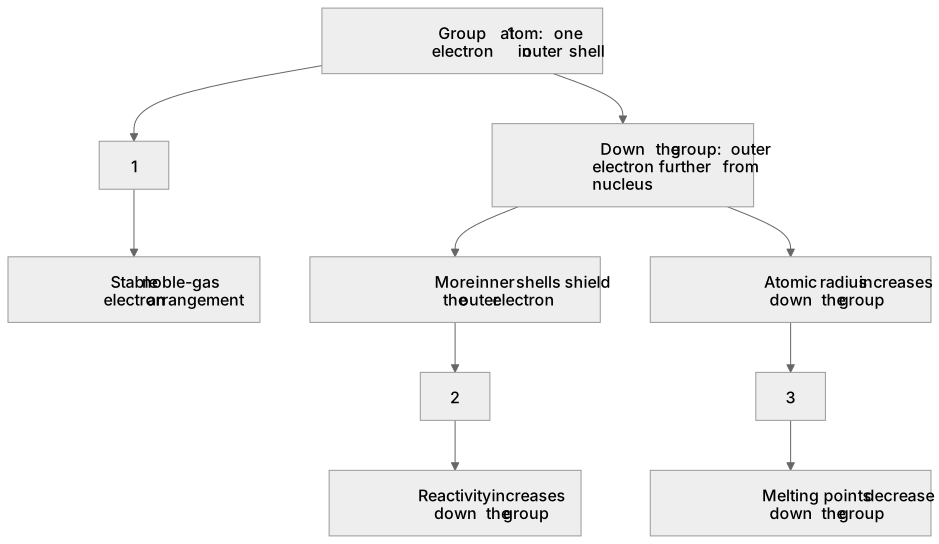
Some boxes have lost their names. Pick the right name for each number.
1Box 1
2Box 2
3Box 3
There is more to this lesson
The full lesson goes on to check your understanding and help you earn the marks. Create a free account to carry on, with your progress saved.
A week of Premium from your first lesson · Then the free plan continues · No card, no charge
Test your understanding of Group 1: explain how properties of the elements in Group 1 depend on the outer shell of electrons of the atoms
Active recall beats re-reading. Take an instant quiz now to test what you’ve learned and lock it into long-term memory.
A week of Premium from your first lesson · Then the free plan continues · No card, no charge