AQA · GCSE · Combined Science
Course version: 8464 · Version from Sept 2018
Group 1: predict properties from given trends down the group.
When you are given data or a described trend for Group 1, you can predict properties of an element lower down the group.
Checked against the AQA 8464 specification (opens in a new tab) on .
- Point 5 of 5
- 4 key terms
Study notes
From the checked teaching notes for this specification point.
The idea
When you are given data or a described trend for Group 1, you can predict properties of an element lower down the group. For example, if reactivity increases from lithium to sodium to potassium, you can predict that rubidium and caesium react even more vigorously with water. Similarly, if melting points decrease down the group, you can predict that rubidium has a lower melting point than potassium. To make a valid prediction, identify the direction of the trend, check the pattern is consistent, then state the property for the named element and justify it using the outer electron. Predictions should be consistent with the trend and explained using atomic structure, not guessed.
What earns the marks
- Identify the direction of the trend from the given data, such as reactivity increasing or melting point decreasing down Group 1.
- State a predicted property for a named element, for example 'rubidium reacts more vigorously with water than potassium'.
- Justify the prediction using atomic structure: the outer electron is further from the nucleus and more shielded, so it is lost more easily.
- Check that the prediction follows the same pattern as the given trend and does not contradict the data.
- Use the trend to compare two elements, such as predicting that caesium has a lower melting point than rubidium.
Common mistakes and how to put them right
Predicting a value that reverses the trend, such as saying rubidium is less reactive than potassium.
Put it right by checking the direction of the trend first.
Giving a prediction without a reason.
Put it right by adding a structural explanation about the outer electron.
Assuming all properties follow the same direction.
Put it right by treating each property separately, since reactivity increases but melting point decreases down Group 1.
Exam tips
- Underline the trend in the question before predicting, so your answer follows the given direction.
- Name the element you are predicting for and compare it with a known element from the trend.
- Add a short justification using the outer electron to move from a simple prediction to a full explanation.
Try the lesson
The start of the Group 1: predict properties from given trends down the group. lesson, made from checked teaching notes for this specification point.
Have a go first
A student knows that lithium floats on water and reacts steadily. Using the trend down Group 1, what should the student predict for potassium?
Listen
When you are given data or a described trend for Group 1, you can predict properties of an element lower down the group. For example, if reactivity increases from lithium to sodium to potassium, you can predict that rubidium and caesium react even more vigorously with water. Similarly, if melting points decrease down the group, you can predict that rubidium has a lower melting point than potassium. To make a valid prediction, identify the direction of the trend, check the pattern is consistent, then state the property for the named element and justify it using the outer electron. Predictions should be consistent with the trend and explained using atomic structure, not guessed. A strong answer earns marks for these points. Identify the direction of the trend from the given data, such as reactivity increasing or melting point decreasing down Group 1. State a predicted property for a named element, for example 'rubidium reacts more vigorously with water than potassium'. Justify the prediction using atomic structure: the outer electron is further from the nucleus and more shielded, so it is lost more easily. Check that the prediction follows the same pattern as the given trend and does not contradict the data. A common slip: Predicting a value that reverses the trend, such as saying rubidium is less reactive than potassium. Instead, checking the direction of the trend first. Exam tip: Underline the trend in the question before predicting, so your answer follows the given direction.
See it
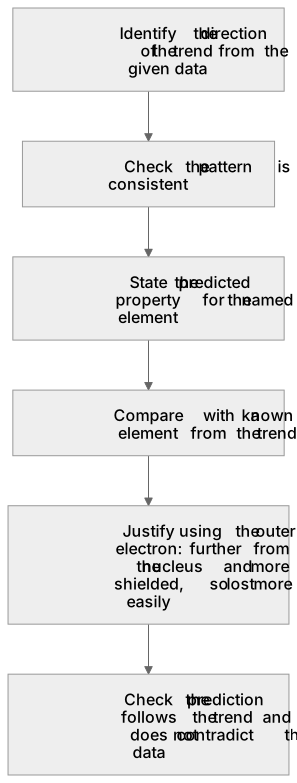
Put it in order
Put these steps in the order they happen.
- 1. State the predicted property for the named element
- 2. Check the pattern is consistent
- 3. Identify the direction of the trend from the given data
- 4. Check the prediction follows the trend and does not contradict the data
- 5. Justify using the outer electron: further from the nucleus and more shielded, so lost more easily
- 6. Compare with a known element from the trend
Key words
Say what each word means before you turn the card.
Trends in the periodic table
Try answering aloud or in your head before turning the card.
Reactivity of Group 1 metals
Try answering aloud or in your head before turning the card.
Melting point trends
Try answering aloud or in your head before turning the card.
Using data to make predictions
Try answering aloud or in your head before turning the card.
See every definition
- Trends in the periodic table
- The direction in which a property changes, such as reactivity increasing or melting point decreasing down Group 1.
- Reactivity of Group 1 metals
- A property that increases from lithium to sodium to potassium, so elements lower down react even more vigorously with water.
- Melting point trends
- A property that decreases down the group, so rubidium has a lower melting point than potassium.
- Using data to make predictions
- Identifying the direction of the trend, checking the pattern is consistent, then stating the property for the named element and justifying it using the outer electron.
Label the diagram
Some boxes have lost their names. Pick the right name for each number.
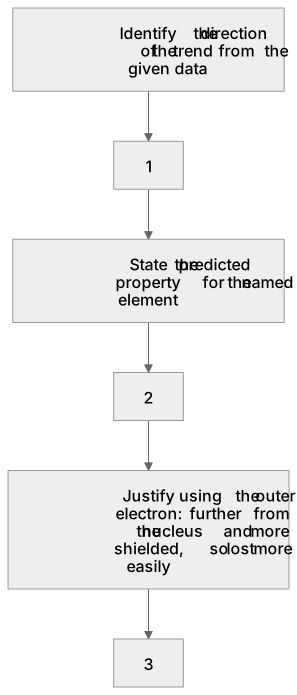
1Box 1
2Box 2
3Box 3
There is more to this lesson
The full lesson goes on to check your understanding and help you earn the marks. Create a free account to carry on, with your progress saved.
A week of Premium from your first lesson · Then the free plan continues · No card, no charge
Test your understanding of Group 1: predict properties from given trends down the group.
Active recall beats re-reading. Take an instant quiz now to test what you’ve learned and lock it into long-term memory.
A week of Premium from your first lesson · Then the free plan continues · No card, no charge