AQA · GCSE · Combined Science
Course version: 8464 · Version from Sept 2018
Students should be able to describe the reactions of the first three…
Full specification wording
Group 1: Students should be able to describe the reactions of the first three alkali metals with oxygen, chlorine and water.
The first three alkali metals are lithium, sodium and potassium.
Checked against the AQA 8464 specification (opens in a new tab) on .
- Point 2 of 5
- 4 key terms
Study notes
From the checked teaching notes for this specification point.
The idea
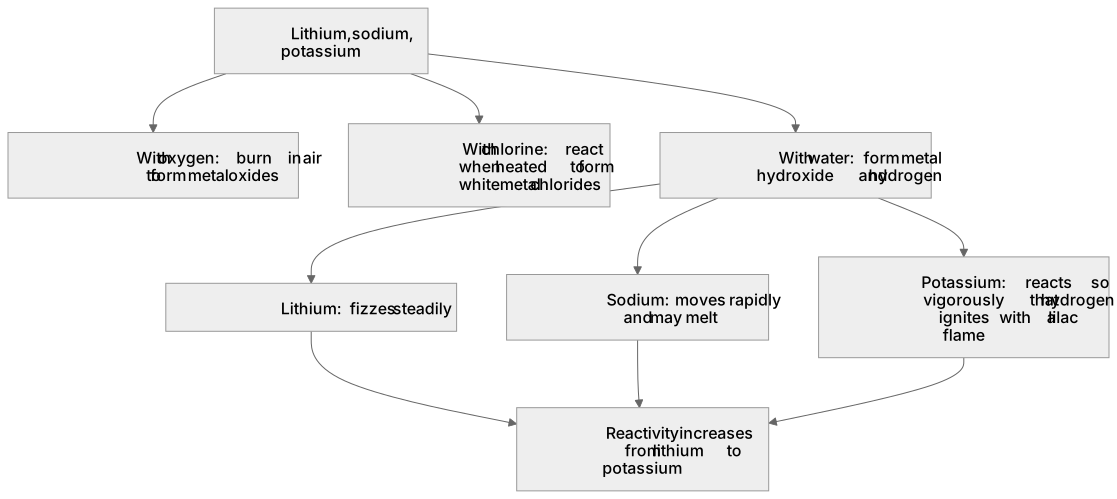
The first three alkali metals are lithium, sodium and potassium. With oxygen they burn in air to form metal oxides, for example 4Li + O₂ → 2Li₂O, and the reaction becomes more vigorous down the group. With chlorine they react when heated to form white metal chlorides, for example 2Na + Cl₂ → 2NaCl. With water they produce a metal hydroxide and hydrogen, for example 2K + 2H₂O → 2KOH + H₂; lithium fizzes steadily, sodium moves rapidly and may melt, and potassium reacts so vigorously that the hydrogen ignites with a lilac flame. Observations such as fizzing, movement, melting and flame colour show the increasing reactivity from lithium to potassium.
What earns the marks
- Lithium, sodium and potassium all react with oxygen to form metal oxides, and the reactions become more vigorous down the group.
- The alkali metals react with chlorine to form white metal chlorides, for example sodium chloride, when heated.
- Reactions with water produce a metal hydroxide and hydrogen gas, and the hydroxide makes the solution alkaline.
- Observations for water reactions include fizzing, the metal moving on the surface, melting into a ball and, for potassium, a lilac flame.
- Word and balanced symbol equations can be written for each reaction, for example 2Li + 2H₂O → 2LiOH + H₂.
Common mistakes and how to put them right
Writing that alkali metals react with water to produce an acid.
Put it right by stating that a metal hydroxide is formed, giving an alkaline solution.
Forgetting that hydrogen gas is produced with the hydroxide.
Put it right by including H₂ in the products and balancing the equation.
Describing potassium as reacting less vigorously than lithium.
Put it right by stating that reactivity increases down the group, so potassium is the most vigorous of the three.
Exam tips
- Name the metal, the reactant and the products clearly, and include the correct formulae for oxides, chlorides and hydroxides.
- Use comparative language such as more vigorous or less vigorous to show the trend from lithium to potassium.
- When describing observations, link them to the reaction, for example fizzing shows hydrogen gas being produced.
Try the lesson
The start of the Group 1: Students should be able to describe the reactions of the first three alkali metals with oxygen, chlorine and water. lesson, made from checked teaching notes for this specification point.
Have a go first
Which gas in the air reacts with lithium to form lithium oxide?
Listen
The first three alkali metals are lithium, sodium and potassium. With oxygen they burn in air to form metal oxides, for example 4Li + O₂ → 2Li₂O, and the reaction becomes more vigorous down the group. With chlorine they react when heated to form white metal chlorides, for example 2Na + Cl₂ → 2NaCl. With water they produce a metal hydroxide and hydrogen, for example 2K + 2H₂O → 2KOH + H₂; lithium fizzes steadily, sodium moves rapidly and may melt, and potassium reacts so vigorously that the hydrogen ignites with a lilac flame. Observations such as fizzing, movement, melting and flame colour show the increasing reactivity from lithium to potassium. A strong answer earns marks for these points. Lithium, sodium and potassium all react with oxygen to form metal oxides, and the reactions become more vigorous down the group. The alkali metals react with chlorine to form white metal chlorides, for example sodium chloride, when heated. Reactions with water produce a metal hydroxide and hydrogen gas, and the hydroxide makes the solution alkaline. Observations for water reactions include fizzing, the metal moving on the surface, melting into a ball and, for potassium, a lilac flame. A common slip: Writing that alkali metals react with water to produce an acid. Instead, stating that a metal hydroxide is formed, giving an alkaline solution. Exam tip: Name the metal, the reactant and the products clearly, and include the correct formulae for oxides, chlorides and hydroxides.
See it
Key words
Say what each word means before you turn the card.
Reactions of metals with oxygen
Try answering aloud or in your head before turning the card.
Reactions of metals with chlorine
Try answering aloud or in your head before turning the card.
Reactions of metals with water
Try answering aloud or in your head before turning the card.
Group trends and reactivity
Try answering aloud or in your head before turning the card.
See every definition
- Reactions of metals with oxygen
- The first three alkali metals burn in air to form metal oxides, and the reaction becomes more vigorous down the group.
- Reactions of metals with chlorine
- The alkali metals react when heated to form white metal chlorides.
- Reactions of metals with water
- These reactions produce a metal hydroxide and hydrogen, and the hydroxide makes the solution alkaline.
- Group trends and reactivity
- Observations such as fizzing, movement, melting and flame colour show the increasing reactivity from lithium to potassium.
Label the diagram
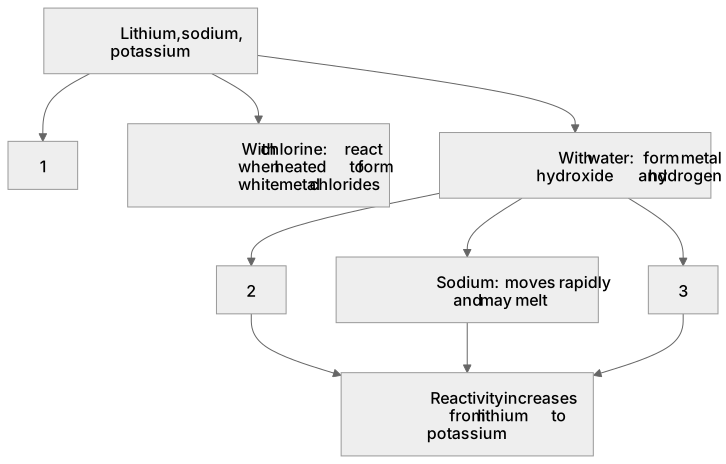
Some boxes have lost their names. Pick the right name for each number.
1Box 1
2Box 2
3Box 3
There is more to this lesson
The full lesson goes on to check your understanding and help you earn the marks. Create a free account to carry on, with your progress saved.
A week of Premium from your first lesson · Then the free plan continues · No card, no charge
Test your understanding of Group 1: Students should be able to describe the reactions of the first three alkali metals with oxygen, chlorine and water.
Active recall beats re-reading. Take an instant quiz now to test what you’ve learned and lock it into long-term memory.
A week of Premium from your first lesson · Then the free plan continues · No card, no charge