AQA · GCSE · Combined Science
Course version: 8464 · Version from Sept 2018
The elements in Group 1 of the periodic table are known as the alkali…
Full specification wording
Group 1: The elements in Group 1 of the periodic table are known as the alkali metals and have characteristic properties because of the single electron in their outer shell.
Group 1 sits on the far left of the periodic table and contains lithium, sodium, potassium, rubidium, caesium and francium.
Checked against the AQA 8464 specification (opens in a new tab) on .
- Point 1 of 5
Study notes
From the checked teaching notes for this specification point.
The idea
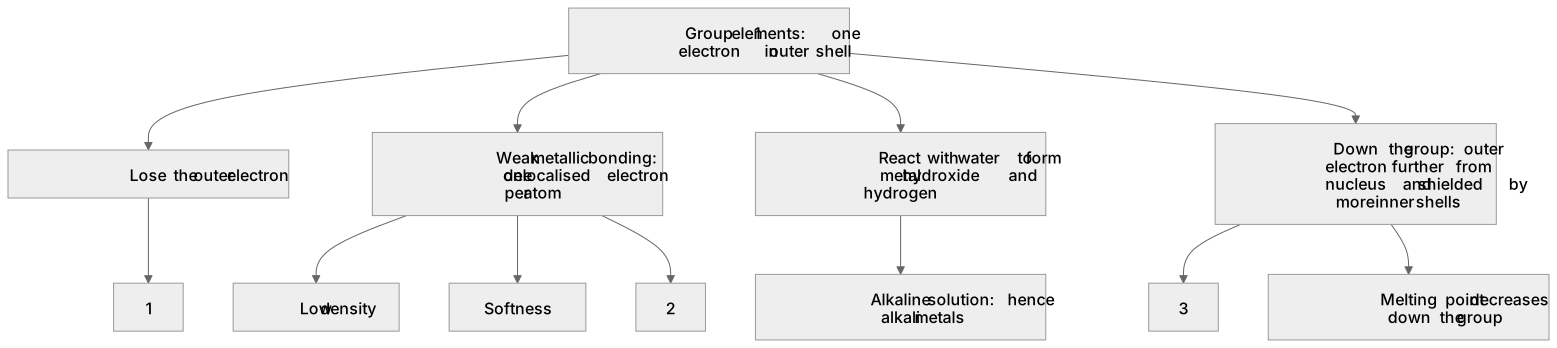
Group 1 sits on the far left of the periodic table and contains lithium, sodium, potassium, rubidium, caesium and francium. Each atom has one electron in its outer shell, so losing that electron gives a stable noble-gas arrangement and a 1⁺ ion. This single outer electron explains the characteristic properties: low density (atoms are large with loosely held outer electrons), softness (metallic bonding is weak because each atom contributes only one delocalised electron), low melting points that decrease down the group, and high reactivity that increases down the group as the outer electron is further from the nucleus and shielded by more inner shells. They are called alkali metals because they react with water to form alkaline metal hydroxide solutions, for example 2Na + 2H₂O → 2NaOH + H₂.
What earns the marks
- Group 1 elements each have one electron in their outer shell and lose it to form a 1⁺ ion with a stable noble-gas electron arrangement.
- Reactivity increases down Group 1 because the outer electron is further from the nucleus and shielded by more inner shells, so less energy is needed to remove it.
- Physical properties include low density, softness and relatively low melting points, all linked to weak metallic bonding with only one delocalised electron per atom.
- Alkali metals react with water to form a metal hydroxide and hydrogen, giving an alkaline solution, which is why they are called alkali metals.
- Trends down the group include decreasing melting point and increasing reactivity, which can be explained by increasing atomic radius and shielding.
Common mistakes and how to put them right
Saying Group 1 elements have one electron in total rather than one electron in their outer shell.
Put it right by stating the outer-shell configuration, for example sodium is 2,8,1.
Claiming reactivity decreases down Group 1.
Put it right by explaining that the outer electron is lost more easily as atomic radius and shielding increase.
Writing that alkali metals form 2⁺ ions.
Put it right by linking the single outer electron to a 1⁺ charge, as in Na⁺ and K⁺.
Exam tips
- Link every property you describe back to the single outer electron, because the question asks for the cause, not just the property.
- Use the correct trend direction: reactivity increases down the group, while melting point and density trends should be stated carefully.
- When giving an equation, balance it and include state symbols if asked, for example 2K + 2H₂O → 2KOH + H₂.
Try the lesson
The start of the Group 1: The elements in Group 1 of the periodic table are known as the alkali metals and have characteristic properties because of the single electron in their outer shell. lesson, made from checked teaching notes for this specification point.
Have a go first
What name is given to the elements in Group 1 of the periodic table?
Listen
Group 1 sits on the far left of the periodic table and contains lithium, sodium, potassium, rubidium, caesium and francium. Each atom has one electron in its outer shell, so losing that electron gives a stable noble-gas arrangement and a 1⁺ ion. This single outer electron explains the characteristic properties: low density (atoms are large with loosely held outer electrons), softness (metallic bonding is weak because each atom contributes only one delocalised electron), low melting points that decrease down the group, and high reactivity that increases down the group as the outer electron is further from the nucleus and shielded by more inner shells. They are called alkali metals because they react with water to form alkaline metal hydroxide solutions, for example 2Na + 2H₂O → 2NaOH + H₂. A strong answer earns marks for these points. Group 1 elements each have one electron in their outer shell and lose it to form a 1⁺ ion with a stable noble-gas electron arrangement. Reactivity increases down Group 1 because the outer electron is further from the nucleus and shielded by more inner shells, so less energy is needed to remove it. Physical properties include low density, softness and relatively low melting points, all linked to weak metallic bonding with only one delocalised electron per atom. Alkali metals react with water to form a metal hydroxide and hydrogen, giving an alkaline solution, which is why they are called alkali metals. A common slip: Saying Group 1 elements have one electron in total rather than one electron in their outer shell. Instead, stating the outer-shell configuration, for example sodium is 2,8,1. Exam tip: Link every property you describe back to the single outer electron, because the question asks for the cause, not just the property.
See it

Label the diagram
Some boxes have lost their names. Pick the right name for each number.
1Box 1
2Box 2
3Box 3
There is more to this lesson
The full lesson goes on to check your understanding and help you earn the marks. Create a free account to carry on, with your progress saved.
A week of Premium from your first lesson · Then the free plan continues · No card, no charge
Test your understanding of Group 1: The elements in Group 1 of the periodic table are known as the alkali metals and have characteristic properties because of the single electron in their outer shell.
Active recall beats re-reading. Take an instant quiz now to test what you’ve learned and lock it into long-term memory.
A week of Premium from your first lesson · Then the free plan continues · No card, no charge