AQA · GCSE · Combined Science
Course version: 8464 · Version from Sept 2018
Homeostasis: body temperature
Body temperature is a key internal condition regulated by homeostasis.
Checked against the AQA 8464 specification (opens in a new tab) on .
- Point 5 of 11
- 4 key terms
Study notes
From the checked teaching notes for this specification point.
The idea
Body temperature is a key internal condition regulated by homeostasis. In humans, core temperature is maintained around 37 °C, the optimum for enzyme-controlled reactions. If temperature drops, kinetic energy decreases and reactions slow down; if it rises too high, enzymes denature. Body temperature control is an automatic system involving nervous and chemical responses. Receptors detect temperature changes and send signals to a coordination centre, such as the brain. The brain processes this information and sends impulses to effectors, which are muscles or glands. Effectors bring about responses, like sweating or shivering, to restore the optimum temperature. This ensures cells function efficiently despite external changes.
What earns the marks
- Body temperature is an internal condition controlled by homeostasis and kept close to 37 °C in humans.
- Maintaining an optimum temperature is essential because high temperatures denature enzymes and low temperatures slow down reaction rates.
- Receptors detect changes in temperature (stimuli) and send information to coordination centres.
- The brain acts as a coordination centre, receiving and processing information from temperature receptors.
- Effectors, such as muscles or glands, bring about responses that restore the optimum body temperature.
Common mistakes and how to put them right
Thinking that homeostasis is a conscious action.
Put it right: The control of body temperature is an automatic control system.
Stating that enzymes are 'killed' by high temperatures.
Put it right: Enzymes are proteins, so they are denatured, meaning their active site changes shape.
Forgetting to mention the role of the coordination centre.
Put it right: Include the brain or coordination centre when describing how receptors communicate with effectors.
Exam tips
- Remember that for Combined Science, you do not need to detail the mechanisms of vasodilation or vasoconstriction, but you must know the general control pathway: receptor to coordination centre to effector.
- Link the maintenance of body temperature directly to providing the optimum conditions for enzyme action.
Try the lesson
The start of the Homeostasis: body temperature lesson, made from checked teaching notes for this specification point.
Have a go first
Homeostasis maintains optimal conditions for enzyme action and cell functions. Which of the following is an internal condition controlled by homeostasis in the human body?
Listen
Body temperature is a key internal condition regulated by homeostasis. In humans, core temperature is maintained around 37 °C, the optimum for enzyme-controlled reactions. If temperature drops, kinetic energy decreases and reactions slow down; if it rises too high, enzymes denature. Body temperature control is an automatic system involving nervous and chemical responses. Receptors detect temperature changes and send signals to a coordination centre, such as the brain. The brain processes this information and sends impulses to effectors, which are muscles or glands. Effectors bring about responses, like sweating or shivering, to restore the optimum temperature. This ensures cells function efficiently despite external changes. A strong answer earns marks for these points. Body temperature is an internal condition controlled by homeostasis and kept close to 37 °C in humans. Maintaining an optimum temperature is essential because high temperatures denature enzymes and low temperatures slow down reaction rates. Receptors detect changes in temperature (stimuli) and send information to coordination centres. The brain acts as a coordination centre, receiving and processing information from temperature receptors. A common slip: Thinking that homeostasis is a conscious action. Instead, the control of body temperature is an automatic control system. Exam tip: Remember that for Combined Science, you do not need to detail the mechanisms of vasodilation or vasoconstriction, but you must know the general control pathway: receptor to coordination centre to effector.
See it
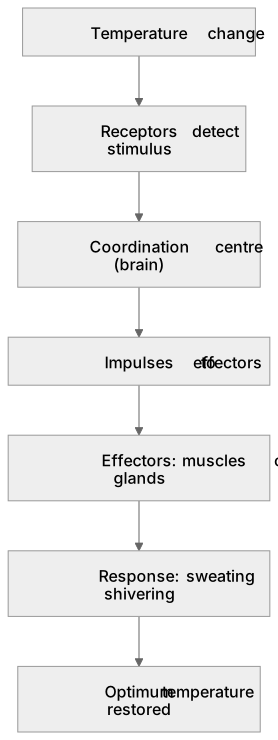
Put it in order
Put these steps in the order they happen.
- 1. Optimum temperature restored
- 2. Response: sweating or shivering
- 3. Coordination centre (brain)
- 4. Effectors: muscles or glands
- 5. Temperature change
- 6. Receptors detect stimulus
- 7. Impulses to effectors
Key words
Say what each word means before you turn the card.
Homeostasis and internal conditions
Try answering aloud or in your head before turning the card.
Enzyme optimum temperature
Try answering aloud or in your head before turning the card.
Receptors and effectors
Try answering aloud or in your head before turning the card.
Automatic control systems
Try answering aloud or in your head before turning the card.
See every definition
- Homeostasis and internal conditions
- Body temperature is an internal condition controlled by homeostasis and kept close to 37 °C in humans.
- Enzyme optimum temperature
- Maintaining an optimum temperature is essential because high temperatures denature enzymes and low temperatures slow down reaction rates.
- Receptors and effectors
- Receptors detect changes in temperature and send information to coordination centres, while effectors, such as muscles or glands, bring about responses that restore the optimum body temperature.
- Automatic control systems
- The control of body temperature is an automatic control system involving nervous and chemical responses, not a conscious action.
Label the diagram
Some boxes have lost their names. Pick the right name for each number.
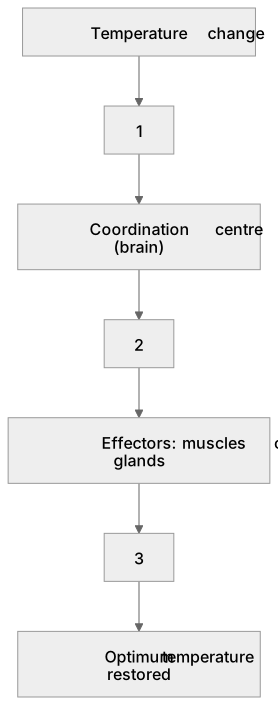
1Box 1
2Box 2
3Box 3
There is more to this lesson
The full lesson goes on to check your understanding and help you earn the marks. Create a free account to carry on, with your progress saved.
A week of Premium from your first lesson · Then the free plan continues · No card, no charge
Test your understanding of Homeostasis: body temperature
Active recall beats re-reading. Take an instant quiz now to test what you’ve learned and lock it into long-term memory.
A week of Premium from your first lesson · Then the free plan continues · No card, no charge