AQA · GCSE · Combined Science
Course version: 8464 · Version from Sept 2018
Homeostasis: water levels.
Water levels in the body are regulated by homeostasis to maintain optimum conditions for enzyme action and all cell functions.
Checked against the AQA 8464 specification (opens in a new tab) on .
- Point 6 of 11
- 4 key terms
Study notes
From the checked teaching notes for this specification point.
The idea
Water levels in the body are regulated by homeostasis to maintain optimum conditions for enzyme action and all cell functions. Water level control is an automatic system. Receptors detect changes in the water concentration of the internal environment. This information is sent to a coordination centre, such as the brain, which processes the signals and coordinates a response. Effectors then act to restore the optimum water level. For Combined Science, students only need to know that water levels are controlled by homeostasis; the specific mechanisms of water loss and kidney function are not required.
What earns the marks
- State that water level is an internal condition controlled by homeostasis.
- Explain that controlling water levels maintains optimum conditions for enzyme action and all cell functions.
- Describe that receptors detect changes in internal water levels and send information to a coordination centre.
- Explain that the coordination centre processes the information and directs effectors to bring about a response to restore optimum levels.
Common mistakes and how to put them right
Including detailed mechanisms of ADH and kidney tubules.
Put it right: For Combined Science, focus on the general principles of homeostasis, as ADH and kidney function are Biology-only content.
Confusing the roles of receptors and effectors.
Put it right: Receptors detect the change in water levels, while effectors bring about the response to correct it.
Forgetting that homeostasis maintains conditions for enzyme action as well as cell functions.
Put it right: Link homeostasis to maintaining optimal conditions for enzymes and cells.
Exam tips
- When asked for examples of conditions controlled by homeostasis, list water levels alongside body temperature and blood glucose concentration.
- Remember the general pathway for homeostasis (receptor to coordination centre to effector) applies to water level regulation.
Try the lesson
The start of the Homeostasis: water levels. lesson, made from checked teaching notes for this specification point.
Have a go first
Homeostasis maintains optimal conditions for enzyme action and all cell functions. Which of these is an internal condition controlled by homeostasis in the human body?
Listen
Water levels in the body are regulated by homeostasis to maintain optimum conditions for enzyme action and all cell functions. Water level control is an automatic system. Receptors detect changes in the water concentration of the internal environment. This information is sent to a coordination centre, such as the brain, which processes the signals and coordinates a response. Effectors then act to restore the optimum water level. For Combined Science, students only need to know that water levels are controlled by homeostasis; the specific mechanisms of water loss and kidney function are not required. A strong answer earns marks for these points. State that water level is an internal condition controlled by homeostasis. Explain that controlling water levels maintains optimum conditions for enzyme action and all cell functions. Describe that receptors detect changes in internal water levels and send information to a coordination centre. Explain that the coordination centre processes the information and directs effectors to bring about a response to restore optimum levels. A common slip: Including detailed mechanisms of ADH and kidney tubules. Instead, For Combined Science, focus on the general principles of homeostasis, as ADH and kidney function are Biology-only content. Exam tip: When asked for examples of conditions controlled by homeostasis, list water levels alongside body temperature and blood glucose concentration.
See it
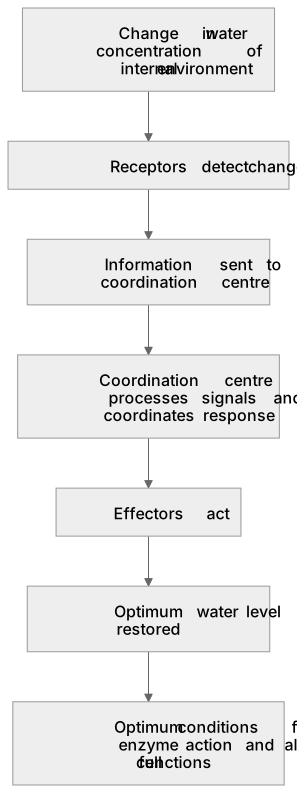
Put it in order
Put these steps in the order they happen.
- 1. Optimum conditions for enzyme action and all cell functions
- 2. Optimum water level restored
- 3. Information sent to coordination centre
- 4. Effectors act
- 5. Change in water concentration of internal environment
- 6. Receptors detect change
- 7. Coordination centre processes signals and coordinates response
Key words
Say what each word means before you turn the card.
Homeostasis
Try answering aloud or in your head before turning the card.
Receptors
Try answering aloud or in your head before turning the card.
Effectors
Try answering aloud or in your head before turning the card.
Optimum conditions
Try answering aloud or in your head before turning the card.
See every definition
- Homeostasis
- The regulation of internal conditions, such as water levels, to maintain optimum conditions for enzyme action and all cell functions.
- Receptors
- Components that detect changes in the water concentration of the internal environment and send this information to a coordination centre.
- Effectors
- Components that act to bring about a response to restore the optimum water level.
- Optimum conditions
- The conditions maintained by homeostasis that are needed for enzyme action and all cell functions.
Label the diagram
Some boxes have lost their names. Pick the right name for each number.
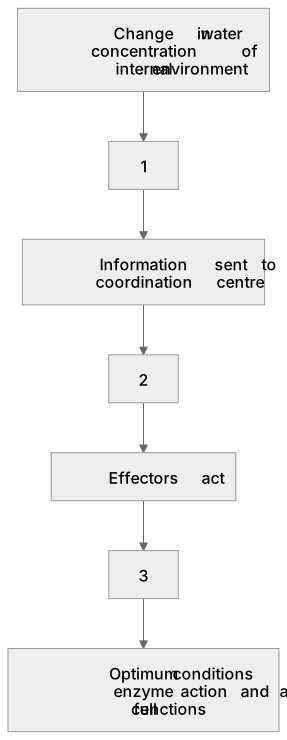
1Box 1
2Box 2
3Box 3
There is more to this lesson
The full lesson goes on to check your understanding and help you earn the marks. Create a free account to carry on, with your progress saved.
A week of Premium from your first lesson · Then the free plan continues · No card, no charge
Test your understanding of Homeostasis: water levels.
Active recall beats re-reading. Take an instant quiz now to test what you’ve learned and lock it into long-term memory.
A week of Premium from your first lesson · Then the free plan continues · No card, no charge